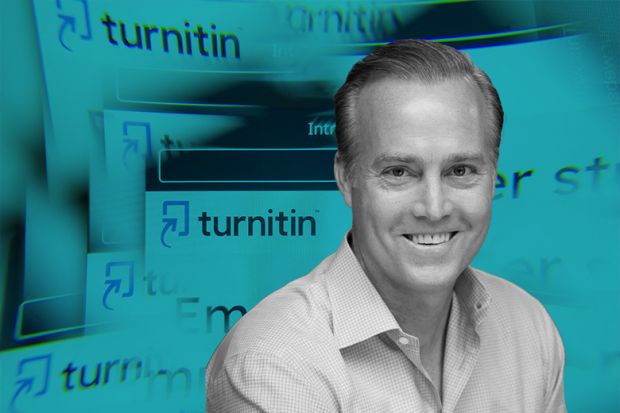
The chief executive of plagiarism detection giant Turnitin has admitted spooking UK universities with the suggestion that it might use student data to train artificial intelligence tools, but he said the “very severe” budget constraints facing the sector are just as much of a factor behind a spate of institutions abandoning their deals with the company.
After several UK universities announced that they were scrapping or reconsidering their contracts with Turnitin, Chris Caren, who has led the company since 2009, acknowledged that the edtech giant had moved too fast on changes regarding the use of student data.
A proposed new end-user licence agreement (EULA) had provoked controversy regarding how student work could be used to train AI tools. In response, Newcastle University, the University of Westminster and the University of Southampton have all committed to cutting ties with Turnitin when their current deal lapses.
Caren admitted that Turnitin had got it “wrong” by moving too quickly to introduce the EULA.
“We didn’t give [customers] nearly enough time to actually review it, to get their questions answered before we proposed launching it,” Caren told Times Higher Education.
The planned implementation, which had been set for 7 July this year, was met with outcry. Several institutions expressed concerns to UCISA, a membership organisation for universities and colleges that supports their use of technology systems.
Since then, Turnitin has agreed to work with a UCISA representation group to address the concerns.
Following the feedback, Caren said, the updated EULA will now not come into practice for “at least a year”.
But he noted that the reaction in the UK differed considerably from that in other Turnitin markets. “The curious thing is, if you zoom out, [we have] 16,000 customers globally. We told all of them this new EULA is coming. We had about 100 customers raise their hand, saying ‘I have concerns’…about 90 of the 100 were UK institutions. I don’t know how to interpret that, but it’s just interesting.”
Asked whether he believed the reaction had anything to do with the financial pinch squeezing the sector, Caren said he had spoken to someone from one of the universities that had decided to let its Turnitin contract expire.
Caren claimed that the source had suggested that with the recent downturn in international students, “the budget strain is very severe”.
“So his basic summary is: ‘We have a budget crisis, [the] administration decided not to renew Turnitin to save money, and then this EULA thing happened and they used this as an excuse for why.’ Those were his words.”
Caren added: “I think this is the case for all three, but I haven’t spoken to the other two at length.”
A Newcastle spokesperson said: “We have decided not to renew the contract. As part of our regular procurement process, we routinely review the market and compare providers to ensure we are securing the most appropriate service for our needs.
“We continue to evaluate alternative options to ensure that robust academic integrity standards are maintained throughout the transition and beyond.”
Southampton said cost-cutting was not a factor in its decision. Westminster did not respond to requests for comment.
Commentators have also suggested that universities are not renewing because Turnitin’s tools have become less useful in the age of AI. Its plagiarism checker cannot detect the work of chatbots, and questions have been raised about the accuracy of its AI detector.
Caren billed Turnitin’s latest offering, known as “Clarity”, as the solution for educators left unsure how to monitor students’ AI dependence.
“Effectively, students write their essay in our editor…You can still go to other web pages and copy and paste and stuff, but we know how many hours a day they spend on task, if the writing looks like it was just copying something…or actually true deadline writing.”
Caren said one customer he had spoken to said of Clarity: “They went from ‘We don’t care, we can’t watch or even monitor AI usage because it’s so out of control’ to [a situation where] ‘We have like 61 cases of misconduct in Clarity and 59 resulted in punishment of some sort.’ So the hit rate to misconduct is much higher, which hopefully that means the deterrent effect over time is much higher as well.”
The tech boss, who studied engineering at Stanford University and previously worked for Microsoft, was adamant that Turnitin’s proposed changes would not involve using student data to build large language models, and had never been intended for this type of use.
“I think the fear the UK market had was that [we would be] taking student data, training a model that would then write like students write or be a commercial service that others can use, based on [students’] writing,” he said.
“In fact, all we’re doing is taking a very small number of anonymised student papers and doing the same with AI-written papers to build this classifier, [a tool] that says, ‘This is for sure human; this is for sure AI; or not sure, so let’s not even flag it.’”
Reflecting on his more than 16 years at the helm of the company, Caren called AI “far and away” the biggest change he had witnessed. He described the threat it posed to critical thinking, reading and writing as a preoccupation of his. Caren believes AI has a great deal to offer in terms of providing students with tailored tutoring and one-to-one feedback. But “right now”, the technology is having a “tremendously negative impact”.
“Most students don’t really do homework any more,” he said. “They have AI do it for them.”
Caren went on: “When I simplify down, like, what am I focused on? The crude way to answer it is, I’m trying to save the college essay from extinction.
“I think there could be a world – which would be really sad – where there is very little writing and very little reading taking place in college. I just can’t imagine what that does to the outcomes of graduates.”
Register to continue
Why register?
- Registration is free and only takes a moment
- Once registered, you can read 3 articles a month
- Sign up for our newsletter
Subscribe
Or subscribe for unlimited access to:
- Unlimited access to news, views, insights & reviews
- Digital editions
- Digital access to THE’s university and college rankings analysis
Already registered or a current subscriber?