
“We shouldn’t confuse a failure to maintain a sustainable funding settlement for universities with a failure of the principle that students should have choice and that we need a system in which students can go where they want to receive the higher education that best meets their needs.”
That is the view of Jo Johnson, the former Conservative universities minister who, in 2017, oversaw the passage of England’s Higher Education and Research Act (Hera), described at the time as “the most significant sector legislation in 25 years” and whose effect on the sector has been enormous – and highly contested.
Johnson was minister for universities, science, research and innovation from May 2015 to January 2018 under Conservative prime ministers David Cameron and Theresa May. He reprised the role for just three months in 2019, after his brother Boris ousted Theresa May as prime minister amid the post-Brexit political chaos, before resigning as an MP, citing “unresolvable tension” between “family loyalty and the national interest”.
The decision, announced in 2013, to abolish number controls at English universities was made on the watch of Johnson’s predecessor but one, David Willetts, the other major reforming minister of recent decades, who oversaw the tripling of tuition fees to £9,000 in 2012. But Johnson was head of Downing Street’s policy unit at the time, and he was minister when the abolition came into effect for the 2015-16 academic year.
Moreover, the absence of number controls was central to the market ethos that Johnson sought to introduce into the sector, which underwrote the Hera’s replacement of the Higher Education Funding Council for England with a market-style regulator, the Office for Students.
Speaking to Times Higher Education ahead of the forthcoming 10th anniversary of the Hera – which also led to the creation of UK Research and Innovation (UKRI) to coordinate the country’s nine research councils – Johnson accepted many institutions are “undoubtedly under serious financial pressure”, amid a wave of redundancies, expectations that half of the sector will be in deficit this year and fears that some institutions may be teetering on the brink of insolvency. But he rejected accusations that the lifting of student number controls was to blame and “was therefore a mistake”.
“We need to be clear about what’s causing the instability,” said Johnson, who is now a Conservative peer. “[It] has much more to do with the prolonged, real-terms erosion of the domestic unit of resource for undergraduate teaching.”
Domestic undergraduate fees rose only once between 2012 and 2024, when the £9,000 tuition fee cap increased to £9,250 on Johnson’s watch in 2017. Recent analyses found that this meant that the real-terms value of the fee fell by a third since 2012 and is well below the £12,000 average cost of providing a degree to a domestic student.
Hence, the “first priority” of current skills minister Jacqui Smith, whose remit includes higher education, “has to be fixing the funding problem”.
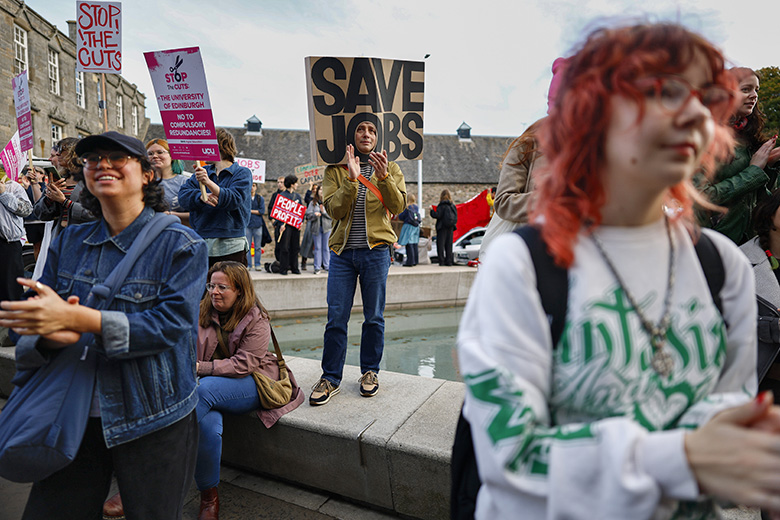
More prestigious universities have filled the financial gap by hoovering up students who would previously have gone to lower-tariff institutions, creating capacity problems for themselves and plunging the rest of the sector into ever greater reliance on international students. But their numbers are now declining owing to greater immigration restrictions, underlining the need for a “sustainable” funding model for English students that does “not require institutions to be dependent on international students”, said Johnson. “That puts the funding for the system on a precarious and uncertain basis, and we’ve all seen the price which it pays when this is the case.”
In his view, the key to solving the problem is ensuring that tuition fees rise annually in line with inflation.
After coming to power in 2024, Labour raised tuition fees with inflation to £9,535 in 2025-26 and confirmed last November that further inflationary rises in the following two years will see fees rise above the politically totemic £10,000 figure by 2027-28. That followed a pledge in the Skills White Paper, published the previous month to enshrine annual inflationary rises in law.
Yet new prime minister Andy Burnham, who is focused on cost-of-living issues, has yet to publicly endorse that pledge. And while, in July, education minister Josh MacAlister said the government will legislate for the annual rise “when parliamentary time allows”, MPs have yet to discuss the measure. And Johnson worries that parliamentary time may run out before the next general election, due around May 2029.
“It was disappointing that [the legislation] wasn’t in the most recent King’s Speech [in May], particularly as we head towards the latter half of this Parliament when such measures become harder to achieve [because MPs are afraid to vote for bills unpopular with the electorate],” said Johnson, who has previously suggested fees might rise to £12,000 to cover the full cost of a degree.
“The model for domestic undergraduate provision needs to be sustainable on its own terms, and that’s why it’s really important that indexation [of fees to inflation] is automatic, so the government doesn’t have to make the difficult political decision every year or drive mechanisms through Parliament to achieve it every year.”

That difficulty is very real, Johnson acknowledged. He achieved his one fee rise in 2017 thanks only to the introduction of the Teaching Excellence Framework (TEF), allowing the government to sweeten the pill with the promise of rising teaching standards. The idea at the time was that year-on-year increases would be linked to strong performance in the TEF. However, “Historians will remember [the TEF] was not used to increase fees in subsequent years because Theresa May called a general election in which she became dependent on the Democratic Unionist Party,” he said, referencing the “confidence and supply agreement” that, while falling short of a full coalition, required May to keep DUP MPs from Northern Ireland on side in order to pass legislation. And they “weren’t interested in any form of tuition fee increases whatsoever, and the mechanism sort of became obsolete”.
The OfS has now proposed to link a high TEF rating with eligibility for tuition fee uplifts, access to public teaching funding such as the strategic priorities grant and eligibility to apply for or extend degree-awarding powers. Meanwhile, expansion in student numbers would be frozen at institutions rated bronze in the TEF, and enrolment would be cut by 10 per cent at universities rated “requires improvement”.
Johnson said he was glad that the TEF is now “playing the role that I always hoped that it might”.
But even if automatic tuition fee rises for well-rated institutions are enshrined in legislation, a restructuring of the UK’s landscape is “inevitable” given the current funding situation, Johnson believes.
England is “an outlier in terms of the number of institutions per capita, and we’re in a world where there’s a real return on scale”, he said. Recent consolidations such as the mergers between the universities of Kent and Greenwich, King’s College London and Cranfield University, and City and St George’s, University of London “point the way that is, I think, going to be part of the sector’s future over coming years”, he added. “Mergers and strategic combinations of that sort are going to be really important, so we do need to have an enabling environment for that.”

Johnson always foresaw a certain level of institutional churn resulting from the Hera, and many sector figures were spooked from the start of his breezy talk of “market exit” for the universities that lose out from increased competition. But Johnson remains adamant that the “fundamental organising principle for the sector of student choice and the student interest remains the right one”, and he dismissed calls for the restoration of number controls.
“We need to be clear about what the alternative [is to] a system organised around students freely exercising their own decisions about where to go,” he argued. “It isn’t some benign academic commonwealth – it’s command and control quotas and allocation of places to institutions by Whitehall, with governments effectively deciding what should be taught where and in what quantities.”
And that, he added, would “not mean thriving humanities and social sciences departments – if that’s the criticism [of the market system]. It would mean quite severe retrenchment in areas out of favour in Whitehall at any one time, and a focus on ministerially favoured programmes du jour. I don’t think that’s a world which is better.”
Hefce was championed by many for its role as a “buffer body” between ministers and the sector, which occasionally lent a helping hand to struggling institutions. The OfS’ relationship with the sector, on the other hand, has been rocky, with vice-chancellors critical of what was commonly seen as an overly adversarial relationship. A recent reset of the regulator’s approach was soured by a misguided attempt to fine the University of Sussex for alleged free-speech breaches. The university successfully overturned the £585,000 fine in the courts earlier this year as a judge ruled that the OfS’ investigation of Sussex had been characterised by “bias” and “a closed mind”.
Yet, again, Johnson was adamant that the principle behind the OfS’ establishment had been the right one. It was “an attempt to create a regulatory system that was appropriate for a world in which we had a very much greater number of students entering the higher education system – and doing so while they were bearing the predominant cost of their own higher education through income-contingent loans”, he explained.
“The central idea of Hera was that we needed a system that reflected that students were, by and large, funding their own university experience,” he said. “It put the student interest and accountability for quality and outcomes at the very heart of it. And that still seems right to me.”
In that sense, he is dismissive of the complaint voiced by many academics that “student consumerism” has undermined standards by increasing students’ sense of entitlement and undermined their work ethic while making universities excessively sensitive to the effects of student opinion on recruitment (not least via the TEF, which draws on the National Student Survey).
“The old regulatory model had many strengths, but it was primarily a funding council model in which Hefce doled out funding to providers,” he said. “It didn’t have as its central focus the idea of the student interests and value for money for the entities funding higher education: namely the students themselves and the taxpayers underpinning the loan book.”
The flip side to market exit, of course, is market entry, and another aspect of the Hera was to make it easier for startup “challenger institutions” to gain access to student loans, degree-awarding powers and full university status. Further changes in 2019 built on the act, with the OfS abolishing the need for those seeking university titles to have at least 1,000 students, a threshold that stood at 4,000 until 2012.
These changes were designed to encourage more high-quality entrants that could encourage innovation by taking on larger universities wedded to the full-time, three-year undergraduate degree. Previously, this had proved prohibitively difficult, even for the much-heralded New College of the Humanities, established in 2010 in London’s famous Bloomsbury district as a rival to Oxbridge but obliged to have its degrees validated by Southampton Solent University, and which was eventually bought as a London branch campus by Northeastern University in 2018.
Even with the Hera’s changes, Johnson accepts it was always likely to be difficult for new entrants to seriously challenge the dominant model of higher education, embedded internationally for centuries. Nonetheless there have been some high-quality new entrants into the system in recent years, he insisted.
“I’m proud to have helped that happen,” he said. “The system is better for the existence of the likes of the Dyson Institute for Engineering and Technology, which…is an extraordinary institution.” Johnson is on the council of the degree-awarding institution established in 2017 at the Dyson technology campus in Wiltshire.
“It’s attracting students who could go anywhere in the world,” he said. “They could go to Oxford, Cambridge, Imperial but many choose to go to Dyson because it’s offering something distinctive, which is workplace-integrated learning of an exceptionally high standard,” he said.
He also commended the New Model Institute for Technology and Engineering (NMITE), founded in 2018 in Hereford, for its “innovative engineering provision”.
“They are, however, very small and haven’t had the impact on the system as a whole which I’d hoped,” he admitted. “What I underestimated was the need to help the existing providers be more innovative.”
Hence, “If I had my time again, I would spend more effort on [facilitating] things like shorter courses, two-year degrees, more modular provision, and more credit transfer – making sure that institutions didn’t just sort of pay lip service to it as a possibility, but actually allowed it to happen,” Johnson said.
In that regard, he commended the lifelong learning entitlement (LLE), which will allow people to borrow up to four years’ worth of student loan funding over the course of their working lives for courses beginning from January. But he is worried that it, too, might fail to have the transformational impact on the sector that its authors intended, amid lukewarm interest from many universities in establishing eligible courses.
“Reforms don’t just, you know, happen by themselves: you need government to go in and really deliver them, make sure that institutions are responding to them. Otherwise the LLE risks being something of a disappointment,” he said. “It will not deliver the skills revolution that ministers once hoped it might unless they ensure that universities really pick it up and run with it.”
Johnson’s return as higher education minister in 2019 may have been brief, but it was also consequential, leading to the restoration of the two-year post-study work visa that Theresa May had scrapped, a move that is credited with catalysing a post-pandemic resurgence in international enrolments. However, the Labour government announced a year ago that from January, new applicants will only be able to stay for 18 months. On top of the ban on most international students bringing dependants brought in at the tail end of the Conservative era, that policy shift, many believe, explains the sharp fall in international applications this summer. Higher Home Office refusal rates for Nigeria, Pakistan and India over the summer is also causing major financial worries for institutions.
Johnson laments how legal immigration routes, which are “important and beneficial to the country” have been “contaminated in the public debate by concern around illegal migration and the small boats”.
Labour won concessions from the government as ministers raced against time to push through the bill in the pre-election “wash-up” for outstanding bills, prior to Parliament being dissolved on 3 May ahead of the general election on 8 June. But Johnson regrets that Theresa May held out against a House of Lords amendment to remove students from targets to reduce net migration.
“We shouldn’t regard them as part of the immigration problem, which governments need to fix, as it were,” he said. “I’ve always argued that [they] should be regarded more as sort of tourists or temporary visitors who shouldn’t count towards any net immigration targets that the government might be consciously or unconsciously working towards.”
Quite apart from their tuition fees, “international students bring huge benefits to our system”, he said. “They provide a real pipeline into our research base, which is fundamental to Britain being a major science player on the world stage.”
In that sense, any benefits to the research system that will accrue from UKRI’s more centralised oversight of the research councils, emphasised by chief executive Ian Chapman, could be undermined if the flow of international talent is stifled, Johnson fears.
“We’re not going to remain [a major player] unless we have students coming in, doing undergrad, then postgrad, then doctorates and then postdoctoral work…It’s really important that everybody remembers that.”
Register to continue
Why register?
- Registration is free and only takes a moment
- Once registered, you can read 3 articles a month
- Sign up for our newsletter
Subscribe
Or subscribe for unlimited access to:
- Unlimited access to news, views, insights & reviews
- Digital editions
- Digital access to THE’s university and college rankings analysis
Already registered or a current subscriber?