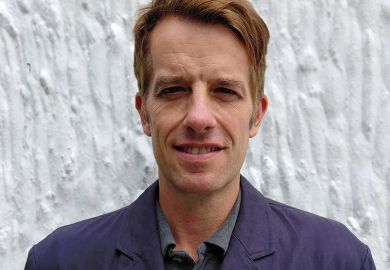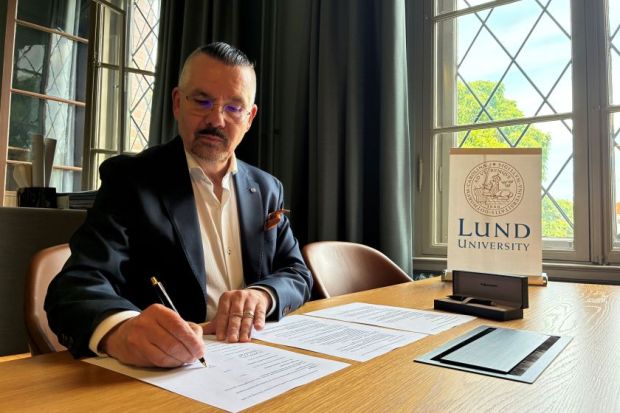
Political pressure to curb research collaboration with academics in “high-risk” countries could damage science and undermine universities’ academic mission, Lund University’s vice-chancellor has warned as he embarks on another three-year term at the Swedish institution.
Erik Renström, who began his tenure during the Covid-19 pandemic, said international tensions had “exploded” over the past few years, forcing university leaders to spend far more time thinking about research security and political interference.
“There’s a danger of focusing too much on risk [when it comes to research security]. There’s also a big risk if we become too political,” Renström told Times Higher Education. “There are [Swedish politicians] who say that they would prefer us to be extremely careful [about international collaborations], careful to the point that I’m absolutely sure that it would harm our operations, and it would be a very anti-academic point of view.”
He stressed that while the Swedish government generally kept universities “at arm’s length”, there were “some” politicians who nevertheless made their views on clamping down on international partnerships “very clear”.
In recent years, global conflicts and political tensions, including the war in Ukraine, growing friction between Western governments and China, the return of Donald Trump to the White House, and the war in Gaza, have placed European university partnerships under greater scrutiny.
Governments are worried that international partnerships could expose sensitive research and technology to foreign states. Public concern has also grown in recent years, particularly around partnerships linked to countries accused of human rights abuses.
Renström said he believes that even when there are political tensions, universities should look at collaborations individually instead of treating some countries as entirely off-limits. “Generally speaking, I think we should be able to collaborate with everyone. But we also have to respect the reality that there are certain projects that may be extremely sensitive or simply not a good idea at a given time,” he said.
He pointed to climate science as an area that had suffered from the breakdown in links with Russia. “Climate research has suffered enormously from having Russia excluded from certain projects. One should look at it case by case and see if there is some greater good for mankind. [If yes], then we should pursue [the collaboration].”
Renström added that open collaboration in areas like artificial intelligence and quantum technologies could spread knowledge internationally and contribute to peace. “The underlying sentiment is really that we should collaborate. As a university, [that] is within our DNA. It’s something that was not that prevalent when I took office, but it has been a major part of my work these past four years,” he said, adding that this involved extensive discussions with politicians and fellow university leaders internationally.
This December, Renström will mark six years at the institution. Looking back, he said he was particularly proud of Lund’s international strategy. Under Renström, the university launched its largest international recruitment programme to date. In the latest round, 11 per cent, the largest share, of the 723 applicants were from the US, followed by Germany, Denmark and the UK.
Previously, Lund’s international partnerships resembled “a social tea party”, he said, in that the university responded to invites instead of being more deliberate about who to collaborate with.
Looking ahead, Renström said international recruitment will be among the major priorities during his next term despite the political tensions around migration in Sweden. About 30 per cent of the university’s 46,000 students are international.
In Sweden, similar to many countries across Europe, there has been a tense political debate around immigration over the years. The country went from being among Europe’s most welcoming to adopting some of the continent’s strictest measures.
Renström said the government had listened to universities’ concerns over rules affecting overseas researchers and doctoral students, but described Sweden’s migration legislation as “a mess and a nightmare to navigate”.
He said some international academics were also concerned about the political climate in the country. “They don’t really feel welcome. They are afraid of what it will mean for the possibility to obtain residency and work permits here.”
But he said conditions for international university staff had improved in several respects in recent years, and that politicians understood that Sweden needed to attract international talent.
He suggested the coming term could be his last as vice-chancellor. “There is a theoretical possibility of extending it by another three years. That’s quite rare. Let’s see what’s up then, but normally, I think it’s good for universities to change their leadership after 10 years,” he added.
“These are challenging times [for universities]. But by and large, we are in a fortunate place in Sweden…there is still great investment coming into certain areas. So I think we should remain optimistic.”
Register to continue
Why register?
- Registration is free and only takes a moment
- Once registered, you can read 3 articles a month
- Sign up for our newsletter
Subscribe
Or subscribe for unlimited access to:
- Unlimited access to news, views, insights & reviews
- Digital editions
- Digital access to THE’s university and college rankings analysis
Already registered or a current subscriber?