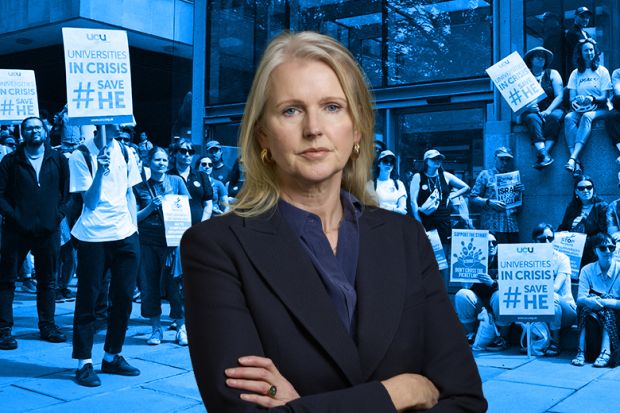
The UK government must urgently come up with a clear plan for what would happen to students who are left stranded by university closures, according to the Conservatives’ shadow education minister.
Joanne Cash, a barrister and life peer in the House of Lords, said her “concern and focus” since accepting the education brief in June is the likelihood young people will be unable to complete their studies if struggling providers suddenly shut.
“The viability of some institutions is obviously a matter of real concern,” Cash told Times Higher Education.
“We know that a third of institutions are running a deficit this year…What’s going to happen? My concern and my focus at the moment is that the government has not said it will guarantee a backup position for those students who might find themselves locked out of their current courses if one of those institutions does go bust.”
A House of Commons Education Select Committee inquiry earlier this year concluded there was little clarity over what would happen if a university closed.
Providers are required by the Office for Students (OfS) to devise student protection plans but these are widely considered to be inadequate for the scale of the challenge, especially for larger institutions who may have several thousand students needing to be rehomed.
Ministers have so far resisted recommendations made by the committee to create an early warning system for closures and a special administration regime that would outline a distinct process for closure.
Cash said her team was working on “deep-diving [and] heavy lifting” to determine her party’s policy position on how to deal with the financial crisis uprooting the sector, including the question of whether to encourage greater consolidation, as well as “challenging” the government on its plan for students who end up affected.
Asked her thoughts on the debate over whether more highly ranked universities, like members of the Russell Group, should be permitted to charge more for tuition, Cash said she hadn’t reached a “final decision” on the question.
But she confirmed she did agree with the idea of minimum entry barriers when it comes to attending university.
This summer, it was revealed the Department for Education (DfE) was considering plans to block UK university applicants without a pass in English GCSE from receiving tuition and maintenance loans.
Critics suggest such a change could limit access to higher education for those from working-class backgrounds.
“I think a mandatory GCSE [in] English [and] mandatory GCSE [in] maths should be the bar for getting a degree,” said Cash, who also suggested Andy Burnham’s focus on embedding technical educational pathways from as young as 14 could undermine “fundamental academics”.
Besides expressing worry about the potential fallout of the sector’s money problems, Cash also said she was “very concerned” about antisemitism on campus.
Cash suggested anti-Jewish sentiment was “being allowed on campuses and going unchallenged by the student body”.
“It’s worse than that,” said Cash, “it’s going unchallenged by the academic body, the teaching body”, she said.
Asked how she would address the problem, Cash said she wanted to see teaching faculties make clear antisemitism would not be tolerated “on their watch”.
In addition, she suggested everyone who arrives at university be given some kind of “refresher” session on the subject.
Register to continue
Why register?
- Registration is free and only takes a moment
- Once registered, you can read 3 articles a month
- Sign up for our newsletter
Subscribe
Or subscribe for unlimited access to:
- Unlimited access to news, views, insights & reviews
- Digital editions
- Digital access to THE’s university and college rankings analysis
Already registered or a current subscriber?