Adapting UK campuses to deal with increasingly regular bouts of extreme heat will be “hugely problematic” for cash-strapped estates teams, experts predict, with even more modern buildings likely to feel the strain of rising temperatures.
After the hottest summer on record in 2026 – featuring five independent heatwaves – meteorologists predict next year will be even hotter owing to a rare “El Niño” event.
Trevor Payne, former director of estates at the universities of Oxford and Birmingham and chair of the Smart Space Forum, which facilitates conversation between estates heads, said heatwaves are “here to stay”.
“And it’s not just heat – it’s flooding, it’s electrical resilience,” he told Times Higher Education (THE). Asked whether universities needed to rapidly increase their preparedness for extreme weather, he said: “There’s no time to lose.”
This summer’s heat – which saw a record 40 days of temperatures above 30°C – led to a number of institutions introducing emergency measures such as installing portable fans or directing staff and students to areas with air conditioning.
Most campuses are a mix of both heritage and more up-to-date, multi-use buildings and many estates teams have dismissed the idea of retrofitting buildings as prohibitively expensive.
Payne said there were actions that could precede the most costly of interventions. “Use the buildings that you’ve got effectively. Understand which rooms get hottest; which ones have better shading.
“Use the intelligence that you’ve got. In reality, there isn’t going to be capital available and probably there isn’t going to be the time to sort this out before the heat of next summer.”
Once universities are tracking building use sufficiently, Payne said, investment in air conditioning can be “targeted” towards where it is needed the most.
Liam O’Dell, director of estates and facilities at the University of East London (UEL), told THE that the institution’s campus in London’s docklands was naturally ventilated owing to its proximity to the water.
The Stratford campus, however, features a grade II-listed heritage building which “presents its own issues”, O’Dell said.
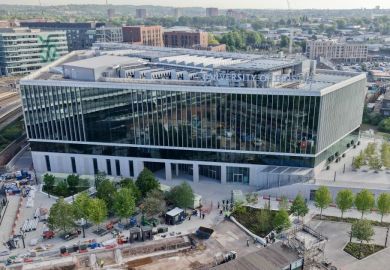
Heat concerns are also being factored into all new capital projects. O’Dell pointed to UEL’s Stratford Health Campus in Newham, which began construction five months ago.
Anyone working on expanding a university’s estate will be considering the “conditions” necessary for “the work that’s going on and the learning” intended for each new building, he said.
Like Payne, he said gathering data regarding energy use, timetabled activity and occupancy is a key consideration, as well as the more holistic public messaging that heatwaves and extreme weather will require from institutions.
Asked whether the sector was broadly prepared for the consequences of extreme heat, William Whyte, a professor of social and architectural history at the University of Oxford, said: “I suspect the answer is in most cases ‘no’.
“An example of a building where that has been thought about is the building I was responsible for constructing here at Oxford, the Stephen A. Schwarzman Centre for the Humanities,” Whyte said.
Completed in 2025, the building’s heating and cooling systems were “calculated against predictions of the global temperature in about 2050”.
But Whyte added: “Even in that case, the truth is, we are hitting the temperatures that were predicted for 2050...Even the best preparations may prove, in the long run, to be inadequate.”
Both Whyte and Payne suggested that university timetables may have to change to accommodate the realities of climate change. While most students disappear over the hottest months, summer activities such as exams and graduations face disruption.
“It will have an impact on accommodation, because non-purpose-built or older accommodation may really struggle to deal with any fluctuations in temperature,” Whyte said. “It will also have an impact on universities like my own that have quite late exam periods...it’s a really serious problem.”
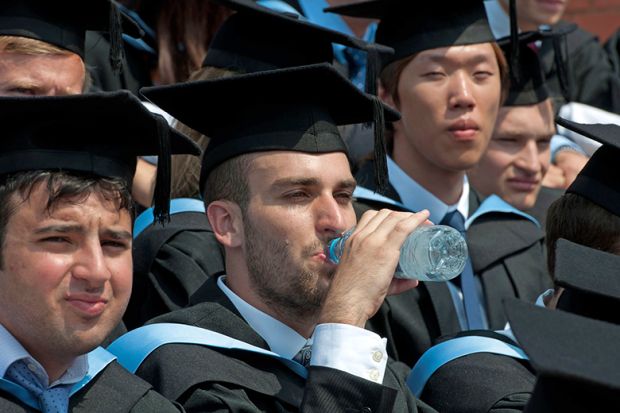
Payne agreed: “You’ve got to set the right environment for exams, but it’s also things like graduation.
“We graduated students this summer in extreme heat...it’s about how we adapt to run those events, because this issue isn’t going away.”
For Whyte, adapting to climate change on top of the “backlog” of maintenance works cash-strapped universities already face could prove existential.
“The current financial problems for universities are just so tough,” he said. “When you add this problem of climate change...that’s going to prove hugely problematic for a large number of institutions and I don’t quite know how they’re going to survive.”
Register to continue
Why register?
- Registration is free and only takes a moment
- Once registered, you can read 3 articles a month
- Sign up for our newsletter
Subscribe
Or subscribe for unlimited access to:
- Unlimited access to news, views, insights & reviews
- Digital editions
- Digital access to THE’s university and college rankings analysis
Already registered or a current subscriber?