Stanford University’s decision to close its research centre in South Korea reflects continuing pressure on US institutions’ foreign partnerships and contradictions inherent in Seoul’s internationalisation push, experts have said.
The elite university is closing the Stanford Center at the Incheon Global Campus (IGC) after five years, it has announced.
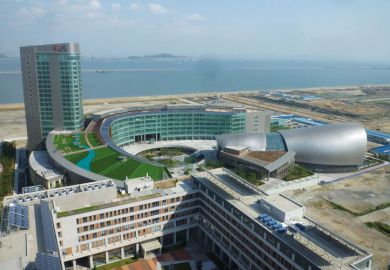
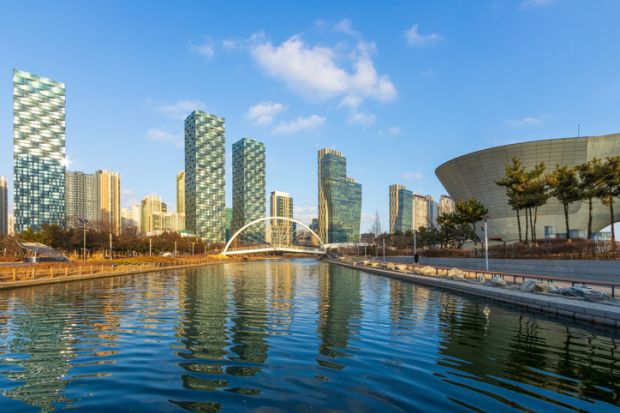
Located in Songdo, a “smart city” about 40km outside Seoul, IGC launched in 2012 through a collaboration between the South Korean government and Incheon Metropolitan City. The vision of the shared university campus was “to create a world-class global educational hub” where students could pursue education at foreign universities at a more affordable cost.
Having Stanford’s research centre in Songdo was expected to facilitate joint research with leading universities in Korea such as Yonsei University, Seoul National University and Korea University. It also aimed to further strengthen the educational ecosystem in South Korea amid a national internationalisation drive.
The central government, Incheon Free Economic Zone Authority (IFEZ) and the Ministry of Trade, Industry and Energy poured more than W17 billion (£9 million) into the Stanford Center.
Julie Greicius, associate dean for communications and alumni affairs at Stanford Engineering, told Times Higher Education that the Stanford Center will conclude all research activities and begin winding down operations this year.
“After opening in June 2021 during the height of the COVID pandemic, the program faced financial and operational difficulties," she said, adding that Stanford's relationship with Korea will continue to develop in other ways.
“We remain dedicated to solving the challenges of sustainability and clean energy in urban environments, and optimistic that our relationship with Korea will continue to thrive through many other ongoing collaborations.”
The closure of the Stanford Center follows weeks of intensifying scrutiny in the US on the foreign ties of elite universities, including an announcement from the Department of War calling on US universities to audit their partnerships.
At the time of its launch, IGC set a lofty goal of hosting 10,000 students and 10 international campuses by 2025. However, only five international universities are currently open on IGC: the State University of New York (which includes both Stony Brook University and Fashion Institute of Technology), George Mason University, Ghent University from Belgium and the University of Utah. As of 2024, student enrolment reached 4,225.
Theodore Jun Yoo, professor in the department of Korean language and literature at Yonsei University in Seoul, said the root cause of the closure lay in the mismatched ambitions of Stanford University and the IGC, which existed from the outset. He argued Stanford University was not “the obvious partner for a city hoping public funding would translate into local ownership and local pay-off”.
“Songdo wanted something it could point to as proof that Incheon was becoming an innovation hub,” Yoo told Times Higher Education, citing local jobs, research capacity, or “technology that Korea could actually use” as examples of such innovation.
“But the US research system works differently. The priority is often a few high-impact results…over a stack of locally useful outputs, and universities guard IP like it is the crown jewels. Stanford was not necessarily interested in producing lots of visible results for Incheon just because Incheon helped pay the bills.
“Stanford wanted to run a Stanford operation, protect Stanford IP, and define success by Stanford standards.”
Kyuseok Kim, director of the IES Abroad Seoul Center, echoed Yoo’s sentiments that the closure of the research institution in Songdo should be understood in the context of “a relationship that had already shown signs of fragility”.
“By 2023, a reduction in government subsidy following a performance review had already prompted Stanford to consider withdrawal,” Kim told Times Higher Education. “The subsequent renegotiation, including controversy over the extent of Korean government oversight and research autonomy, suggests a more fundamental weakness in the original partnership design.
“Korea was understandably eager to attract a globally prestigious institution such as Stanford, but I think there was an element of prestige-driven internationalisation: securing the Stanford name itself appears to have been treated as an important policy achievement, without sufficiently robust mechanisms from the outset to ensure mutual accountability, sustainable financing and locally embedded research outcomes.”
Although Yoo believed that president Donald Trump’s “draconian domestic assault” on higher education is “forcing powerhouses like Stanford to curb projects abroad”, other scholars were cautious about interpreting the Stanford Center closure as evidence that US-South Korea research ties are weakening.
“The broader bilateral research relationship is much deeper than this single centre and continues to expand in areas including AI, semiconductors, biotechnology, quantum technology and basic science,” said Kim.
John DiMoia, associate professor of Korean History at Seoul National University, said that the closure will not have “a major impact on US-Korea research collaboration”.
“Numerous other universities maintain a strong presence in Songdo,” he told THE, adding “there remain numerous collaborations in Seoul and Daejeon, the major sites for Korean academia and research collaboration.”
Register to continue
Why register?
- Registration is free and only takes a moment
- Once registered, you can read 3 articles a month
- Sign up for our newsletter
Subscribe
Or subscribe for unlimited access to:
- Unlimited access to news, views, insights & reviews
- Digital editions
- Digital access to THE’s university and college rankings analysis
Already registered or a current subscriber?