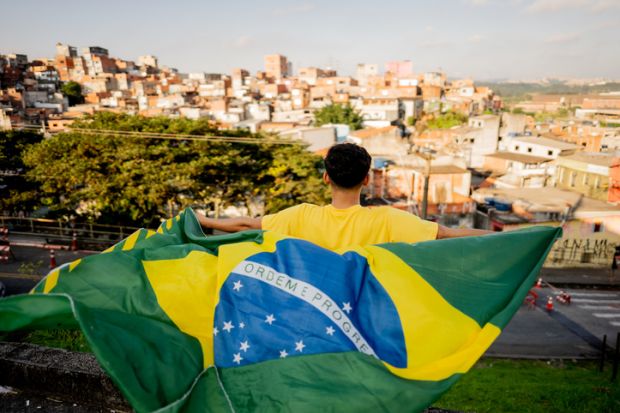
Brazilian universities will continue to come under pressure regardless of who wins this autumn’s high-stakes election, but a victory for the son of Jair Bolsonaro over left-wing incumbent Luiz Inácio Lula da Silva (Lula) will pose far more risks, experts say.
Lula and Flávio Bolsonaro have both announced their candidacies for the presidency, along with Social Democratic Party leader Ronaldo Caiado, a former governor of the state of Goias.
According to recent polling, Lula, who is seeking a historic fourth term, is predicted to take approximately 43 per cent of intended votes to Bolsonaro’s 40 per cent in a run-off scheduled for 25 October – as long as no candidate secures 50 per cent of the vote in the 4 October first round.
David Treece, an emeritus professor of Portuguese and affiliate of King’s College London’s Brazil Institute, said: “We’re looking at an election which is, on all fronts, very polarised.”
Flávio Bolsonaro is running in the shadow of his father, a former army captain, who served one term as president from 2019 to 2022.
His presidency was marked by the defunding of the country’s public universities and an anti-science rhetoric that forced many high-profile academics to leave Brazil.
He was jailed in 2025 for 27 years and three months after plotting a coup to take back power following the election of 2022, which Lula narrowly won.
Bolsonaro’s son is running on a similarly right-wing platform, promising tax cuts, increased privatisation, and closer ties with the Donald Trump regime in the US.
If he were to win, it would see the largest country in the region fall in line with a wider Latin American shift to Trump-favoured leaders, following elections in Argentina, Colombia and Peru.
Brazil is the largest higher education sector in Latin America, with 8.4 million students enrolled in 2022 and 4.1 million in other forms of adult further education, according to the International Trade Administration (ITA).
Lula’s long political career, which began in the 1970s, has seen an emphasis on expanding access to higher education, particularly for those from working-class backgrounds and Indigenous and Afro-Brazilian populations.
In particular, he oversaw the introduction of the Programa Universidade para Todos (University for All programme), which provided scholarships for the most disadvantaged to gain admission to private institutions.
But this approach is not beyond criticism, according to Treece, who suggested it was partly responsible for undermining the public sector.
“There’s no question it’s brought unprecedented numbers of people into higher education...in huge numbers, it’s transformed university profiles,” he said. “That’s extraordinary.
“But it has put terrific pressure on those students to succeed and on the infrastructure. It’s also involved, it has to be said, a big shift of resources to the private sector.”
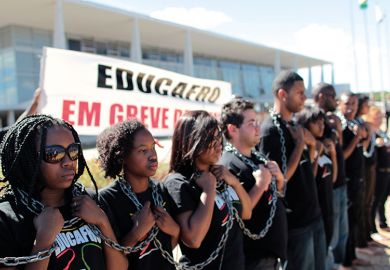
Lula’s most recent term in office has also seen lecturer strikes as the government struggled to undo many of the funding cuts of the previous regime.
Diego Sánchez-Ancochea, professor of the political economy of development at the University of Oxford and head of the Oxford School of Global and Area Studies, said a Bolsonaro win however would “have very negative consequences for public universities and for science and technology more generally”.
“One only needs to consider what happened during Jair Bolsonaro’s government. The government cut non-wage expenditure significantly, first in 2019 and then in 2022. It eliminated scholarships and promoted private universities over public ones.”
Jair Bolsonaro tarred universities with accusations of “cultural Marxism”, Sánchez-Ancochea said, and “consistently attacked freedom of speech and academic freedom”.
“His son is likely to adopt a similar approach, given his focus on austerity and the fact that much of his electorate does not see universities positively.”
Treece, who set up a group called Scholars for Academic Freedom in 2018, echoed these concerns, pointing out the “unique” approach to electing people to top positions in Brazilian universities – a democratic tradition Bolsonaro senior had undermined with a series of direct, governmental appointments.
The older Bolsonaro had also made serious cuts to university funding, with half the country’s 68 federal institutions undergoing 50 per cent budget cuts under his presidency.
Register to continue
Why register?
- Registration is free and only takes a moment
- Once registered, you can read 3 articles a month
- Sign up for our newsletter
Subscribe
Or subscribe for unlimited access to:
- Unlimited access to news, views, insights & reviews
- Digital editions
- Digital access to THE’s university and college rankings analysis
Already registered or a current subscriber?