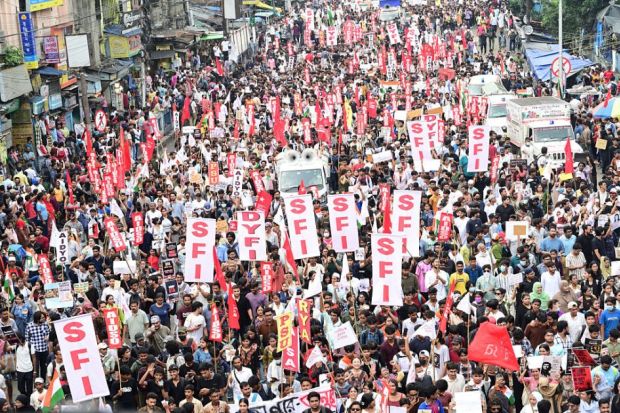
Religion. The economy. Agriculture. Democracy and the electoral process. The reality of caste. Corruption. Storm and lightning through everything have left the Modi government unfazed, and, in some cases, mightier. How is it that this government, run by a party that swept state elections as recently as May, was shaken by youth-led protests about the state of higher education in the country? How did the invincible BJP come to lose its triumphal sheen?
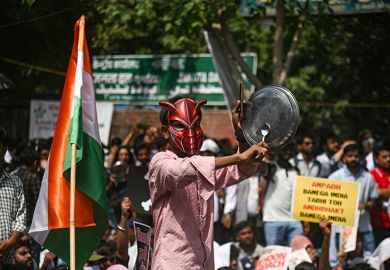
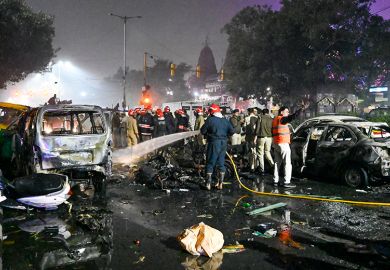
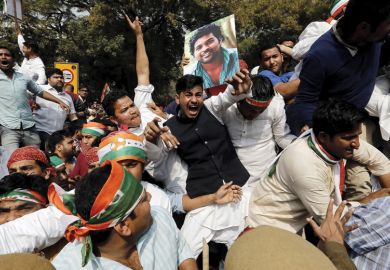
Shaken by the intensity of the student demonstrations protesting the leaks and eventual cancellation of the national medical college entrance examination energised by the mockingly titled “Cockroach Janata Party”, heads finally rolled in the government. The party which does not “do resignations”, according to one of its senior leaders, had to relent, with the education minister, Dharmendra Pradhan, tending his resignation on 25 July.
No doubt this victory for the leaderless, spontaneous protest movement is nothing more than symbolic, what with the moral and ideological record of Prahlad Joshi, the interim minister who has followed Pradhan’s resignation. And the structural problems of Indian higher education are so deep that even the tip of solutions are nowhere in sight. But even so, the blow to the Modi government is unmistakable, and absolutely unprecedented since its inception in 2014.
Does this mean that higher education is more important to India than all the other realities? One can hardly make that claim. Religion still drives communities and shapes sentiments nationwide. Caste still excludes people in irreversible ways beyond the imagination of Western societies used to the inequalities of class. Democracy is more vital than ever in the world’s largest democracy, more so as it comes under the onslaught of exclusionary citizenship drives. In 2020-21 we saw what peasant unity could do in this nation, particularly north India, the long cold winters it could brave through, their protests jamming infrastructure and traffic movement around Delhi. And finally, the hollowness of the economy under the brittle facade of its size and rank in the world has started to disenchant the working and the middle classes as they struggle to find jobs and hold on to what they have as the artificial intelligence wave starts to sweep the country.
Higher education is not more important than any of these. But the truth is that almost all of them come together with electric vitality in India today in the crucible of higher education. Perhaps they come together in an even more pervasive way through school education, but the participants (or victims) of that system in India cannot be vocal enough given their vulnerable age. But the youth who have completed schooling and now stare at the dark crack between the roulette wheel of opportunity and the abyss of exclusion have shown that they have the voice and energy to stare this system down.
The force of their stare is clear enough. Economy, jobs, corruption, democracy, institutions, hope for a better life and survival itself, mobility beyond the poverty of agriculture. Each and every one of these realities, for India’s youth, must move through the chute of higher education. Almost everything that is a defining issue in India today reaches crisis, transformation or rejuvenation, through education, particularly at this urgent juncture of high school and professional training.
How do these concerns collapse in a single heap when national examination systems fail students? The 2017 suicide of S. Anitha, a poor student from Tamil Nadu, the daughter of wage labourers from the caste-oppressed Dalit social group, tells a painful story. Despite securing a high rank in the Tamil Nadu State Board examinations, she failed to get a seat through the national qualifying examination for entrance into government medical schools. Under the new rules, state board marks, which were the basis of admission, were no longer considered under the centralised education system. Anitha’s performance in the examination fell short of the requirement for reserved seats, and on 1 September that year, she took her own life.
It is a tragedy that bares everything that is dark, disturbing and destructive in India today: the relentless attempt of the juggernaut of the central government to override state authority and dismantle federalism, the oppressive myth of “One Nation, One Exam”, the structural violence and exclusion fated for the poor, the caste-oppressed, and women, their destroyed dream of upward social mobility and financial security, the hope for a doctor’s job and contribution to the nation’s economy.
It took just one death to reveal them all, but the suicides haven’t stopped. Thousands die by suicide every year after failing to secure seats in competitive national examinations. More than 20 have killed themselves after the medical entrance exams were voided owing to the leaks of the question papers this May.
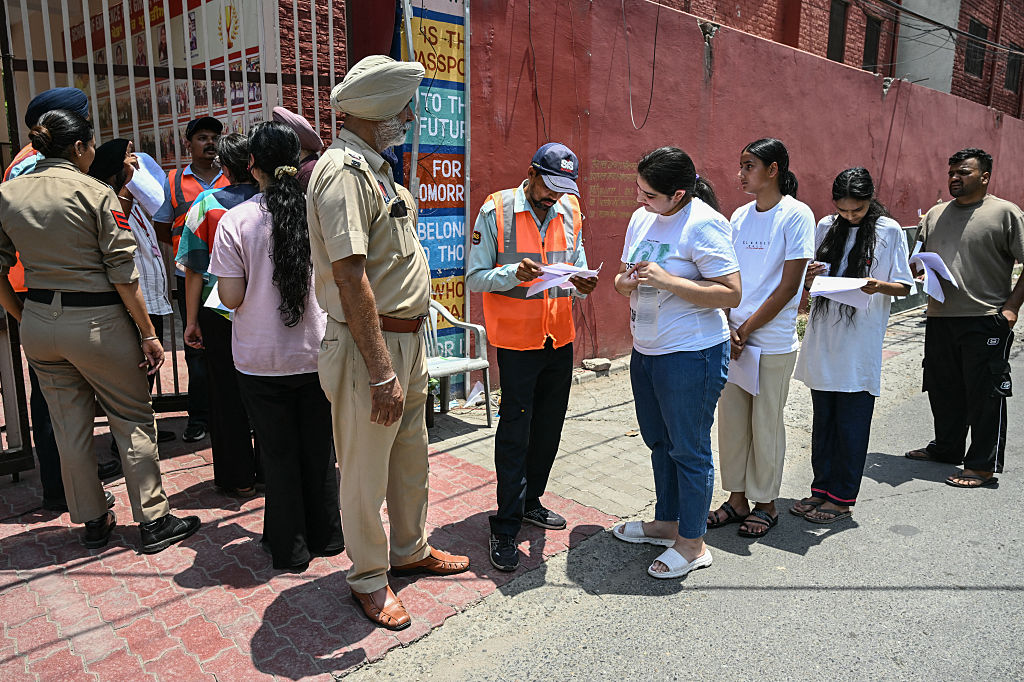
India’s youth population, a significant percentage of its 1.4 billion total, is massive by world standards. It is also well known that India has been wasting this demographic dividend ever since it became a reality, and now this dividend is finally on a downward curve. Key to the wastage of the demographic divide is the failure of the economy to produce jobs on any sustainable scale.
Even the much-touted liberalisation of the economy in the early 1990s, many economists point out today, made the upper classes wealthier while failing to produce enough jobs for even the educated middle class, much less the millions in dire poverty. The illusion of employment produced by the short-lived wave of call centres and software coding was quickly cut short by technological change and now stands to be wiped out altogether by the AI wave. But these were still the good times. During the declared good times – achhe din – promised by the Modi government, top-down development and crony capitalism, as in the infamous Gujarat model, have finished off any remaining prospect of significant employment generation.
The corporate economy produces a handful of jobs for the elite in places in Bengaluru, Hyderabad, Mumbai and the region around Delhi. But if you happen to be one of the hundreds of millions of poor or lower-middle-class youth in India’s rural or provincial backwaters, your only shot out of poverty or a precariously low middle class is through the insane roulette wheel of examinations that pit a vast population against a microscopic minority of seats, be it for places in good medical or engineering colleges, or for jobs in the government. The Union Public Service Commission that recruits government servants across the ranks continues to dominate national career prospects in a way that suggests the liberalisation and globalisation of the economy never happened in this country, and that we are still a failed socialist state.
It goes without saying that Indians have unquestioningly accepted the urgency of examinations and have elevated it to an entirely different altitude of significance. Mass examinations to recruit government clerks were put in place by the British government, for which the entire enterprise of higher education in India had to be positioned to serve the staffing needs of the massive empire. This one shot at success required copious rote learning and attempts to game the system that now has a long history of questionable distinction in India for close to a couple of centuries.
Selection through examinations was doomed to reach a level of crisis as the proportion between examinees and available places approximated the absurd. And this is exactly what has happened. There has been a near-complete failure to create jobs as well as spots in institutions of higher education, particularly in professions such as medicine and engineering, which remain time-tested pathways to upward mobility, financial security and social prestige in post-independence India. Low-quality private engineering colleges tried to exploit the market for a while, but they ran out of steam after their degrees proved worthless in the job market.
As higher education institutions in the West stare at rapidly dropping college-age populations and shrinking admission numbers (particularly as anti-immigrant moves block international student recruitment), India has a problem that goes so far in the opposite extreme that it may be difficult for people outside the country to grasp it. For a postcolonial nation with memories of war, partition, famines and other disasters that persist through generations, where hundreds of millions still live in precarious conditions, the poverty trap is real even for new (and still unstable) members of the middle class.
With securing a seat through the great roulette wheel of examinations the only hope to stay out of poverty, the private coaching industry has done a devilish job of preying on the fear of the teeming millions for whom success at the examinations is the holy grail of life. The lessons the coaching centres offer have nothing to do with any mastery of any subject; they are all single-mindedly devoted to gaming the system. The kind of absurd preparations they offer, and the kind of knowledge and aptitudes they shape, is a whole other perversion that I’ve tried to write about elsewhere.
But the even greater flaw with the examination system is that this is in essence the only system now for hundreds of millions of Indian youth who cannot afford an expensive private education or manage to escape overseas. And the current government, which believes in centralising everything to the point of reducing India’s federal identity to a mockery, has centralised examinations relentlessly, even introducing a common admission test for getting into public universities after high school.
The motto “One Nation, One Exam” is an ominous echo of the government’s other slogan “One Nation, One Election” – an attempt to undermine federalism and crush regional political parties by holding state and central elections at the same time. Centralised control, under this government, amounts to centralised corruption. At least in the past, in this great big diffuse, scattered country, when corruption had multiple nodes and venues, resistance to it was also scattered and pluralised, perhaps chaotic and ineffectual, but still real. With power and controls in one place, this government has aimed to eradicate the plurality of resistance – as it has tried to do with almost all institutions of public life, the legislature and the judiciary included.
But something massive has backfired this time. Something that has not happened yet with the government’s takeover of the judiciary, the electoral system, the public and private sectors of industry, airports, every national monument, even the right to citizenship. What was it?
It has everything to do with the demographic group that was betrayed by the exam disaster – the youth. The youth who saw their precious years being squandered away by the hole in the system, who saw their friends and classmates die by suicide at the repeated tragedy of the annulment of corrupted examinations. The American description “Gen Z” doesn’t quite do justice to this youth group, given their staggering diversity across the nation and the rungs of its society. But even this diverse group are unified by their understanding of the system as one party, one man. They have no other government or prime minister in their extant memory.
After a decade and a half of putting his face on every monument and document all the way to the Covid vaccination certificate, after inserting his name into just about every government scheme, archive and documents, to say nothing of the colonialism of the national media, Narendra Modi has seen, for the first time in 12 years, that a one-man, one-system can also mean one villain. For the generation of student protesters, he is not the head of the system – he is the system. He is not only the only prime minister they have known, he is the supreme leader. And when everything goes supremely wrong, they know who to blame.
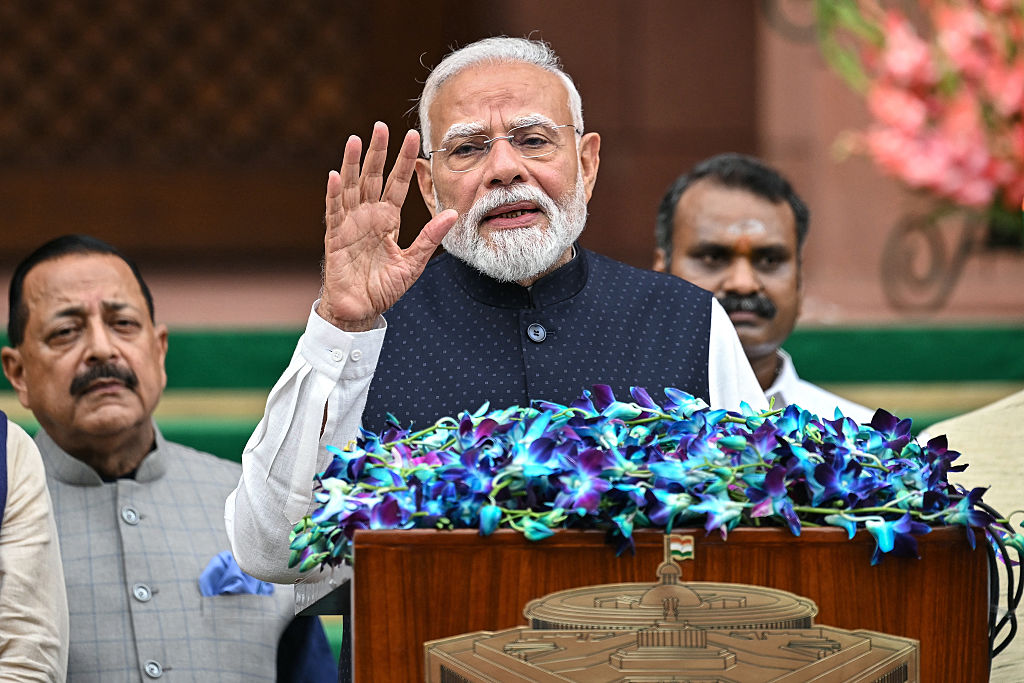
Given the national educational pathway, for most students, the most crucial turning point comes at the end of high school where success or failure, entrance or rejection promises hope or despair to students and families across all social strata, religion and ideological divide. This very turning point has crashed for the aspirants whose aspirations range from sheer survival to high prestige.
The destruction of no other domain has triggered such a catastrophic outrage. Exclusionary citizenship tests targeted minorities, the poor, and the vulnerable, leaving the more privileged and articulate segments of the population largely unaffected and indifferent. Determined and powerful as the farmers’ protests were, the life and predicament of the peasant couldn’t enter the non-peasant imagination of a nation that desperately seeks urban modernity. Until it affects you personally, a corrupted judiciary only remains scandalous on alternative media followed by vilified left liberals. Even the famine of jobs has a faceless villain given that the workings of the economy are mysterious and inexplicable even to an educated population, to say nothing of the uneducated masses.
But failure and dysfunction in the examinations handled by the central government? That has a clear face. And who does it affect? Everyone who hopes for a decent life in this country, those who have betted everything in their life until now on their chance of getting a coveted seat through the examination. Crucially, this is a population old enough and articulate enough to know how they have been cheated, and they possess the language (both civil and vulgar) to stage and express their discontent. Neither religion nor caste, deployed by the BJP strategically to divide and unify as necessary, to engineer riots or consolidate vote banks, could divide this population who feel their years and lives are now slipping away.
This time, the government saw its police violence land on the children of the very families who had voted them to power, including the fervent Hindu, the believer in the greatness of Bharat, the upper-caste follower of every Brahminical ritual, as well as students like S. Anitha. Aspiration to higher education and its promised social mobility/security, in this country, unites the Hindu and the Muslim, the right, middle, and the centre, the rich and the poor. It also includes the caste-privileged and the caste-oppressed until the lightning rod issue of reservation and quotas comes up and divides them again. But the failure of the whole system destroys them all together – the seeker of the “general” as well as of the “reserved” seat.
These are students fuelled by generations’ faith in the examination system – and the ranks and “merit” lists it unequivocally produced through decades, even centuries. For those who come from families who have inherited the legacy of success in examinations, it offers the alluring promise of continuity – the prestige of a place and/or a rank, the mark of merit beyond doubt, and a secure life after, with proper social status and recognition. Their parents and grandparents were clerks, officers, military personnel, civil servants, engineers, doctors, teachers, professors – all of them qualifying through examinations that had earned the trust of generations and now, their fetishising obsession. And for the millions whose parents and grandparents had been none of these and were bonded to the labours of the land and the human body, examinations are the only portals to all that and more.
How can a government mess up the only system that offers any glimmer of hope to the teeming millions from all directions, across all ideology and identity? How can they hope to get away with this mess? The destruction of the Great Roulette Wheel is the destruction of the powers that control it. Higher education, or the examination system that stands for it in India, may very well be the Achilles heel of this government that has miraculously managed to add every firestorm into its arsenal of firepower.
Saikat Majumdar’s most recent book is Open Intelligence: Education Between Art and Artificial.
Register to continue
Why register?
- Registration is free and only takes a moment
- Once registered, you can read 3 articles a month
- Sign up for our newsletter
Subscribe
Or subscribe for unlimited access to:
- Unlimited access to news, views, insights & reviews
- Digital editions
- Digital access to THE’s university and college rankings analysis
Already registered or a current subscriber?