One of the most heart-rending ethical outrages that can occur in wartime is the use of a hospital to launch an attack. How should the opponent respond to such a devastating breach of the sanctity of life? Keep the hospital out of its line of fire and incur death-blows from a place dedicated to the nourishment of life? Or return fire and kill the wounded and dying within, alongside the soldiers who are using them as human shields? As the world has found out far too often, there is no good answer to this question.
But what if the mis-chosen bunker is a place meant to nourish not only health but also education? What if the victims of the lethal violence are all innocent civilians? What if the alleged antagonists are not regular soldiers but radicalised members of a religious minority in a country dominated by religious majoritarianism and already keen to label much of intellectual and academic life as suffused with dangerous anti-nationalism? And what if the hospital is linked to that minority group, at once vulnerable and demonised, with the violence traced to a secessionist rebellion in the most disturbed part of the country?
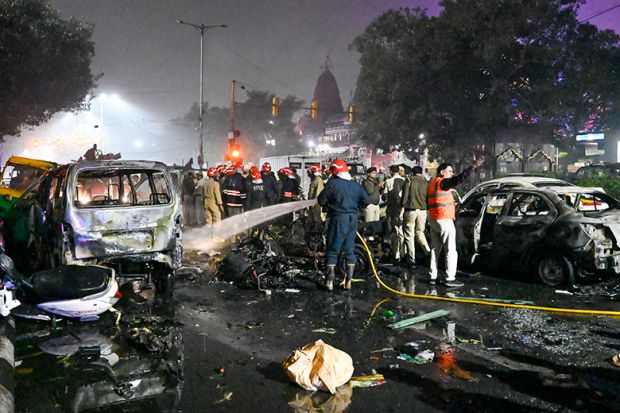
This is exactly what happened a few weeks ago in India, right in the heart of the National Capital Region. On 10 November, a car exploded near the Red Fort, a nearly 400-year-old Mughal landmark in Delhi, killing at least 15 people and injuring more than 20 others.
Investigators have alleged that the key planners of the attack were Umar Nabi, who died in the car, and Muzammil Shakeel Ganai, who has been arrested and remanded in custody. Both were physicians who worked for Al-Falah University and the Al-Falah Medical Research Foundation in Faridabad, a city around 30km from Delhi. Another doctor and medical faculty member of the university, Shaheen Shahid Ansari, also arrested, is supposed to have led the group, which is believed to have links to the banned organisations Jaish-e-Mohammed (JeM) and Ansar Ghazwat-ul-Hind. Both of those organisations are responsible for militancy in the disputed Jammu and Kashmir region; Ansari supposedly mentored JeM’s newly formed women’s recruitment wing.
The group are said to have planned the attack over time inside the university campus. The room where the plot was reportedly hatched was described by the news magazine India Today as “an ordinary, damp, and musty hostel room”. Building 17, room 13, the magazine reported, belonged to Muzammil Shakeel Ganai, who came from the Kashmiri town of Pulawama – where a terror attack was carried out in 2019 by a suicide bomber, resulting in the death of 40 Indian military personnel.
In that room, he held regular meetings “with other radicalised doctors and was plotting coordinated blasts in Delhi and nearby states”, the magazine stated. Investigators believe the plotters had clandestinely moved chemicals from the university’s laboratories to the hostel room and, from there, transported them to two villages in the state of Uttar Pradesh, where they assembled the explosives used in the Red Fort blast.
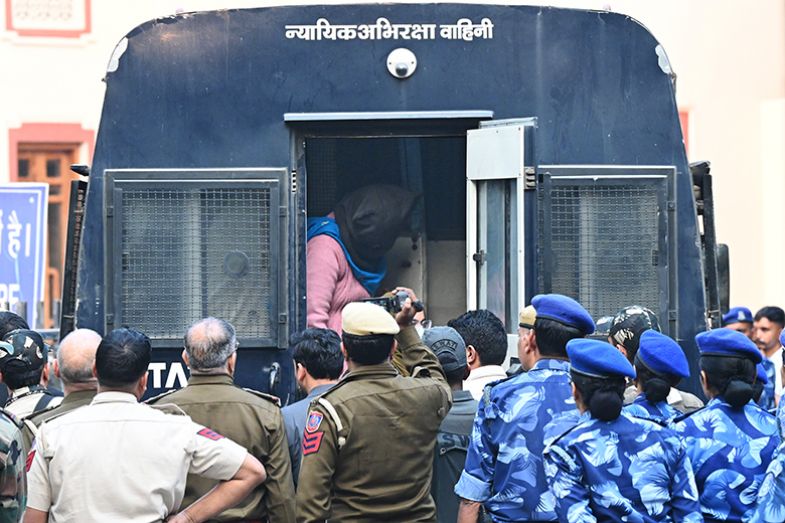
So what does the incubation of terror plot inside a university that is also a medical college entail for higher education in India, a country whose rising youth population struggles to find appropriate institutions to fulfil its aspirations and where professional education in medicine and engineering – both offered by Al-Falah – are not only integral to national development but surefire tickets to the middle class?
And the most disturbing question of all, what does it entail for Kashmiri youths seeking educational and professional opportunities outside the bleak conditions of their ravaged state? Many of those students come to the national capital – but many academic and professional doors have already started to close on them under the current BJP Hindu nationalist government.
Al-Falah has deservedly been called out for the deadly lapses on the part of its campus security. It has also been accused of serious financial irregularities, while doubts swirl in the media about its accreditation and academic credibility. Moreover, on 1 December, its founder, Jawad Ahmed Siddiqui, was sentenced to a 14-day jail term in a case of money-laundering involving illegal use of student fees and public funds, as well as an extensive case of land fraud around the establishment of the university campus.
As a result of the blast, the Association of Indian Universities (AIU) has withdrawn Al-Falah University’s membership and the National Medical Council (NMC) has permanently removed four doctors linked to the terrorism case from the Indian Medical Register, barring them from practising medicine in the country. Questions were also raised about the university’s continued accreditation by the National Assessment and Accreditation Council (NAAC).
While the accreditation question has been sorted out, clouds of uncertainty still hang over the future of Al-Falah’s students. Over 600 of these are medical students, and they are clinging to the hope that the NMC will come to their rescue by continuing to recognise Al-Falah degrees.
“NMC is our only lifeline now,” a final-year student from Lucknow told the media. “We know some faculty did unimaginable things. Punish them, investigate fully, but please don’t kill our careers. Transfer us, merge us with another college, do whatever – just don’t cancel the affiliation without a migration plan. We beg you.”
A current Al-Falah postgraduate medical student made a similar plea. On condition of anonymity, they remarked to the Indian news agency NDTV: “Our university is being called a terror den, an incubator of radicals. Some even say it should be razed to the ground. But what about the hundreds of students who came here only to build a career?”
Two suitcases in hand as he exited the campus gates after the completion of his exams, he lamented, “If the college shuts down tomorrow, five years of NEET [National Eligibility cum Entrance Test] struggle and lakhs [hundreds of thousands] of rupees – everything will vanish. We will become that batch whose degree no hospital trusts.”
In India, students’ aspirations are commonly shared by their parents. Hence, many parents of Al-Falah students are now staring into a similar abyss. NDTV reported the anxiety of one father, who entered the university gate on a bike with his first-year student daughter seated behind him.
“It’s my dream to see my daughter become a doctor. Where do I go now after what happened?” he asked the reporter. “My daughter says, ‘Papa, if I leave now, I lose one year; if I stay and the NMC cancels recognition [of Al-Falah degrees], I lose everything.’ What kind of choice is this for a parent?”
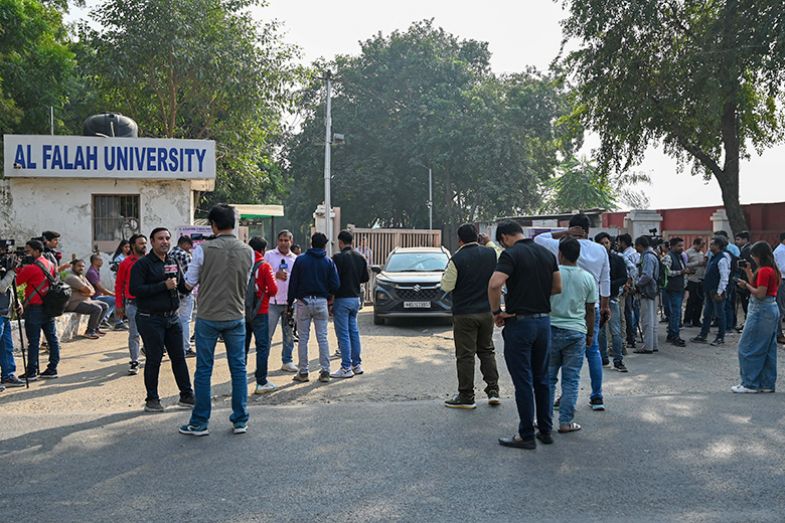
Regardless of whether this institution has violated particular higher education protocols or failed to uphold acceptable quality standards, the high educational levels of the people allegedly involved in this terrorism plot must give us pause. After all, some of them, such as Shaheen Shahid Ansari, had successful prior careers in medical training and practice at other institutions, too. Nabi had studied in the Government Medical College in Srinagar, the capital of Kashmir.
The Red Fort blast has kindled conversations in India about “white-collar terrorism”, and its perpetrators have been dubbed a “white-coat terror network”. These terms bring up some dark memories for me. I remember starting out as a graduate student just a month before 9/11 at a university located an hour away from the Twin Towers. The perpetrators of those attacks, too, were highly trained – in that instance, in aeronautical engineering and aircraft operation. And their terrorist network was spearheaded by a man of significant education and personal means.
In India, militants are far likelier to be drawn from among the country’s hundreds of millions of unemployed youths of little to no education. Their poverty, marginalisation and sense of exclusion from state and civil society are easy to exploit by radicals, and their aimless, scattered lives are easy to harness for destructive missions. So what does it mean when educated, empowered individuals submit to the ideology of terrorism – when they are ready to use their professional expertise to design the attack and sacrifice their professional success and its material rewards for acts of destruction meant to signal their dissent against the state? Does the Red Fort blast say more about its alleged perpetrators’ ideology or about their individual characters – or about some as yet unknown circumstance that came to entangle them in such nefarious purposes?
Apart from the poignancy of his concern about the damage the bomb may do to his child’s career, what also lingers in the memory about the Al-Falah father’s remarks to reporters was his response to a question about whether more of the university’s students might have been radicalised.
“Not every intellectual is a radical,” he said. “Our dreams shouldn’t be punished for someone else’s sins. I trust the values I’ve taught my child.”
Are the terrorists really intellectuals? Do we need to assume an intellectual dimension to their ideological radicalism just because they are affiliated with a university? After all, while there are certainly intellectual traditions, including anticolonial, Communist and anti-racist ones, that have espoused the use of violence, there is scant evidence of any radicalisation of these individuals that can be described as intellectual or ideational.
That radicalisation was apparently well hidden – from friends and family, as well as colleagues and students. Shaheen Shahid Ansari is remembered, for instance, by many at Al-Falah as a resolver of conflicts among students and colleagues. It is true that she was also known for her rigidly orthodox religious views, with definite ideas of what constituted proper attire for women, for instance. But orthodoxy does not automatically imply radicalism, and it most certainly does not signal any affiliation to terrorist groups.
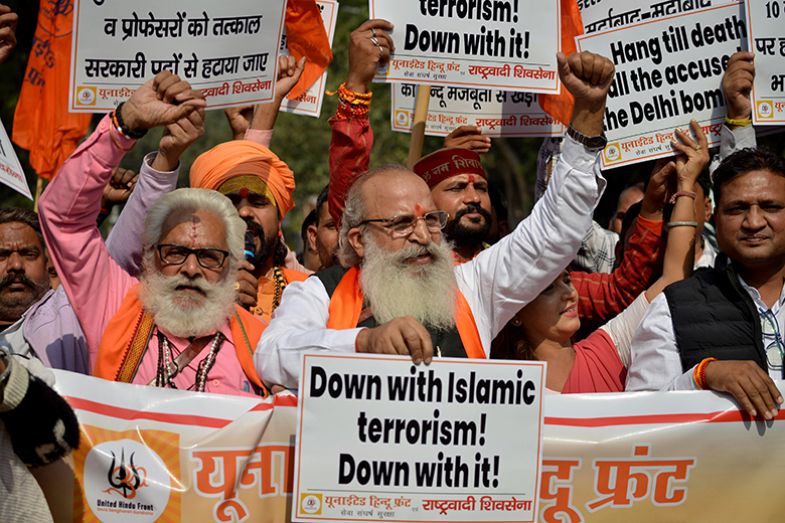
The Red Fort bombing also brings to the fore some very difficult wider issues for the Indian university. The serious financial lapses that have been uncovered at Al-Falah shine a light on one of the darkest ailments of modern India – the omnipresence of corruption, even among institutions that proclaim their ambition to be unblemished havens of intellectual ambition and ethical behaviour.
And while guaranteeing security will always remain a nightmare in a country where a rapidly expanding population drives unplanned growth in densely populated neighbourhoods, it is not unreasonable to assume that it would at least be a little bit easier to maintain security in monitored, enclosed spaces like universities and medical colleges. While students and other youth are routinely arrested for protesting against the authorities’ failure to address pollution, we have managed to allow university campuses where chemicals can be moved from the laboratory to make bombs that shatter that sprawling urban fabric.
This is also a delicate moment because counter-cultural thinking, including reasoned critique of the state and dominant political interests, is already an endangered act in India today, both on and off campuses. Left radicalism and its attendant violence, once-dominant in certain university spaces, have given way to tyranny of the religious right in the 21st century. Rampant political interference and manipulation have ensured that major public universities, such as the University of Delhi, are on a rapid downward slope intellectually. For their very survival, both public and private universities now need to be deeply complicit with those in power – and that complicity is enforced via various different levers of control. The Red Fort incident may well be used as a pretext to impose yet more levers – especially when it comes to universities that serve predominantly Muslim student bodies.
Once upon a time, the dream was that a university would be a safe space, fully respectful of both freedom of thought and the sanctity of life. Allegations of a white-coat terror cell at Al-Falah University have bared the ugly truth that this is no longer true in India – if it ever was. The tightening of the noose around the neck of free thought on campus has gone hand in hand with the loosening of material security inside it.
The Red Fort bombing is a tragedy, whose human cost will never be recovered. But how to ensure that something like this is never repeated? We can have a conversation with ideological extremists who believe in debate, but we have no language to confront for terrorists who stay silent and craft bombs. Nor, it seems, do we have the security measures to stop them from plotting right in the middle of college campuses.
Who knows, perhaps there are uncanny links between the quiet frustration that arises from the silencing of speech and the quiet mixing of the chemicals that go into the making of life-destroying bombs. Either way, it is clear that Indian academics and politicians alike need to reflect very deeply on their current practices if they want to ensure that something like this never happens again.
Saikat Majumdar’s most recent book is The Amateur: Self-Making and the Humanities in the Postcolony (2024).
Register to continue
Why register?
- Registration is free and only takes a moment
- Once registered, you can read 3 articles a month
- Sign up for our newsletter
Subscribe
Or subscribe for unlimited access to:
- Unlimited access to news, views, insights & reviews
- Digital editions
- Digital access to THE’s university and college rankings analysis
Already registered or a current subscriber?