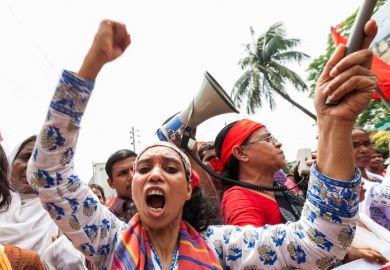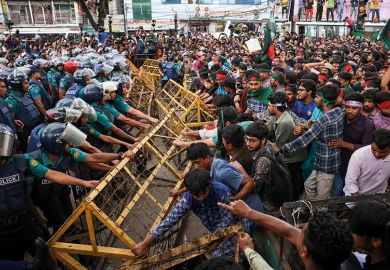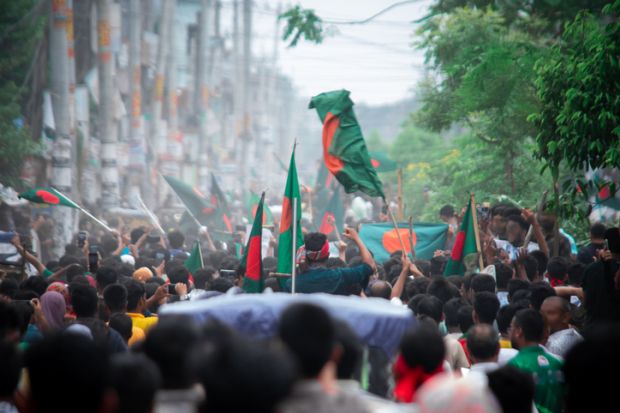
Bangladeshi academics fear gains made under the caretaker government formed following the 2024 student-led uprising could be undone by the country’s new government.
A general election held earlier this month delivered a landslide victory for the Bangladesh Nationalist Party (BNP), led by Tarique Rahman, returning the party to power after years in opposition.
Mohammad Rashed Alam Bhuiyan, associate professor of political science at the University of Dhaka, said there had been a brief period of greater openness under the interim administration formed after protests removed then prime minister Sheikh Hasina from office, but warned that political influence inside universities could quickly reassert itself under the new regime.
“After this election, our previous vice-chancellor resigned. The government will appoint a person who is closer to their political party,” he said. “I expect there will be more politically appointed people.”
Tariqul Islam, assistant professor at the School of General Education at BRAC University in Bangladesh, said that any governance reform could prove beneficial.
“There is potential for meaningful change in university governance under the new government, particularly if institutional autonomy and transparency in leadership appointments are prioritised,” Islam said.
“However, without strong structural safeguards, higher education institutions may remain vulnerable to political interference.”
Islam said that the country had long suffered from “political polarisation” constraining academic freedom and institutional autonomy, with “many academics” engaging “in self-censorship out of fear of professional or legal repercussions”.
This election followed a period of political turbulence. Although elections are constitutionally held every five years, this vote came just 26 months after the previous poll because of the student-led uprising in July and August 2024.
The protests began over government job quotas but escalated into a nationwide anti-government movement. The United Nations later reported that about 1,400 people were killed during the unrest. An interim administration took office in August 2024, pledging reforms and a credible election.
“To me, universities have been highly significant in the political developments leading up to the election. Students and faculty once again became central political actors, with campuses serving as key spaces for protest, debate and mobilisation,” Islam said.
“The youth-led July ’24 movement reflected deep frustration over governance, accountability, and economic prospects, making universities catalysts of wider political change rather than passive observers.”
Bhuiyan said the protests disrupted what he described as “a very patron-client political system, where the ruling political party and its student wing dominated the university”.
Residential halls, he added, were “captured by politically connected student wings”, with dormitories used to consolidate party control.
“We were in largely an autocratic government for the last 17 years since 2008,” he said. “The students who actually broke that embargo and came out to the streets – that’s a huge development.”
He argued that student mobilisation helped restore electoral credibility.
“Due to university students’ demonstration and participation, we could at least hold a peaceful election this year, or at least a free and credible election,” he said. But he warned that those gains could be reversed if party influence tightens again.
Beyond politics, structural constraints remain. “I teach a classroom of 150 students,” Bhuiyan said.
Heavy teaching loads and administrative duties limit time for research, while resource distribution “needs to be more neutral” and based “according to merit”, not political identity.
Although the government has said it will contribute 5 per cent of GDP to education, Bhuiyan said he had yet to see clear policy shifts to strengthen universities’ global competitiveness.
Bangladesh’s international academic standing, Islam added, will depend on whether “political stability, academic freedom and credible governance can be demonstrated”.
Register to continue
Why register?
- Registration is free and only takes a moment
- Once registered, you can read 3 articles a month
- Sign up for our newsletter
Subscribe
Or subscribe for unlimited access to:
- Unlimited access to news, views, insights & reviews
- Digital editions
- Digital access to THE’s university and college rankings analysis
Already registered or a current subscriber?