Australia’s smallest university has teamed up with a private education company to develop the country’s newest medical school and help resolve a dearth of general practitioners (GPs) in the bush.
Federation University has signed an agreement with New Medical Education Australia (NewMed), a Brisbane-based company headed by two veteran medical educators, to launch a course mainly designed for rural GPs.
If it proceeds, the project will be Australia’s 23rd medical school and arguably its most unique. NewMed, which claims more than 20 prominent medical academics on its staff, would effectively become Federation’s school of medicine.
The four-year postgraduate-entry course would be delivered online apart from three annual face-to-face “anchor events” at Federation’s main campus in the inland Victorian hub of Ballarat, and elsewhere around Australia. Practical training would take place in GPs’ clinics for the first three years and in hospitals for the final year.
NewMed says it has struck “primary care agreements” with geographically arranged clusters of GP clinics – each containing about six practices and accommodating up to 12 students – across Australia’s five mainland states.
The approach sidesteps a key problem in medical education, competition for placements, by delivering most of the practical training through regional GPs who do not currently host students. “We’ve got more placements than we need to commence the programme,” said Stephen Tobin, NewMed’s CEO and dean.
The company will offer stipends to clinics that host students, roughly matching the financial support provided through the government’s Practice Incentives Program. Participation could also provide a “pipeline” for future recruits, Tobin said. “If you took someone who was…highly motivated and gave them a good experience, you could have them coming back through your doors in five years’ time.”
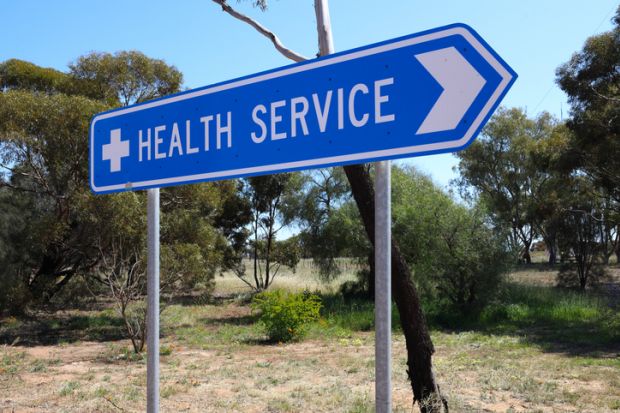
Many regional towns are desperately short of doctors, with placards outside GPs’ clinics pleading for staff.
It reflects a wider problem in a country that has an ageing population and cannot produce enough medical practitioners to meet its needs. Fifty-five per cent of the 9,000-odd newly registered doctors in 2024-25 were foreigners, according to the Medical Board of Australia.
Federation vice-chancellor Duncan Bentley said medical students who left regional communities often failed to return. “By enabling future doctors to learn where they live, this offers a transformative solution to the doctor shortage – particularly for GPs – in rural and regional Australia.”
First, it must win approval from the Australian Medical Council (AMC) before registering with the Australian Health Practitioner Regulation Agency. The partnership expects to submit its second submission for the two-stage AMC process during February, after passing the first stage late last year.
NewMed said it anticipated hosting AMC assessors later this year with a view to enrolling its first cohort of 95 domestic students in 2027.
Under the partnership, NewMed will provide the curriculum while Federation takes responsibility for ensuring quality and academic integrity, including oversight of academic governance processes and compliance with university policies.
The partnership also relieves NewMed of the obligation to obtain registration from the higher education regulator Teqsa, which last year declined NewMed’s application to become a university college, citing doubts about its “financial backing”. As a registered university with self-accrediting status, Federation does not need Teqsa approval.
Federation also has Department of Education approval to offer FEE-HELP, the government loan scheme covering the upfront costs of full-fee degrees. Most students at the proposed school will pay full fees.
Private Bond University and Macquarie University’s private medical school likewise charge full fees from domestic medical students. Some full-fee domestic places are also offered by the universities of Melbourne and Notre Dame Australia.
Tobin said his proposed school’s lack of a “big bricks and mortar setup” would not disadvantage students so long as they had access to committed GP supervisors. “A group of eight or nine students online [in] a…dynamic small group teaching session should work really very well.”
He said GPs’ clinics were good places to learn medicine because they gave students access to people of all different ages and socio-economic backgrounds with a range of health issues.
Tobin said Federation had “stacked up very favourably” in NewMed’s research into potential university partners because of its focus on outer urban and regional communities, its courses for allied health professionals, its research on cancer and hypertension, its interest in data management and its “strong” commitment to Aboriginal and Torres Strait Islander health.
He said the proposed school would also help address the ethical concerns around Australia’s reliance on overseas-trained doctors. “It’s only a small contribution but we think it’s a good way to start.”
Register to continue
Why register?
- Registration is free and only takes a moment
- Once registered, you can read 3 articles a month
- Sign up for our newsletter
Subscribe
Or subscribe for unlimited access to:
- Unlimited access to news, views, insights & reviews
- Digital editions
- Digital access to THE’s university and college rankings analysis
Already registered or a current subscriber?