Nicola Sturgeon has warned universities to “think carefully” about using the word “crisis” when discussing their ongoing financial challenges, blaming some of the issues in Scotland on the way devolution is structured.
Asked about the solution to university funding problems in Scotland, the former first minister said she was “unapologetic” in her defence of “a system where we don’t ask students to pay tuition fees upfront”, but rejected the notion that this was the same as “free fees”.
“Part of our problem is the terminology we use – ‘free education’. Education is not free. The question is: who pays for it and how is it paid for? My belief…is we fund public services through a progressive taxation system.”
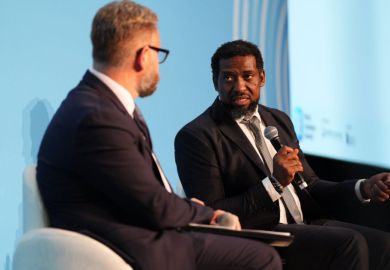
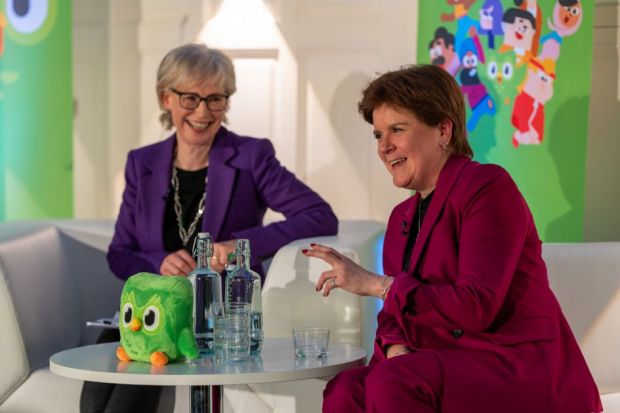
Speaking at an event in Glasgow organised by the Duolingo English Test, Sturgeon said the argument that those who don’t benefit from higher education shouldn’t have to fund it comes back to the design of the tax system, with those who earn more paying more.
The Scottish government recently announced a cross-party review of the nation’s university sector, but the Scottish National Party, which is predicted to win this year’s Holyrood election, has made it clear that it will not back down on state-funded tuition fees.
It comes as debates grow louder in England about the fairness of the student loan system, with chancellor Rachel Reeves defending the current system as a way of ensuring those who benefit most from higher education are paying for it.
“One of the controversial…things I did as first minister was reform the income tax system and ask people at the top end to pay more,” Sturgeon continued.
However, she said, Scotland has limited control over the design of the tax system as it is only able to adjust income tax, while other measures are controlled by the UK’s central government.
“We don’t have the wider tax powers to make this a much more balanced debate,” said Sturgeon, who is an ardent supporter of Scottish independence. “We’re having to raise money on very limited tax powers and the demand for the money we raise is…always going outstrip supply.”
She acknowledged other pressures on universities including the impact of Brexit and the downturn in incoming international students.
However, she continued, while “it’s important to point out the challenges” the sector is facing, “you have to…think carefully in any sector about how often and how quickly you use the word ‘crisis’ because that can have an impact…on perceptions of institutions”.
“We’ve got real strength in the higher education sector in Scotland, there are big challenges and big questions, but I think we will make a mistake if we allow ourselves to be blinded to the fundamental underlying successes as we try to navigate those challenges.”
Asked about Westminster’s updated international education strategy, released in January, Sturgeon conceded that the financial reliance by universities on international students “has probably got out of balance”.
“But we should be wanting to attract international students here for reasons other than finance,” she continued, referencing the demographic challenges Scotland faces as a result of its ageing population.
Speaking at the same event, renowned pollster John Curtice – also a professor of politics at the University of Strathclyde – warned that while research suggests there is sympathy for the higher education sector across the UK, there remains a sense that “it’s a bit of an ivory tower”.
He continued: “There certainly is very little understanding about the role of universities in the production and dissemination of research, and to that extent…there is still quite a job to do to say that universities are part of broader society.”
He said Labour’s move away from its historical target of 50 per cent participation in higher education should be seen as a “signal” to the sector, as should the public’s stance on international students, with divisions over whether the country should have more or less.
Universities “have enjoyed this enormous expansion”, he said. “Is it time to hang on to what you’ve got rather than necessarily think that this is something that’s going to get bigger and bigger and bigger?
“Universities are now part of the polarised political debate in our society,” he continued. “Reform voters and Conservative voters are much more likely to be sceptical about university education.”
Register to continue
Why register?
- Registration is free and only takes a moment
- Once registered, you can read 3 articles a month
- Sign up for our newsletter
Subscribe
Or subscribe for unlimited access to:
- Unlimited access to news, views, insights & reviews
- Digital editions
- Digital access to THE’s university and college rankings analysis
Already registered or a current subscriber?