Encouraging UK universities to double down on their research specialisms has been welcomed by academics at an institution which has put the health of local pensioners at the heart of its research strategy.
With ministers urging many institutions to stop being “generalists” and concentrate on “applied research in specific disciplines”, universities are under greater pressure to focus on areas of deep expertise, with the science secretary Liz Kendall warning research funding must not be “spread too thin”.
Recently announced reforms to the Research Excellence Framework’s environment section will also require universities to be more explicit about their research strategy.
While some university leaders worry this push towards specialisation may benefit larger research-intensive institutions as smaller universities are encouraged to go teaching-only in most subjects, some providers are embracing the policy shift by sharpening their focus on research fields related to their local community.
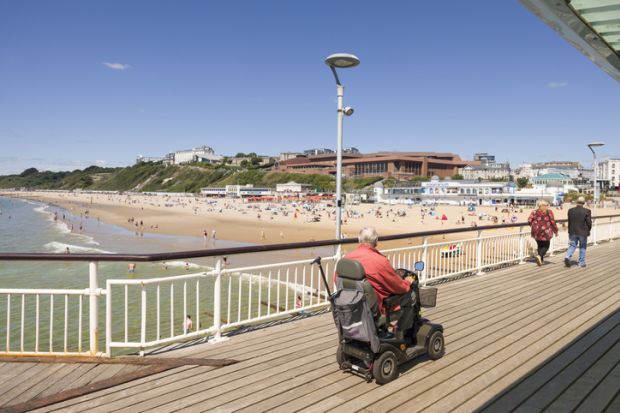
Among the six areas of research strength identified by Bournemouth University is improving the health and well-being of pensioners – a focus which reflects the area in and around the south-coast city being home to one of the oldest populations in the world.
“Our demographics are much older than other places – about 10 years older on average compared to the rest of the UK,” explained Tom Wainwright, professor of orthopaedics at Bournemouth, on the high numbers of over-65s on the south coast who, in partnership with regional hospitals and healthcare partners, have been involved in numerous projects at the university’s Orthopaedic Research Institute.
“When you set up a research institution you have to play to your regional strengths and one of our strengths is our demographics,” continued Wainwright.
Based on a study led by Bournemouth, which was recently published in The Lancet, over-65s with osteoarthritis who undertook group-based cycle classes enjoyed much better outcomes than those receiving one-to-one physiotherapy.
“If you think about post-92 universities we have to think smartly about our research and play to our strengths which includes engaging with our region,” reflected Wainwright.
“We can’t do research in every area or produce the world-leading studies on rare diseases that you see in London universities. But we can pick areas of research where we can excel, as we have in orthopaedics,” he continued.
On how the university’s research strategy increasingly aligned with Labour’s desire for more “mission-based” research – with the NHS selected as a high priority – Wainwright said: “The NHS is full to the brim.”
“We’ve shown recovery times and other outcomes are much better when people work as a community, which could be very important in reducing waiting times.”
Other Bournemouth research initiatives focused on older people include the Digital Coaching for Frailty (DIALOR) project which encourages older people with long-term health conditions to undertake health coaching using a mobile phone app while the university’s Ageing and Dementia Research Centre also examines how digital innovation could improve outcomes.
While digital connectivity may not be an issue for some of Bournemouth’s more affluent retirees, those living in rural areas find it much harder to engage, said Lee-Ann Fenge, professor of social care, who leads on the university’s dementia research.
“Public transport links and travel costs can make social care more difficult for rural areas but we also see issues of digital exclusion as these places don’t have that 5G connectivity. As we move health services away from analogue toward digital delivery these issues of exclusion are really important to examine,” she explained.
With Bournemouth’s health researchers working under the NIHR Applied Research Collaboration Wessex consortium, which recently received £16 million in funding, the university also engages with older people in less affluent towns such as Poole and Weymouth, plus the naval cities of Portsmouth and Plymouth, Fenge continued.
“We have the largest population of military veterans in the UK, and we know certain groups of people will have extra levels of social exclusion,” she explained. “Veteran well-being is incredibly important but seldom do we think about it in terms of ageing or dementia, but it’s important that we do,” Fenge added.
On Bournemouth’s focus on ageing-related research, she continued: “All of this fits the government’s policy particularly because these studies can influence policy at a national and even international level.”
“Being mindful of where we’re located is important for us as a university and it’s good [if policy] allows us to focus on this type of research,” she said.
Register to continue
Why register?
- Registration is free and only takes a moment
- Once registered, you can read 3 articles a month
- Sign up for our newsletter
Subscribe
Or subscribe for unlimited access to:
- Unlimited access to news, views, insights & reviews
- Digital editions
- Digital access to THE’s university and college rankings analysis
Already registered or a current subscriber?