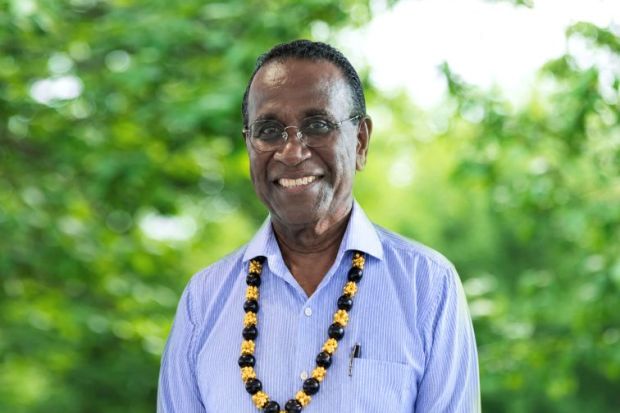
The world’s most pan-regional university has looked inward for a new leader, with the University of the South Pacific (USP) choosing Solomon Islands academic and civil servant Transform Aqorau as its next vice-chancellor.
Aqorau, an international lawyer and fisheries management expert, is current vice-chancellor of Solomon Islands National University (SINU). His father Frances was the country’s first university graduate.
Aqorau’s accession to the helm of USP comes at a pivotal time for the world’s most distributed university, which was established in 1968 to provide higher education for a dozen island nations scattered across an expanse of ocean larger than Russia. Last year, Papua New Guinea (PNG) – with roughly four times the population of the other countries combined – was admitted as the university’s 13th member state. USP’s Port Moresby campus is scheduled to open next year.
Aqorau’s appointment also reflects the growing prominence of the half-dozen national universities in USP’s catchment. Four of them – SINU, Fiji National University (FNU), the National University of Vanuatu and King’s International University in Tonga – were established last decade.
In a 2025 address to the Pacific Thought Network at the University of Otago, Aqorau said his “dream” was for SINU to launch joint degrees with other universities in the region and “beyond”, including USP. “These partnerships can…send a message that Pacific universities are not isolated ivory towers” he said. “We are part of a global knowledge commons and we contribute to it.”
Pacific universities’ relations with the global higher education commons have been troubled in recent years. Numerous expatriate vice-chancellors have left their posts and host countries after coming into conflict with local powerbrokers.
They have included FNU bosses Toby Wilkinson and Lyn Karstadt and University of Fiji leader Sushila Chang. Albert Schram, John Warren and most recently Ian Findlay all fled PNG after falling foul of local authorities.
Pacific natives have run into similar troubles while leading universities. Ganesh Chand, a Fijian of Indian descent, was removed as vice-chancellor of both FNU and SINU following conflicts with government figures. National University of Samoa vice-chancellor Le’apai Tu’ua ‘Ilāoa Asofou So’o resigned after he was suspended by the Samoan cabinet.
USP itself endured years of leadership turmoil after Kenyan-born vice-chancellor Pal Ahluwalia fell foul of members of the university’s council, the Fijian government and eventually staff unions. The university has been run by an “interim management group” since Ahluwalia left in September last year.
Aqorau is the right person to “lead USP into the next chapter of its history”, the council said. “Professor Aqorau brings a deep understanding of our region, a proven ability to bring Pacific countries together in pursuit of shared aspirations, and a strong appreciation of the university’s unique mission,” said pro-chancellor Siosiua Utoikamanu.
Aqorau’s term will be clarified “once contractual arrangements have been finalised”, the council said.
An advocate of regional cooperation, Aqorau says the Pacific must break its “cycle of dependency” on foreign aid. “Our forebears fought hard for the political independence of our island nations,” he told the Otago gathering. “Today, we must extend that fight to what I call the second wave of decolonisation – the decolonisation of development itself.”
He said universities were “incubators of the future” with “a transformative role on multiple fronts: creating future leaders grounded in ethics and culture, driving innovation and research to solve local problems, decolonising knowledge systems, and fostering regional connectivity”.
This can only happen if universities put their own houses in order by adopting a policy of “zero tolerance for corruption”, he said.
Register to continue
Why register?
- Registration is free and only takes a moment
- Once registered, you can read 3 articles a month
- Sign up for our newsletter
Subscribe
Or subscribe for unlimited access to:
- Unlimited access to news, views, insights & reviews
- Digital editions
- Digital access to THE’s university and college rankings analysis
Already registered or a current subscriber?