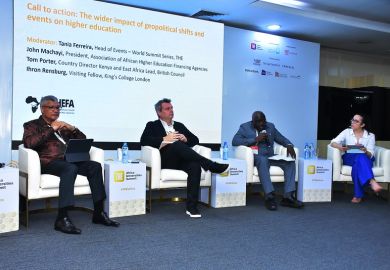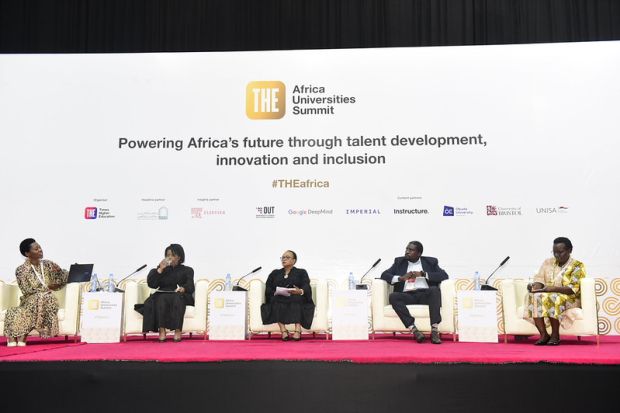
African universities need to capitalise on what makes them African and reclaim how they are presented to the rest of the world, university leaders have told a Times Higher Education event.
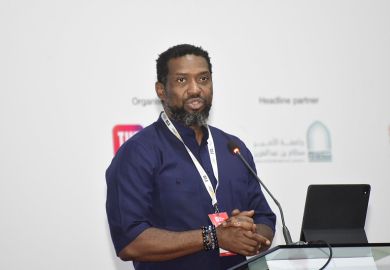
Kenneth Matengu, president of the Association of African Universities, said if universities on the continent were intent on decoupling the higher education system from Western ideals, more thought needed to be given to what this means in practice.
“We have to ask the questions, when we are talking of decolonising education, what we actually mean, and what does this look like when organising higher education? How does it work?” he said.
Matengu, also vice-chancellor of the University of Namibia, noted that there are more than 3,000 ethnicities and over 2,000 languages spoken in Africa, so institutions should consider “how they are represented”.
“Access to knowledge is limited to English, French and German. It’s limited to no more than 10 languages. So to what extent are we really Africanising this space? Our voices are limited in the systemic transfer of knowledge…even a paper written by a top academic in his own mother tongue has no chance of being published in a top-tier journal,” he told THE’s Africa Summit in Nairobi.
Matengu said Africa’s higher education leaders needed to ask themselves: “What do we actually have in Africa? African universities, or universities in Africa?”
“For us to be able to say that we have African universities, we have to be able to have knowledge of sovereignty. We are not completely in charge of our knowledge sovereignty at this stage, whether that is in terms of saying, what is actually valid knowledge? Are we taking into account African values?”
Puleng LenkaBula, principal and vice-chancellor of the University of South Africa, said African institutions must “take the future” and “reclaim the future”, adding that universities in the region needed to reclaim how they are presented.
“Africa does not suffer from a knowledge deficit, it suffers from a knowledge to real-world impact deficit,” she said, explaining that “multiplicities of innovations that come out from us” do not receive the impact they deserve.
“Can Africa produce knowledge? We know that the answer is yes. The real question is are African universities structured, resourced and empowered to transform knowledge that translates into meaningful innovation and social transformation?”
She said universities are “still reeling” from structural adjustment programmes introduced in Africa in the 1980s, which saw funding drastically cut and forced universities to become self-financing.
“That followed the role of universities in contributing to the development of projects and aspirations of the people of Africa. It also made African universities sites of basic research and not necessarily complex research.”
Register to continue
Why register?
- Registration is free and only takes a moment
- Once registered, you can read 3 articles a month
- Sign up for our newsletter
Subscribe
Or subscribe for unlimited access to:
- Unlimited access to news, views, insights & reviews
- Digital editions
- Digital access to THE’s university and college rankings analysis
Already registered or a current subscriber?