Efforts to ensure greater equality within universities should not create new imbalances, a South African politician has warned, highlighting that as more women have been entering higher education, male participation has been falling.
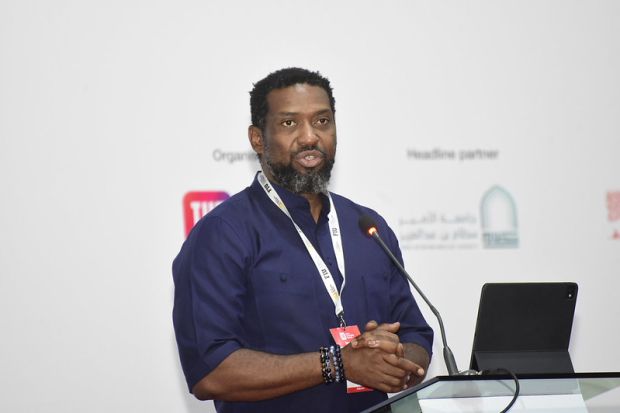
Speaking at Times Higher Education’s Africa Universities Summit in Nairobi, Buti Manamela, minister of higher education in South Africa, said equality, diversity and inclusion (EDI) needed to be at the heart of Africa’s higher education systems.
“There is no neutral education system. Education either reproduces the world as it is or helps us to transform it. That is as true for questions of gender and disability as it is for questions of class, race and power,” he said.
EDI matters are “not a side issue or a matter of institutional image”, Manamela said, but rather a matter of “who gets access to knowledge, who succeeds, who leads, who is left behind, and what kind of society our universities help to build”.
He highlighted a large disparity between men and women entering higher education in South Africa, and the opportunities available for these students after they graduate.
In 2023 in South Africa, there were 671,000 women in higher education, making up 62.7 per cent of students, and just 400,000 men, making up 37 per cent of students.
In the same year, public universities produced 220,000 graduates, of whom 64 per cent were women and 34.6 per cent were men.
Women are the majority in these areas, “but they’re not yet in power”, Manamela said. For when it comes to academic staff, the “picture changes completely”. In 2023, there were just 1,000 female professors, compared with 2,260 male professors, and the minister noted that “even in academia, it is still the case that a gender pay gap still persists”.
“So the pipeline has changed, but the summit of institutional authority has changed far more slowly. This is why EDI cannot be measured only at the entry point and must also be measured across the full chain of access, profession, completion, employment, leadership and also institutional power.”
However, he continued, the figures are “only one side of the story”. Manamela said the “correct question” is whether “our systems are producing gender equality and whether they are doing so for everyone”.
Men cannot be ignored in these conversations, according to the minister, and higher education institutions must ask the “uncomfortable question” of “what is happening to boys and men in the system where social conditions are pushing them away from sustained educational participation”.
“Gender equality must mean exactly that: equality. It does not mean one historical injustice giving way to another…imbalance. It cannot be celebrating female gains while ignoring male disengagement.”
But Africa is “not a one-gender story”, Manamela said, noting that in many parts of the continent women are on the whole vastly underrepresented across all levels of higher education.
He added that “disability cannot be thought of as an afterthought” and “must be understood as a core part of the system”. In 2023, the number of students with a disability who completed higher education in South Africa was 13,700, about 1.3 per cent of students – “a mark of how much work needs to be done”.
“Again, the problem is not only at admission level. It lies in the infrastructure, digital design and assistive technology – which proves to be extremely expensive – and staff training. But it is also whether institutions are built on universal accessibility, or based on the assumptions of a ‘normal’ student. Inclusion is not speech. Here, it becomes a question of desire.”
Consequently, African higher education should “stop treating equity as a matter of optics and start treating it as a measure of institutional justice”.
“The task is to not to choose between women and men. The task is to build institutions capable of producing equality for all.”
Register to continue
Why register?
- Registration is free and only takes a moment
- Once registered, you can read 3 articles a month
- Sign up for our newsletter
Subscribe
Or subscribe for unlimited access to:
- Unlimited access to news, views, insights & reviews
- Digital editions
- Digital access to THE’s university and college rankings analysis
Already registered or a current subscriber?