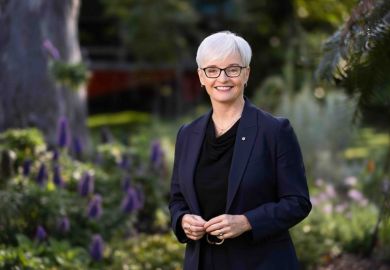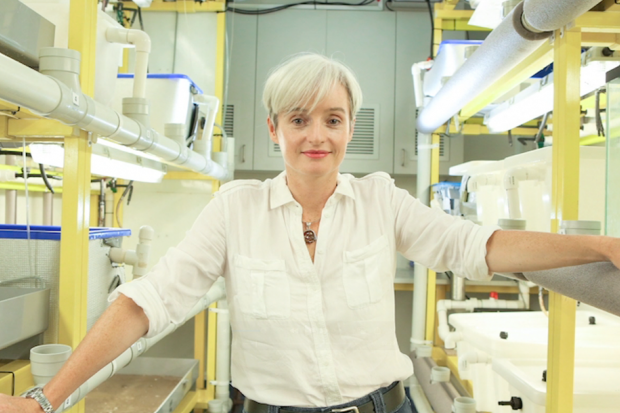
University of Melbourne vice-chancellor Emma Johnston was “still someone in the making” who would have “shaped significant reform” in Australian tertiary education if she had lived longer, an emotional commemoration ceremony has heard.
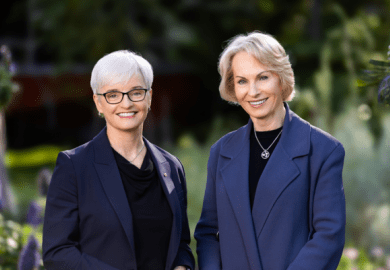
Melbourne chancellor Jane Hansen said the loss of the “remarkable young woman”, who died suddenly in December, had elicited “profound shock and grief” across the campus and sector “and far beyond”.
Hansen said the university had been thrust into “circumstances without precedent” by losing its first female vice-chancellor, less than a year after her “irresistible homecoming” to the institution where she had earned her degrees and served as student council president.
“We mourn not only the loss of an exceptional vice-chancellor at the height of her influence, but also the loss of a leader who was actively building, reforming and setting new standards here at the university and across Australian public life.”
Education minister Jason Clare said that while universities were “full of brilliant people”, Johnston had set herself apart with her “infectious energy”, smile, kindness, “the super-sized ambition and the super-small ego”.
“We still haven’t seen everything that she was capable of or that she would do. She was robbed of that, and so are we. It’ll be impossible to look at the ocean again and not think of our restless, vast and beautiful friend.”
Kylie Walker, CEO of the Australian Academy of Technological Sciences and Engineering, said Johnston had “lived at triple speed” and “packed in three or perhaps six careers”.
“At the age of 52 she had achieved the kind of stature and respect that rarely comes even to those who’ve had another couple of decades to build their leadership and momentum. She fundamentally changed the way that we think about and approach working harbours; the way that we understand the effects of extreme and catastrophic events; the way we lead research; the way we think of ourselves as a scientific workforce.”
Macquarie University environmental scientist Katherine Dafforn said Johnston had applied conceptual ideas of ecology to reveal how human activities affected the natural world. She had demonstrated that metal pollution inadvertently benefited invasive marine species, and led the first ecological experiments to show that dredging historically polluted sediments caused severe ecological effects above the seafloor.
“Her research informed policy and practice across Australia, New Zealand, the United States and beyond, and her work is cited in environmental management and policy documents worldwide.”
Johnston had also stood out for a sense of fun and a desire to connect people. At one conference, she had introduced her co-chair by noting his fondness for the movie Free Willy. At another, she had announced that her PhD student was in the market for a postdoctoral position, but also single and looking for a date.
Former Australian Universities Accord chair Mary O’Kane said Johnston had drawn on her ecology background to inform her approach to higher education and reinvent herself as a “policy wonk”. She had been “damning” of “rapacious recruitment” by institutions that could better serve disadvantaged students through “multi-university activity”, O’Kane said.
Johnston’s efforts at “saving the planet” began early, the commemoration heard. As a student at University High School, where she had won a music scholarship as an “accomplished flautist”, she successfully campaigned to save the soccer field from being turned into a car park. She visited occupied East Timor as part of a university student delegation and helped instigate the Australian intervention that ended political bloodshed and secured the territory’s independence.
“We were brought together by our mutual interest in issues important to young people of the day – defending the right to an education, supporting Indigenous voices, protecting the environment, promoting human rights for all and, of course, keeping the vice-chancellor accountable,” said husband Sam Maresh, who met Johnston as a fellow Melbourne student.
He said she had prioritised “quality family time”, setting expectations at work that she would be home for family dinners where possible. “Even as vice-chancellor, she tried to manage her diary to ensure family time.
“Our kids remained great supporters of their mum’s career. There was only one time she disappointed them – when she turned down an opportunity to be a contestant on Survivor.”
Register to continue
Why register?
- Registration is free and only takes a moment
- Once registered, you can read 3 articles a month
- Sign up for our newsletter
Subscribe
Or subscribe for unlimited access to:
- Unlimited access to news, views, insights & reviews
- Digital editions
- Digital access to THE’s university and college rankings analysis
Already registered or a current subscriber?