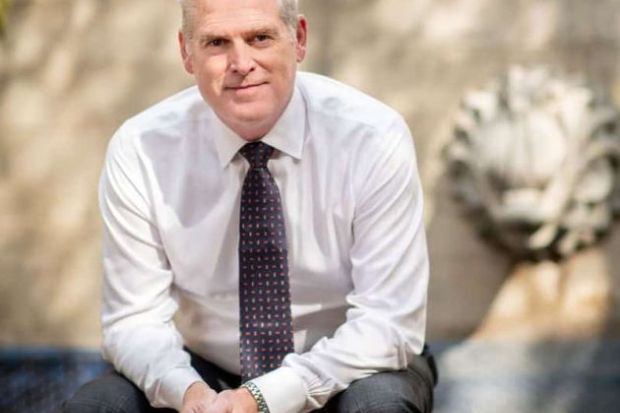
The “pendulum is swinging back” to a time of public mistrust about the benefits of cultural exchange and transmission, the president of the International House Association (IHA) has declared.
Shaun Carver, who leads a movement started in the 1920s to encourage “international fellowship among men and women”, has expressed concerns that people in the West are failing to see the “value” in overseas students coming to their country – in echoes of pre-Second World War society.
His comments follow a series of policy shifts in the UK that universities fear could reduce international student intake, including the incoming introduction of the international student levy, which will charge institutions £925 for each overseas student enrolled. Last week, it was revealed that applications for student visas during the peak month of August declined by 16 per cent year-on-year.
In the US, meanwhile, an immigration crackdown has involved a recent visa pause and an attempt – held up this week in the courts – to limit postgraduate students’ stay in the country to four years.
Founded in 1924 by YMCA official Harry Edmonds and his wife Florence, the IHA set out to house students from around the world to share their different cultural backgrounds. It opened its first International House in New York, with philanthropic support from the likes of financier John D. Rockefeller, Jr. Other houses followed, including at the University of California, Berkeley in 1930, a Paris headquarters in 1936 and one in Tokyo in 1952.
Speaking to Times Higher Education, Carver, who is also responsible for the International House community at Berkeley, said: “The International House movement was way, way ahead of its time, talking about desegregation. In Berkeley, in the area that we’re in, there are fraternities and sororities and faculty housing that was all segregated.
“They didn’t want people of colour in their neighbourhood...and I feel like the pendulum is swinging back towards those days again, where people look at these diverse communities and say, ‘We don’t want them in our neighbourhood. We don’t want them in our country...they’re taking resources from our students.’”
But at a time of increasing support for nationalist and anti-immigration movements, some are concerned that international students could be victims of the tension.
For Carver, those in higher education might be having overly insulated conversations about the issue. “We’re talking to ourselves in some ways,” he suggested.
“It’s really getting out into the public and advocating for these things which I think is the big step we need to take. It’s going into communities, going into cities, and...advocating for international education.”
He also argued that the experience of living in an international house can help dampen down any tensions. He admitted he expected “constant drama” when coming to UC Berkeley’s version, noting that the university is known for its student activism, but claimed the reality was very different.
“Whenever there’s any issue in the world, there’s likely a protest going on [about it] on campus, and our students will...go on both sides [of the protest],” he said. “And then they come back in the house and get on with their lives.” This is because they feel a sense of buy-in to their houses that means the “community comes first”.
And there is a lesson in that, he believes.
“If you look at [other] campuses, it’s not always the case,” he said. “You get a lot of close-minded people that show up and can’t believe there’s someone in their classroom that doesn’t hold the same values...and then they want to dox them, or ostracise them in the community...it’s chilling.”
Carver referenced the Foundation for Individual Rights and Expression’s college free speech survey, which records perceptions of how American universities support freedom of expression on campus.
Berkeley as a whole “sadly does not do very well”, he said. But when its international house community replicated the survey, pollsters found that 94 per cent felt comfortable sharing controversial opinions with fellow residents.
Carver attributed this to the IHA’s mission to foster intercultural understanding and dialogue, and to engage respectfully when sticky issues come up in conversation.
“That tells me...we’re creating an environment for people [where] it is safe to ask questions, to say things that may be unpopular, and that’s the direction we need to be heading in in society,” he said.
Register to continue
Why register?
- Registration is free and only takes a moment
- Once registered, you can read 3 articles a month
- Sign up for our newsletter
Subscribe
Or subscribe for unlimited access to:
- Unlimited access to news, views, insights & reviews
- Digital editions
- Digital access to THE’s university and college rankings analysis
Already registered or a current subscriber?