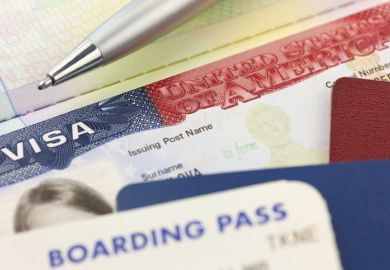
Asian international students caught up in a US visa pause face a “hectic scramble” to start their studies, with some having to defer places because of the ongoing delays.
A temporary halt to immigration visa interview appointments at embassies worldwide was introduced by the US State Department at the end of August.
Consular officers are receiving updated training on new “public charge” rules that will see applicants who are seen as likely to be dependent on the state not granted a visa.
The State Department has not issued a date for when the pause will be lifted and interviews will resume.
International students were already facing issues obtaining US visas as a result of enhanced security checks.
The problems are impacting the travel and study plans of students with offers to study at US universities. Indian and Chinese nationals, who comprise the largest populations of international students in the US, are particularly impacted.
Binita Parekh, a Bengaluru-based expert in overseas education, told Times Higher Education that some of the students she is working with “had already resigned from their jobs after securing admission to prestigious universities”.
“Despite trying to book visa appointments since May 2026, they couldn’t secure slots in time. Several students had already made major personal and financial decisions – quitting their jobs, securing and disbursing education loans, and planning an international move,” Parekh said.
“One student, admitted to the University of Southern California, received an emergency visa appointment in the last week of August 2026. Fortunately, his visa was approved, and he had to pack and leave India within 48 hours of receiving his passport.
“Several universities are allowing international students to arrive seven to 12 days after the official start of the term, which has given some students a narrow window to make it work. However, for those still waiting for appointments at that point, it becomes an extremely hectic scramble, and not everyone makes it. Some have had no option but to defer to a later term.”
Parekh said that the issues were adding to the appeal of alternative destinations such as the UK, South Korea and Japan.
“Indian students are becoming more cautious, actively exploring the UK and Europe, and increasingly no longer treating the US as their first choice,” she said.
Pushkar, director of the International Centre Goa, agreed that although the US used to be the “number one choice” for Indian students – offering healthy salaries, job prospects and ultimately a path to US citizenship – that trajectory has become “more challenging”.
“Students are looking at other options,” Pushkar said, citing Germany and France as countries offering “clear opportunities” for a path to citizenship.
“Because whether one admits it or not, one very clear motivation to go to the UK, US, Australia and New Zealand is to settle down and live there permanently.”
As more Indian students opt for alternative destinations, this will inevitably broaden their appeal too, Pushkar added.
“The kind of monopoly that the Anglo-Saxon countries had is probably gone, and that is of their own doing in the sense that the UK, but probably even Australia, overbuilt and became extraordinarily dependent on international students to run the university in financial terms,” he said.
There are also reports in the South China Morning Post that Chinese students have been forced to defer enrolment until next year.
However, Richard Coward, founder and CEO of education platform Global Admissions, said that despite the issues, the US will retain an appeal.
“The US economy is the world’s leading economy and there are opportunities for higher salaries.
“From what I’m seeing, careers are the number one factor for students in choosing where to study in all destinations.”
But Coward recognised a sustained trend of Chinese students opting to study closer to home. As of 2025, Chinese students in Japan reached a high of 131,097, a figure just short of the 143,200 Chinese students enrolled at UK universities in the 2024-25 academic year.
Register to continue
Why register?
- Registration is free and only takes a moment
- Once registered, you can read 3 articles a month
- Sign up for our newsletter
Subscribe
Or subscribe for unlimited access to:
- Unlimited access to news, views, insights & reviews
- Digital editions
- Digital access to THE’s university and college rankings analysis
Already registered or a current subscriber?