Poland is on track to increase its domestic research spend but still has “much to do” to ensure an equitable share of European funding, according to the minister of science and higher education.
Speaking to Times Higher Education after announcing a new partnership with the University of Oxford, Marcin Kulasek said Polish researchers building stronger ties abroad was key to achieving his ambitions.
He said the Oxford-Poland Hub, a new initiative between the country and the top-ranked UK university, aims to bring researchers from the two countries closer together.
“The hub is not a short-term initiative. It is an investment in relationships that will benefit both countries for many years to come, both academically and socially,” he added.
The new partnership is backed by £900,000 over three years to support joint research projects and academic exchanges between the UK and Poland, covering the humanities and social sciences.
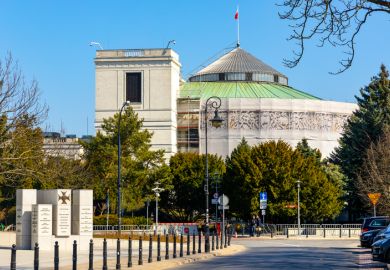
But despite his ambitions abroad, researchers back home in Poland have expressed growing frustration with the level of funding for science and research in the country. In May, hundreds of Polish academics protested outside the parliament in Warsaw and called for an increase in spending on research and development from 1.08 per cent to 3 per cent of gross domestic product (GDP) by 2030.
When Donald Tusk’s government came to power in Poland about three years ago, academics were hoping that the new coalition would bring more funding after eight years of conservative rule. While research funding has increased under the new government, the scientific community has repeatedly warned that the sector could “vanish” if more money is not allocated to support academics.
Kulasek, who has been in the job for two years, said he acknowledged the researchers’ frustrations, adding that there was an understanding within his ministry that more investment was needed.
“First, we have to reach the European average of 2.2 per cent [of GDP on research and development],” he said. “In five years, we will reach this 2.2 per cent and afterwards, we will be trying to get to the other [3 per cent] threshold as soon as possible.”
The government is also hoping to raise Poland’s standing in European science, but with the war in Ukraine, there are competing demands on the country’s public finances, the minister said.
“We have to remember where Poland is located and our geopolitical situation. We’ve got the war on our eastern border, so the security and safety of Polish citizens is the government’s overarching priority,” Kulasek said. “But at the same time, as security and safety are important for Poles and also for Europe, we do not forget that it is very important to invest in science and research.”
Poland is also one of the European Union’s “widening countries” whose researchers have historically secured a smaller share of European research grants. “We are convincing Polish scientists, and also talking with the European Commission, about how we can make it easier for Polish scientists to access these grants, these programmes within Horizon Europe,” Kulasek said, adding “we still have much to do”.
Reflecting on his visit to Oxford, Kulasek said he was surprised by the number of Polish academics already working at the university. “Some of the [Polish scientists and professors] didn’t know each other. We’re already building a community and we saw that Polish scientists were already working with British scientists. They’ve been contributing to science already. So what the Oxford-Poland Hub will do is bring it to another level.”
Register to continue
Why register?
- Registration is free and only takes a moment
- Once registered, you can read 3 articles a month
- Sign up for our newsletter
Subscribe
Or subscribe for unlimited access to:
- Unlimited access to news, views, insights & reviews
- Digital editions
- Digital access to THE’s university and college rankings analysis
Already registered or a current subscriber?