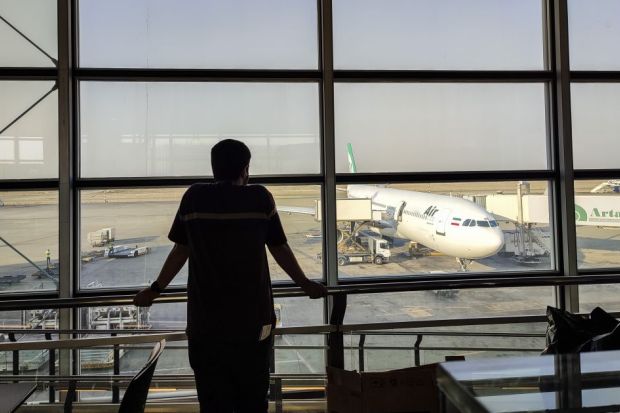
Scholars have warned that universities and researchers in Iran face further isolation as draft legislation that would criminalise academic collaboration with international universities advances through parliament.
The proposed “anti-infiltration” bill would give Iran’s intelligence agencies the power to monitor cooperation with foreign entities and would criminalise routine academic activities including co-authorship or giving interviews to foreign media.
Last week, members of parliament approved several articles in the draft bill that specify that it must be proven that an individual was aware of a foreign connection before they are prosecuted.
The general framework of the bill was approved in August, and the bill will be submitted to the Guardian Council for constitutional approval before it becomes law.
The proposed legislation has drawn widespread criticism from scholars and international bodies outside Iran, including the UN Independent International Fact-Finding Mission on Iran, but domestic opposition has also begun to emerge.
Shahin Akhondzadeh, Iran’s deputy minister of research and technology at the Ministry of Health, has said restricting engagements with international institutions risks compromising the country’s scientific and research capacities.
Negar Partow, vice-president of the International Community of Iranian Academics and a senior fellow at Indiana University’s Center for the Study of the Middle East, said the progression of the anti-infiltration bill was “a major problem and a pressing issue”.
“Before this bill, Iranian PhD students had to have some kind of published article with an international journal to be part of PhD programme,” she explained.
Under the proposed legislation, Iranian researchers would face prosecution if they published articles in international journals without state approval.
“Even now, if you are a co-author, if you collaborate with an Iranian scholar, you can put them in serious danger.”
Partow said fear of the Iranian regime continues to grow and “the pressure on universities has increased”, citing state tactics such as student arrests and expulsions.
However, Alireza Qaiumzadeh, research professor at the department of physics at the Norwegian University of Science and Technology (NTNU), said “restrictions outside Iran” were a “more immediate and tangible source of academic isolation” than the proposed bill.
He denied that the proposed bill was the “most pressing concern” among Iranian colleagues, while recognising that it “could certainly make matters worse”.
“What worries them [colleagues] more are the actual barriers they encounter when trying to maintain scientific ties with the US and Europe…These include difficulties obtaining visas to attend conferences and research stays abroad or take up academic positions abroad, even after receiving formal offers.
“Securing a PhD or postdoctoral position does not necessarily mean being able to obtain a visa or access the laboratories and projects needed for the work. Difficulties accessing international language exams create another obstacle.”
One Iranian scholar based in Europe endorsed the view that academics in Iran face “so much trouble connecting to the international scientific scene already” in addition to the domestic crackdown.
“The most important limitation that I have experienced, and that I know many other Iranian scholars are experiencing, is the limitation of other governments banning us from being in contact with the international – or, more specifically, European and American – scientific scene,” they said.
The Iranian scholar, who spoke to Times Higher Education on the condition of anonymity, was set to study in the US but could not obtain a visa. They went on to secure a position at a highly ranked university in western Europe, which they conducted from Iran, but could not travel to international conferences.
“I know there are many Iranian scholars who also don’t participate in international conferences…because of these visa issues...almost all Iranian scholars have had the same problems getting visas…since 2024.”
The scholar alleged that “universities would avoid you if they knew you had prior problems with visas”, adding that: “I know my supervisor…would not risk accepting another student or postdoc from Iran any more because of my case.”
Register to continue
Why register?
- Registration is free and only takes a moment
- Once registered, you can read 3 articles a month
- Sign up for our newsletter
Subscribe
Or subscribe for unlimited access to:
- Unlimited access to news, views, insights & reviews
- Digital editions
- Digital access to THE’s university and college rankings analysis
Already registered or a current subscriber?