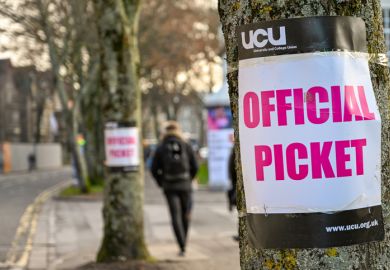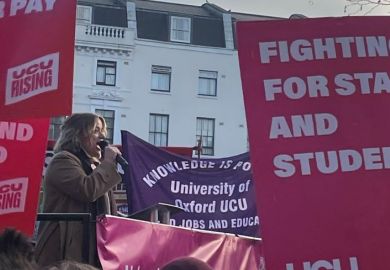
Staff pay at UK universities that do not participate in collective bargaining has risen marginally above the national offer, while the national award is expected to be delayed as negotiations with unions continue.
This year’s national negotiations with the Universities and Colleges Employers’ Association (Ucea) resulted in a final offer of 2 per cent – up on the 1.4 per cent offered last year but far below the 7 per cent that the unions had been pushing for.
The pay award comes after a year of ongoing job cuts and a failed attempt by the sector’s unions to launch national industrial action over pay.
The University and College Union (UCU) has confirmed that it will consult with members over the offer and will recommend staff reject it.
However, Ucea said that the pay award was expected to be delayed and would have to be backdated because the dispute resolution process with the unions was ongoing.
Ucea chief executive Raj Jethwa said: “Ucea made its full and final offer on 15 May, nearly two months ago. For UCU to begin consulting on our offer only at this stage means that staff will inevitably miss their 1 August pay uplift.
“Any recommendation to reject our pay offer is obviously disappointing, given the widespread recognition of the sustainability challenges facing institutions, including among trade union colleagues.
“The 2 per cent pay uplift is the best we could offer given the severity of the financial pressures facing the sector. But the final offer included many other important elements, including our commitment to progress a review of the pay spine itself.”
However, Ucea noted that progress is still being made on the non-pay elements of the offer, and that the trade unions have agreed to participate in negotiations on the review of the pay spine.
Outside the national agreement, Nottingham Trent University, which does not participate in collective bargaining, said it had agreed a two-year deal with its unions, which will see staff receive a “minimum” pay increase of 2.1 per cent from 1 August 2026 – fractionally above the national rise.
Pay will then increase 2 per cent from August 2027, with staff seeing a minimum 4.1 per cent increase over the next two years.
The university, whose former vice-chancellor Edward Peck often argued for the benefits of being outside the pay negotiations, said it had also enhanced a number of benefits, including increasing its minimum paid annual leave allowance.
Meanwhile, Queen’s University Belfast is coming to the end of its multi-year agreement, after being forced out of the national negotiations.
Staff will receive a 3.5 per cent uplift from August, while the new agreement for 2027-2030 will see pay increase by 3 per cent in 2027, 3 per cent in August 2028, and 3.8 per cent in August 2029 – a total of 10.12 per cent over the three-year period.
A spokesperson from the UCU branch said the multi-year agreement would allow union members to look at “longer-term planning”.
“Because we have negotiated another multi-year deal for 2027-2030, we can now focus on the other problems beyond pay that are facing the sector, namely workload, casualisation and EDI,” they said.
Others are not so pleased with the outcome of locally agreed pay offers.
Northumbria University offered staff a one-off payment of between £8,000 and £12,000 to give up their Teachers’ Pension Scheme (TPS) pension in favour of transferring to the Universities Superannuation Scheme, in a move Northumbria said could save it up to £11 million a year.
Those that remained on the TPS were originally told that they would have their pay frozen and would not be eligible for a pay rise for the foreseeable future because of the cost of their pension to the university.
However, the university has since announced that those on the USS pension will get a pay rise of 3 per cent, while staff on the TPS have been offered a “one-off, non-consolidated, non-pensionable payment equivalent to 1 per cent of an individual’s annual salary”, which will be taxable.
Professional service staff will receive the national uplift of 2 per cent.
Adam Hansen, chair of Northumbria’s UCU branch, said that the 1 per cent increase for staff on the TPS “was not even a tip”, and expressed his concerns over academic staff having been taken out of the national agreement.
“Paying staff differently for doing the same work not only sets up all kinds of potential equality issues, to do with gender or long-term illness, for example, but also means that students will be being taught by people with very different levels of reward and motivation. It corrodes the very idea of a university, terminally exhausting goodwill – the sector's secret fuel,” Hansen said.
“National bargaining isn’t perfect. But when management rip their workers out of the protections afforded by national bargaining, it means we are entering a Wild West,” he said.
A spokesperson for Northumbria University said that although the balance between salary and pension contributions may differ depending on the pension scheme chosen, “the overall value of the package is intended to be broadly equivalent”.
“The national collective pay bargaining process determines salaries only – it doesn’t allow any differentiation based on pension scheme nor does it offer protections – so our approach requires the university to negotiate pay increases for academic colleagues locally this year,” they said.
They said the university intends to “resume full participation” in the national negotiations “as soon as we have been able to address the high costs of the TPS”.
“We remain committed to offering competitive salaries that keep pace with sector increases. The recently announced reduction in the TPS employer contribution rate from April 2027 will accelerate the equalisation of pay between academic colleagues participating in the two schemes.”
Gregor Gall, visiting professor in industrial relations at the University of Leeds and affiliated research associate at the University of Glasgow, said although most of the national and local pay offers are “considerably below” inflation rates, “it is nonetheless notable that pay offers have been made at all in the situation of widespread deficits and job cuts”.
“This suggests either that the deficits have been somewhat over-egged or that the job cuts are starting to positively recalibrate institutions' finances. However, it is still likely that more institutions will contemplate ceding from the national pay award in this context,” he said.
Roger Seifert, emeritus professor of industrial relations at Wolverhampton University, said multi-year deals – agreed by both Nottingham Trent and QUB – “take the risks for all sides out of the situation for the period of the agreement”.
UCU was approached for comment.
Register to continue
Why register?
- Registration is free and only takes a moment
- Once registered, you can read 3 articles a month
- Sign up for our newsletter
Subscribe
Or subscribe for unlimited access to:
- Unlimited access to news, views, insights & reviews
- Digital editions
- Digital access to THE’s university and college rankings analysis
Already registered or a current subscriber?