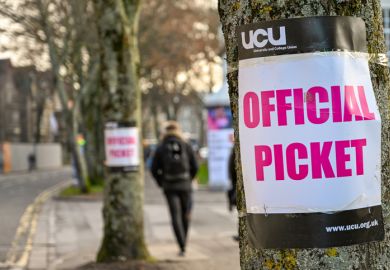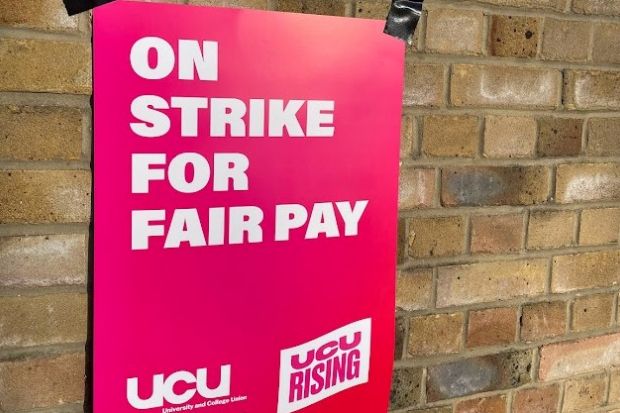
UK higher education unions have demanded a pay rise of almost 7 per cent for a second year in a row.
Revealing their claim for the 2026-27 round of national pay bargaining on 10 March, staff bodies including the University and College Union (UCU) called for all points of the pay spine to increase 3 per cent plus the Retail Prices Index (RPI) of inflation, which currently stands at 3.8 per cent, or £3,000, depending on which is greater.
Employers said the claim would be “extremely challenging” but promised to engage in “productive and constructive negotiations on a meaningful pay uplift” for university staff.
The central ask of the unions comes after they submitted a similar request last year of at least RPI (at the time 3.6 per cent) plus 3.5 per cent, or a flat rate increase of at least £2,500.
Last year’s negotiations, however, resulted in the Universities and Colleges Employers Association imposing its pay offer of just 1.4 per cent for most staff.
Despite this being the lowest pay award since 2020, a significant number of universities told staff they were unable to afford the pay rise.
This year, the unions are also calling on the employers’ association to increase minimum wage to £15 an hour and for all higher education institutions to become Foundation Living Wage employers.
They reiterated calls to review the pay spine and proceed with joint work on non-pay items including contract types, workload and equality pay gaps, which was paused last year after the unions announced a national industrial action ballot on pay, which was ultimately unsuccessful.
Unions also demand that Ucea works with them to lobby the UK government on higher education funding reform, ensuring all Ucea members adopt redundancy avoidance policies and implement policies on non-renewal of fixed-term contracts.
The unions write that staff “have faced several years of significant and successive real-terms pay cuts”, resulting in “worsening living standards for university staff”.
Staff on the lowest pay bands are now earning 19.5 per cent less than they did in 2011-12 in real terms, they note, and staff on higher pay bands are earning 30 per cent less than they did in 2011-12.
Universities are “increasingly failing” to implement the pay award in full despite being Ucea members, the unions added, leaving some staff to face several months of delays in receiving their award and without it being backdated. “We are clear that all university employers must pay the award in full in August”.
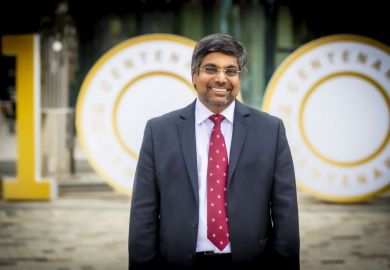
Ucea’s chair and vice-chancellor of the University of Leicester, Nishan Canagarajah, previously insisted that if it were to increase the pay uplift, “clearly there will be job losses to meet that pay rise” but the unions disputed this.
“We know that there is no trade-off between pay and jobs: on the contrary, below inflation pay awards have been accompanied by mass job cuts, unsustainable workloads, lack of career progression, lack of job security and deteriorating employment conditions,” they write.
The unions continue: “We expect Ucea to work together with us to tackle these issues in the upcoming negotiation meetings. Addressing the multiple crises facing higher education will require university employers to work with us for the benefit of the wider sector.”
UCU general secretary Jo Grady accused vice-chancellors of engaging in “academic vandalism, cutting thousands of jobs and hundreds of courses; hollowing out higher education into a shell of what it should be”.
She said Ucea “now needs to work with us to stabilise the sector through protecting jobs and raising pay” or risks “driving the sector to a point of no return”.
In response, Ucea chief executive Raj Jethwa said higher education institutions were “struggling with challenges on several fronts, including economic uncertainty and changes in government policy” and therefore “the sector will see this claim as extremely challenging”.
“Increasing numbers of HE institutions face financial deficit and difficult restructuring decisions. Despite these challenges, employers are committed to engaging in productive and constructive negotiations on a meaningful pay uplift for their valued employees without adding to the existing financial pressures. This in the interests of all this sector serves,” Jethwa added.
Register to continue
Why register?
- Registration is free and only takes a moment
- Once registered, you can read 3 articles a month
- Sign up for our newsletter
Subscribe
Or subscribe for unlimited access to:
- Unlimited access to news, views, insights & reviews
- Digital editions
- Digital access to THE’s university and college rankings analysis
Already registered or a current subscriber?