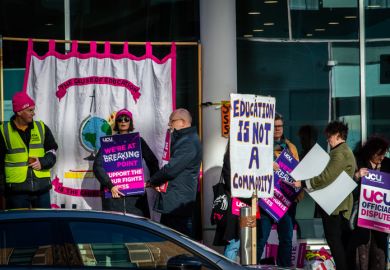
Annual pay talks have concluded with employers offering UK university staff a rise of 2 per cent, warning that “the near future looks bleak” for several institutions.
The Universities and Colleges Employers Association (Ucea) has announced its “full and final” pay offer for 2026-27, warning trade unions that there continues to be a “challenging financial backdrop”, with liquidity levels in the sector “set to worsen further”.
A letter sent at the end of the three scheduled meetings held as part of the pay review process outlined a proposal that would see a 2 per cent uplift implemented for most staff from 1 August 2026.
The offer is a slight improvement on last year’s rise of 1.4 per cent for most staff, which was implemented by universities despite both sides failing to reach an agreement.
The University and College Union (UCU) and the other sector unions had been pushing for a pay uplift of 3 per cent plus the Retail Prices Index (RPI) of inflation, which would equate to a rise of roughly 7 per cent in total, or £3,000, depending on which was greater.
A spokesperson for UCU said the offer will “leave our members poorer as inflation soars”.
But in his letter, Ucea’s chief executive Raj Jethwa writes: “As you will be aware the sector’s financial position remains worrying, as reflected in the House of Commons Education Select Committee report…For many institutions, both domestic and international student recruitment remains challenging and for several institutions the near future looks bleak.”
Universities will continue to be able to defer the pay award by up to 11 months, without back pay, if it is “determined to be in the wider interests of the institution’s sustainability or due to immediate cashflow issues”.
Ucea rejected calls by the joint unions to make universities living wage employers, as “it is a matter for individual institutions to determine” and also rejected calls to introduce a minimum wage rate of £15 per hour. The association said the pay offer “is at the limit of the sector’s affordability” and consequently this request “[was] not possible”.
It reaffirmed its commitment to a joint review of the sector pay spine and committed to “time-limited negotiations” to seek an agreement, which if reached would be introduced from August 2027.
It agreed to take forward further discussions, outside the pay negotiations, on career pathway guidance for professional services staff, and proposed updating its guidance on job security to emphasise “good practice being followed by employers in managed restructuring and redundancy exercises”.
Nishan Canagarajah, chair of Ucea, said the magnitude of challenges in the sector “faced by both sides [is] extremely testing”.
“This full and final pay offer results in a significant financial challenge for the [higher education institutions] we represent and we appreciate the sector support for this pay uplift. But we also acknowledge and understand that for some HEIs this uplift will simply not be possible. Unfortunately, financial circumstances have deteriorated further since the consultation at the start of the year.”
Raj Jethwa, Ucea’s chief executive, added that the uplift does not “reflect the true value employers place on staff, but unfortunately it is the best we can offer given the severity of the financial pressures facing the sector”.
“We believe that our trade union colleagues are equally concerned by these sector challenges. Increasing numbers of HE institutions face financial deficit and difficult restructuring decisions and so the final offer considered this.
“I would add that we have had productive discussions and negotiations which have helped employers to make offers on a number of items included in the unions’ claim.”
The UCU spokesperson said: “Our sector is in absolute crisis. University staff are facing an unprecedented level of redundancies – being forced through by vice-chancellors whose focus is on anything but education provision.
“This offer will do nothing to protect our members from these cuts. Nor does it take account of the destruction of workers’ terms and conditions being gleefully carried out by some universities, including the use of sham subsidiary companies to erode pension provision.
“The offer on pay will also leave our members poorer as inflation soars.
“Ucea needs to stop trying to manage the decline of our once great sector and should instead push vice-chancellors to use reserves to protect jobs and student provision. It should join forces with us to lobby government on fairer funding for higher education and to lift international visa restrictions for staff and students.”
Register to continue
Why register?
- Registration is free and only takes a moment
- Once registered, you can read 3 articles a month
- Sign up for our newsletter
Subscribe
Or subscribe for unlimited access to:
- Unlimited access to news, views, insights & reviews
- Digital editions
- Digital access to THE’s university and college rankings analysis
Already registered or a current subscriber?