When, one night in May, a few lines appeared shortly after midnight in Turkey’s Official Gazette ordering the closure of Istanbul Bilgi University, observers immediately worried that the presidential decree marked a revival of the fierce crackdown on Turkish higher education that occurred a decade ago.
Students and staff at Bilgi, one of Turkey’s oldest private universities, with a strong reputation, a large student body and extensive international links, told Times Higher Education that there had been no warnings that the institution’s licence to operate was in danger of being revoked.
“Most people were sleeping when the decree dropped, just a week before the academic year was coming to an end,” said Yaman Akdeniz, a law professor who was on sabbatical at that time. “Many colleagues and students went to the university, but there were no updates, no official message or reassurance…that this was not happening.”
The edict cited a law allowing the closure of an educational institution if “the expected level of education and training...is insufficient”. But the law’s invocation in this case was widely criticised as the university had recently passed its quality accreditation checks.
The move quickly made the international news, with several reports drawing attention to the university’s liberal reputation. The implication was clear: that this could be another example of the country’s president, Recep Tayyip Erdoğan, forcing the closure of a higher education institution that he saw as an ideological enemy, as he did following an attempted coup against his rule in 2016. In the lead-up to the country’s next presidential election, scheduled for next year, that suggestion resonated.
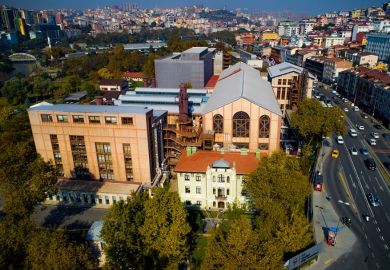
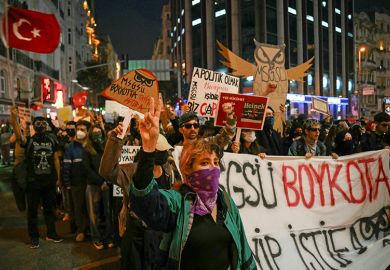
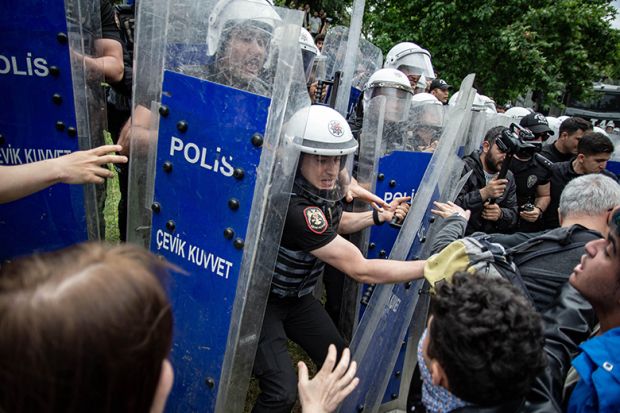
Then there was the huge disruption that the edict – which came in the middle of exam week – would cause to Bilgi students’ education. Many of them gathered on the university’s main SantalIstabul campus (one of four in the city), located on the site of the Ottoman Empire’s first urban power plant. Some stayed through the night, not knowing what else to do. The next morning, riot police arrived and water cannon vehicles were stationed outside to stem the growing protests. A fierce and potentially prolonged clash looked imminent.
What happened next, however, was as surprising as the sudden closure notice. Just three days after the closure edict, a second decree appeared in the Official Gazette reversing it.
President Erdoğan had “carefully reassessed” his initial decision “in line with the strong commitment to preventing any hardship for our students, families, and university staff”, explained the head of Turkey’s Council of Higher Education, Erol Özvar, on X.
This was a startling reversal for a government that rarely backs down in the face of protests and has a long history of cracking down on universities and academics that it sees as antagonistic to it.
For instance, when, in January 2016, more than 2,000 academics – who came to be known as the “Academics for Peace” – signed an open letter urging the government to halt military operations against Kurdish civilians and a negotiated end to the conflict with the Kurdistan Workers’ Party (PKK), many of the signatories were summoned by police within days and prosecuted for spreading “terrorist” propaganda. More than 500 of the signatories were ultimately banned from public service and were dismissed or resigned from their university positions, while nearly 200 were sentenced to prison, according to data provided by Academics for Peace.
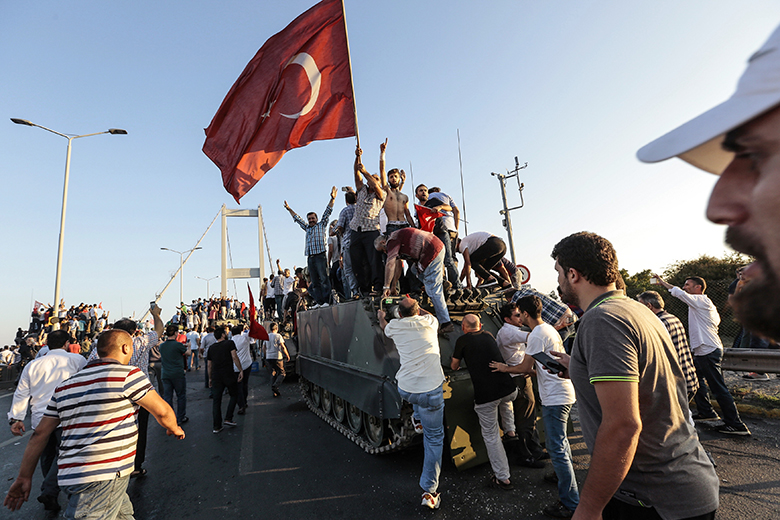
Then there were mass purges that followed a failed coup d’état by a faction of the Turkish military later in the same year. A state of emergency was declared, during which Erdoğan claimed the right to hire and fire university rectors. Under these measures, nearly 6,000 academics were expelled, according to Human Rights Watch, and 15 universities were shut down.
So does the reversal of the closure decision mean that the Turkish government has decided, on reflection, to take a less aggressive stand with regard to political opposition – perhaps with a view to avoiding the fate of fellow right-wing autocrat Viktor Orbán, who was swept from power in Hungary earlier this year by a united opposition having spent a similarly long time in office – during which he too repeatedly clashed with universities?
Not necessarily, commentators suggest. In fact, rather than signalling any political shift, most see the Bilgi incident as more cock-up than conspiracy.
Türkiye Today, a Turkish newspaper, reported that the reversal of the closure edict was issued at the request of the Council of Higher Education (YÖK). And Erol Özvar, the council’s president, explained on X that the initial move to revoke Bilgi’s licence was simply a “mandatory legal procedure” related to a corporate fraud investigation.
That relates to Bilgi’s complex recent corporate history. Founded in 1996, it was part of Laureate International Universities from 2006, before being sold in 2019 to Can Holding, a Turkish conglomerate that was subsequently accused of money laundering, tax evasion and involvement in organised crime. Amid a criminal investigation into the allegations, the university was seized by the state, alongside numerous other Can assets, last September and put into the hands of a government-controlled trusteeship.
Given that the university is now in effect state-owned, “the closure is more interesting than the reversal,” said Yaprak Gürsoy, a professor of European politics and the chair in contemporary Turkish studies at London School of Economics, who began her academic career at Bilgi. “Do they not even trust the government-controlled trusteeship? It seems [the government] realised that a mistake had been made and that it had to be corrected immediately.”
As for why the university was singled out in the first place, Gürsoy didn’t think it was “a case of shutting down a liberal university. The closure was just a blatant mistake”: a clear example of how “the government can make a decision on a whim”. Erdoğan’s 2017 constitutional reforms replaced Turkey’s 95-year-old parliamentary system – under which Erdoğan was prime minister – with a new constitution in which executive authority is concentrated in the presidency and decrees are used extensively, she explained.
In that sense, Gürsoy accepts the official explanation that the closure decision was reversed when the consequences for Bilgi’s 22,000 students became clear – and that the reversal happened despite the political protests, not because of them.
But she also suspects that the international attention played a part, given its potential to damage Turkey’s carefully cultivated image as a destination for international students from Asia and Africa. While some universities have been closed, Turkey has aggressively expanded its higher education sector under Erdoğan, who sees its now 200 universities as instruments of soft power. A decree that left numerous international students facing mid-year chaos was not consistent with that ambition.
“Students…would hesitate to come to Turkey [if they came to perceive that] anything can happen to any university,” Gürsoy said.
Still, she stressed that the Bilgi incident does not indicate that Erdoğan has become politically weaker. And his behaviour in the run-up to the election certainly does not suggest that he is attempting to soften his image ahead of the election.
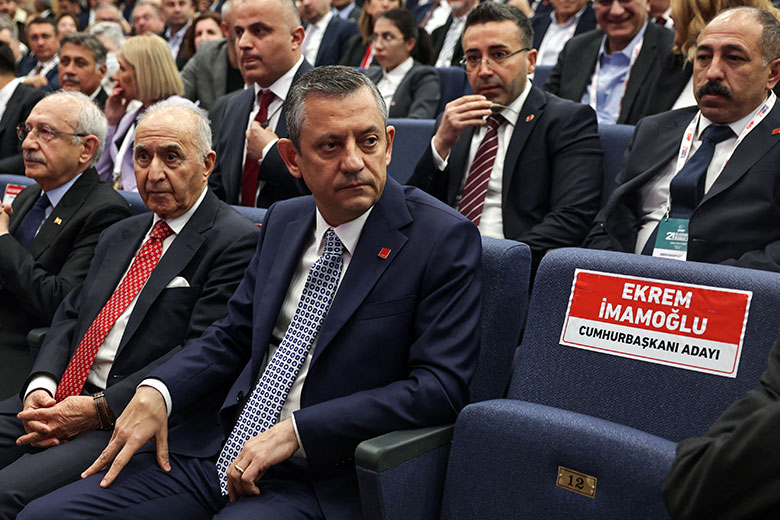
In May, around the same time as the closure edict, Turkey’s appeals court removed the head of the opposition Republican People’s Party (CHP), Özgür Özel, an increasingly popular leader, in a move that critics described as a “judicial coup”. Another of the party’s most prominent figures, Ekrem İmamoğlu, was arrested last year on corruption allegations, stripped of his role as mayor of Istanbul and remanded in custody awaiting a trial that still hasn’t happened more than a year later. He was elected in 2019 after beating a candidate backed by Erdoğan’s Justice and Development Party (AKP).
Under the constitution, presidents are limited to two five-year terms, which would bar Erdoğan from running in 2028. However, there is speculation that he may seek to remain in office by amending the constitution – or by calling an early election, which would reset the term clock and allow him to stand again.
Hence, academics who have suffered under Erdoğan are not getting excited about any imminent conversion of his status to president emeritus. And this is especially true of the Academics for Peace. In 2019, Turkey’s Constitutional Court ruled, by a narrow majority, that they had not committed the crime of propagandising for a terrorist organisation, but hundreds had already left their universities and even the country by then. Very few were able to return to their academic positions and those who succeeded often found themselves in institutions that had become unrecognisable because of the political pressure on them.
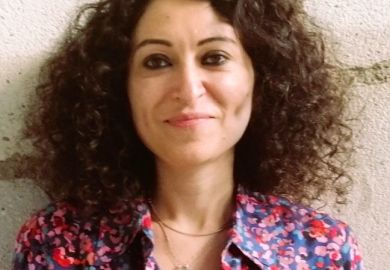
Esra Mungan, a psychology professor, told Times Higher Education that one of her fellow signatories is now a farmer to make a living, while another works as a translator. Others have taken up jobs at NGOs.
She herself was jailed for a month, but that was not the hardest part of her ordeal.
“I was in a [prison] ward with many socialist women, having very intellectual conversations…I felt very strong, with a lot of public support and hopes for Turkey,” she said, adding that her institution, Istanbul’s Boğaziçi University, supported her throughout her incarceration.
But the aftermath of the failed coup meant that “step by step, academics became more frightened to speak out” as universities themselves became subject to greater government control.
“In the first year and a half, colleagues were being dismissed, especially those on fragile contracts who were outspoken,” Mungan said. “There was strong resistance, but nothing changed. Things kept getting worse. The environment turned so toxic. Our university was politically taken over,” she said – likening it to Erdoğan’s conversion of Istanbul’s Hagia Sophia world heritage site back into a mosque in 2020. The iconic building, originally built by the Romans as a gigantic Christian church, had been a museum since the Turkish republic was founded in 1935.
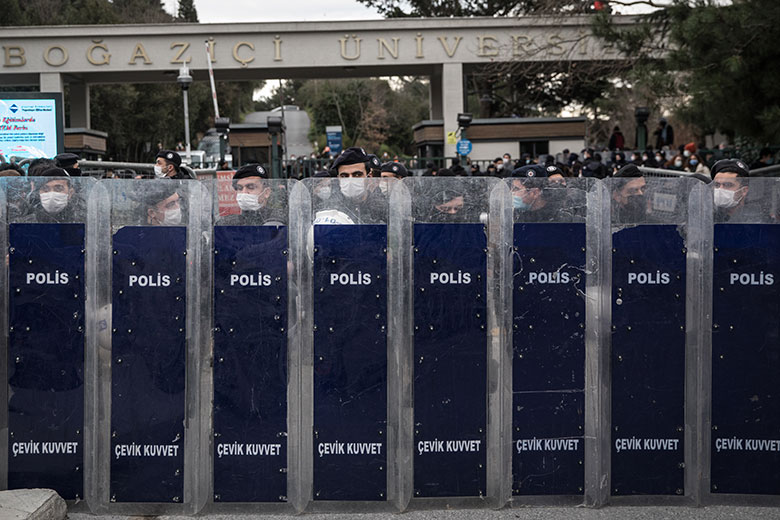
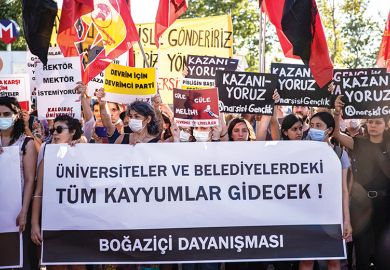
In 2021, for instance, Boğaziçi erupted after the government appointed Melih Bulu, a party loyalist, as rector by presidential decree. Erdoğan said that “a routine appointment” was “being used” by anti-government activists “to provoke the universities”. After six months of student protests, Bulu was removed by presidential decree – but replaced by another government appointee.
The experience took a personal toll on Mungan. “In the classroom, you try to give your students hope, but when you come home you feel so tired and depleted. There was strong resistance for the first two years, but as academics and students there is so much you can do. We are not professional resisters.”
Hence, in December 2024, Mungan decided to step down from her role at Boğaziçi. But she is still active, giving public lectures through what she describes as an “academy of resistance” and continuing to speak up about academic freedom in the country. But she noted that students at Bilgi, like those in other private universities, are not known for protesting.
Mehmet Ugur, professor of economics and institutions at the University of Greenwich, sought asylum in the UK in 1985 after being imprisoned for four years during Turkey’s 1980 military coup. He agreed that the post-2016 purges had eroded academic freedom in Turkey. But there is now a kind of stability that makes the oppression less visible as a day-to-day problem, he added.
“The management of universities is selected and curated based on those who are loyal to the regime,” he said. “Even investors in liberal-oriented private universities make sure that the governing bodies and their recruitment policies are ‘acceptable’ for the government.”
Meanwhile, the purging of many of the most critical academics, who have “left academia and found jobs in the private sector or in non-governmental organisations” has lessened the “scope for critical dissent. Second, those who returned to academia have become less vocal in their criticism of the education system and chosen to focus on funding applications and publications in order to survive…and compete in the international market.”
Against this backdrop, Ugur also thinks the Bilgi incident belongs to a different category from the ideological purges of 2016 and possibly relates to factional fighting within the AKP – with one faction pressing for the closure and another then pushing back.
“This is in line with the news about internal competition the party,” he said. “I do not have concrete information about the factions, but such rebalancing acts are common in authoritarian regimes with centralised corruption. My view is that Erdoğan did not reverse the decision because of concerns about reactions from students and their families.”
He added that the regime was currently “settling scores with shadowy entrepreneurs and celebrities who have been allowed to prosper and increase their fan bases under the government’s watch. This was evident in the recent waves of arrests and charges targeting individuals who vote for the AKP but are considered as outside its core support base. The aim here is to maintain control in a system of centralised corruption, where the mix of potential beneficiaries from corrupt practices is reshuffled from time to time to maximise loyalty to the regime.”
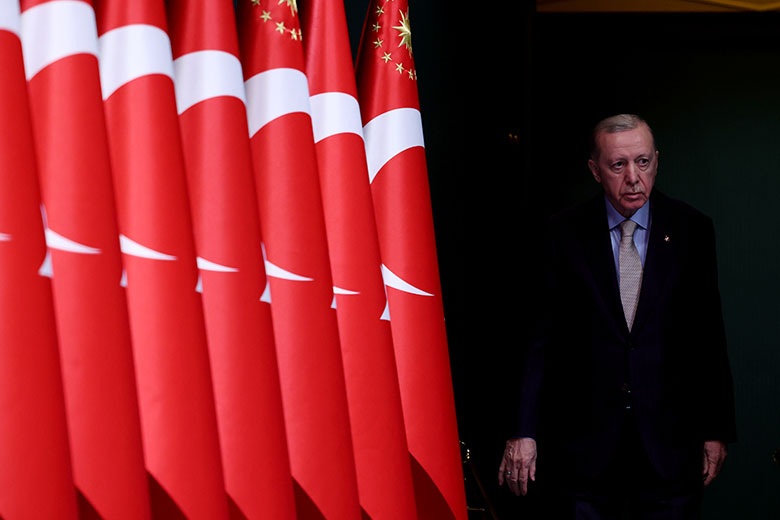
Whatever the real cause of the closure edict and its cancellation, uncertainty at Bilgi is lingering. Akdeniz, the law professor, said students are still worried about what the future may hold. “Some students, out of panic, may decide to transfer to other universities,” he said. “Some of my own students have told me they were considering leaving.”
And while he shares the view that the whole incident was a “bureaucratic blunder”, he laments the lack of transparency that makes that perception impossible to confirm.
“It’s very difficult for us and the media to know how decisions are being made,” he said. “Something must have been going on in the background, but nobody really knows why the university was shut down and the decision then reversed.”
Bilgi was approached for comment.
Register to continue
Why register?
- Registration is free and only takes a moment
- Once registered, you can read 3 articles a month
- Sign up for our newsletter
Subscribe
Or subscribe for unlimited access to:
- Unlimited access to news, views, insights & reviews
- Digital editions
- Digital access to THE’s university and college rankings analysis
Already registered or a current subscriber?