Governments and universities across Europe and the Middle East are invoking counter-terrorism, national security and community safety to “justify” restrictions on freedom of expression and academic freedom, according to a new report.
The British Society for Middle Eastern Studies’ (BRISMES) Committee on Academic Freedom (CAF) said in a report published on 5 August that it had analysed 28 cases involving restrictions on lawful academic and political expression.
Of these, 20 cases involved the UK and Europe, with all but two relating to the Israel-Palestine conflict. The remaining eight cases, across the Middle East and North Africa, were described by the committee as involving “more severe” forms of repression.
The report shares several examples from the UK, France, Switzerland and Germany, which include universities cancelling academic events, disciplinary action against students and staff, restrictions on teaching materials, and professional repercussions.
“Although each case arises within a specific institutional context, taken together they reveal broader patterns that raise concerns about the protection of academic freedom in European higher education,” the report reads.
In one example, BRISMES raised concerns over the case of François Burgat, a retired research director at the French National Centre for Scientific Research (CNRS) and scholar of political Islam, who was convicted on appeal of “glorifying terrorism” over comments related to Israel’s war in Gaza.
It said the case reflected “a broader trend towards the criminalisation of intellectual debate concerning developments in the Middle East” and warned that the use of terrorism legislation in such contexts risked undermining “academic freedom, freedom of expression, and public debate on matters of significant public concern”.
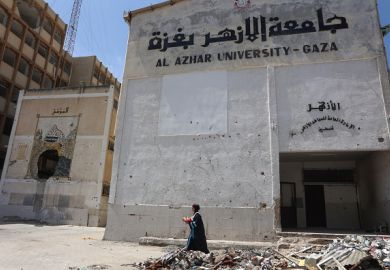
In the Middle East and North Africa, the report highlighted cases from Egypt, Iran, Kuwait, Bahrain, Lebanon and the Palestinian territories. Four of the eight cases involved arrests, detention, prosecution or restrictions on movement, while others concerned interference with research and teaching, as well as violence, killings and attacks on educational institutions.
“A recurring pattern across the Egypt, Iran, and Kuwait cases is the use of national security, terrorism, espionage, or similar frameworks to criminalise peaceful expression and intimidate critical voices,” the report says.
BRISMES called on universities and research institutions to “uphold their obligations to protect free expression and academic freedom” and urged governments and public authorities to “refrain from criminalising peaceful scholarly and political activity” while creating safe pathways for scholars at risk.
The committee also called on scholarly associations and academic networks to continue “documenting and speaking out against violations”. It said that protecting academic freedom requires more than responding to individual cases, but also confronting the “institutional, political, legal, and military structures” that allow repression.
“What is at stake is not only individual liberty, but the wider message such cases send to scholars, students, and public intellectuals about the risks of speaking, writing, or participating in public debate,” the report says.
Register to continue
Why register?
- Registration is free and only takes a moment
- Once registered, you can read 3 articles a month
- Sign up for our newsletter
Subscribe
Or subscribe for unlimited access to:
- Unlimited access to news, views, insights & reviews
- Digital editions
- Digital access to THE’s university and college rankings analysis
Already registered or a current subscriber?