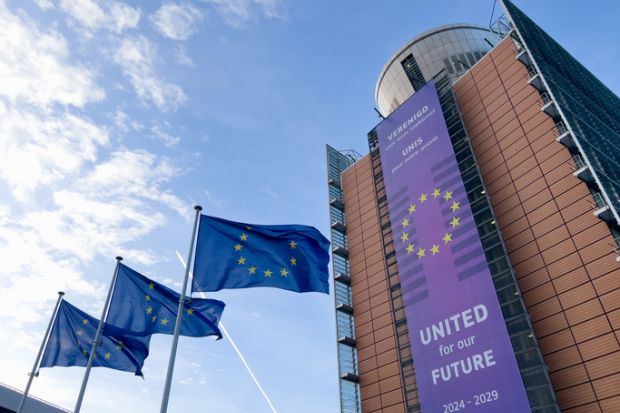
Senior figures from the European higher education sector have warned that the European commission’s push for competitiveness risks overlooking the broader social mission of universities, as debate intensifies over the next Horizon Europe framework.
Speaking at a discussion organised by the European University Association at the European parliament in Brussels on 5 March, Marcin Pałys, former rector of the University of Warsaw and EUA vice president, argued that the competitiveness agenda needed to be kept in perspective.
“Competitiveness itself does not make Europe attractive,” he said. “It’s attractiveness as a whole, as a society and its values that makes it attractive.”
He also warned of a disconnect between the commission’s ambitions and the daily reality facing universities. “We can see the divergence of these topics and the big questions with the daily operations of universities, with problems with research capacity, regulatory overburdening, complicated legal frameworks,” he said, adding that social innovation, often overlooked in favour of technical priorities, was also essential in making Europe competitive.
The relationship between FP10, the next iteration of the EU’s flagship research programme which funds curiosity-driven research, and the new European Competitiveness Fund, a much larger instrument designed to focus on strategic industrial priorities, has raised fears among researchers that funding could become more tied to economic priorities rather than scientific excellence.
Alexandr Hobza, a cabinet expert in the office of commission executive vice-president Stéphane Séjourné and a member of the team behind the Draghi competitiveness report, defended the commission’s approach to competitiveness. “It’s very clear in the current world we need to be more directive and set priorities and use resources well, because the world is becoming more geopolitical, with the rise of China, the role of the US,” he said.
But he also acknowledged the need to maintain a bottom-up approach in FP10. “In order to succeed and become innovative, we also need a bottom-up approach to identify new trends and come up with new ideas,” he said, adding that Horizon Europe’s traditionally strong bottom-up element “should be strengthened in the future”.
Lana Par, president of the European Students’ Union, warned that the competitiveness agenda risked creating trade-offs that would ultimately weaken Europe. “Excellence must remain accessible. If higher education becomes less affordable or less inclusive, it’ll weaken Europe’s social and economic resilience,” she said.
The discussion also heard perspectives from industry representatives. Claire Skentelbery, director general of EuropaBio, questioned whether universities were the right vehicles for fast-moving innovation. “Universities are often very slow in what they do,” she said, arguing that the focus should be on accelerating the interface between academia and industry rather than expecting universities to operate like companies.
Laurence Farreng MEP warned that the role of higher education in Europe’s competitiveness drive was “far too often overlooked,” and called on universities to embrace modernisation including dual-use research.
Register to continue
Why register?
- Registration is free and only takes a moment
- Once registered, you can read 3 articles a month
- Sign up for our newsletter
Subscribe
Or subscribe for unlimited access to:
- Unlimited access to news, views, insights & reviews
- Digital editions
- Digital access to THE’s university and college rankings analysis
Already registered or a current subscriber?