
A practical guide to using games in university teaching


Created in partnership with

Created in partnership with
You may also like
In 2025, our game-oriented learning and research project turned 10. Over the past decade, our multidisciplinary team has carried out an in-depth study of game-oriented learning, using existing games for educational purposes. Here is what we’ve discovered and our best tips for using games in your own classroom.
In 2015, several management and language teachers got together to design new teaching methods, based on the integration of games into activities such as courses and student projects. To support this initiative, we developed a powerful tool: the GamiXlab. It’s a gamelab that includes a large game library (more than 1,000), a software development platform and network-connected flight simulators. This reflective and critical adventure, punctuated by successes and failures, is one of the largest and longest-running projects dedicated to game-oriented learning in French-speaking higher education.
- Use games to get students back to class
- Lessons from gamification to enhance students’ capacity for learning
- Using gamification as an incentive for revision
In the early years of the project, our initial objective was to identify the game-oriented learning techniques used in higher education, particularly in management sciences. We characterised nine of them:
Gamified simulation: a more or less simplified model (digital or otherwise) of the real world that incorporates elements of gamification, such as points, competition and leaderboard.
Gamified pedagogical activity: any educational activity designed by the trainer that incorporates gamification elements.
Pedagogical serious game: a game specifically developed for serious use, and to meet one or more educational objectives. It doesn’t require adaptation by the teacher, but they must undergo training in the game and its objectives.
Full serious gaming: unmodified adaptation of a commercial game for use in training. It is up to the trainer to define how the game will be used in line with the educational objectives they have set.
Partial serious gaming: adaptation of a commercially available game that has undergone specific educational modifications to facilitate its integration into the training programme.
Learning by serious-game design: documentary research and group work activities enabling students to design a (serious) game. The trainer sets the educational objectives to facilitate game development.
Pretext resource: using the fantastic or appealing worlds of games as “bait” to improve learner engagement in training.
Incidental ludic learning: learning achieved through fun leisure activities. There are no predefined educational objectives, other than those set by game designers.
Metagame learning: achieved through personal or collaborative research into game worlds and mechanisms. There is no predetermined educational objective, and this practice depends entirely on the willingness and curiosity of the players.
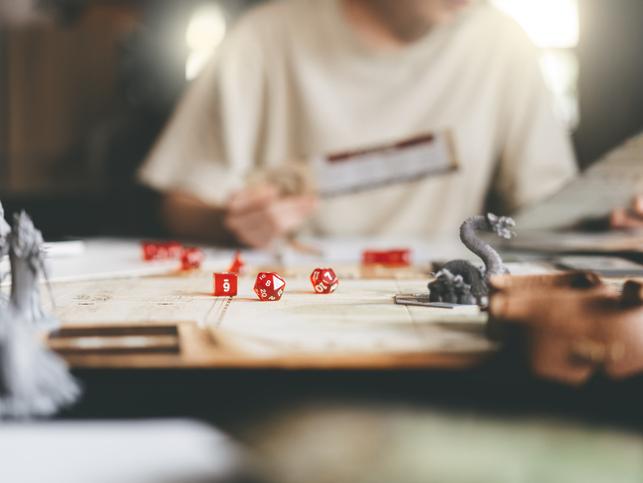
We then looked more closely at the practice of repurposing games in management and language courses. We identified three types of games: physical wargames, tabletop role-playing games and open-world sandbox video games.
All games must meet the following six criteria in order to achieve the teachers’ learning objectives:
- a shift or decontextualisation of the game world in relation to the real world, so that students can easily get involved in the games
- freedom of action: students must have a high degree of agency so that they can truly feel free in their decisions
- transparency of the consequences of players’ actions
- decoupling between the game scenario and the pedagogical scenario: success in the game should not be tied to pedagogical progression
- the ability to support a wide range of pedagogical scenarios, providing narrative flexibility
- logistical feasibility: technical aspects, accessibility, cost.
The third phase of our research focused on providing evidence of learning outcomes achievement, based on a structured methodology for the full re-engineering of a course. The aim was not merely to implement a game within a single session, but rather to design an entire course around the game, drawing on multiple cycles of experiential learning.
We also established strong links between intercreativity (real-time collaborative co-design of the scenario) and the collective flow of a class when using wargames in management courses.
At the same time, we have been working on replacing proprietary video games with FLOSS (Free/Libre Open Source Software) games in order to address two topics: the creation and dissemination of open educational resources and technological frugality. As well as extending the actions already undertaken, since 2024, we have been studying advanced practices in the use of wargames and RPGs. For example, we’ve looked at how they can be used to develop critical thinking and general literary culture in students of management sciences.
Our advice
Since the project began in 2015, we’ve published much of our work and findings in gaming magazines, helping us to reach teachers who do not necessarily have access to scientific resources. This approach has given rise to some exciting projects. For example, at the Université de Haute Alsace, two teachers have reproduced the FlightTeam simulation platform for risk management courses.
Discussions with teachers and trainers have enabled us to identify a few important points that are easy to implement. First, it is easier to start repurposing existing games rather than creating serious games from scratch. Building a game library, as we have with the GamiXLab, allows teachers to develop their game literacy and the skills to identify relevant game mechanics.
Don’t be afraid to drastically simplify the rules, offering very simple and sometimes even slightly prescriptive scenarios. This is especially true for wargames and role-playing games, which can sometimes be complex. Students are rarely familiar with these types of games, and making a simple decision between the left door or the right door, for example, will require a lot of discussion. This is perfect for language or management teaching.
Keep playing time short but repeat the experience, so that students can take on all the roles in the game or educational scenario. This will avoid students feeling frustrated, while ensuring that everyone has had the opportunity to participate.
Finally, the last piece of advice is to never evaluate the game time. Students must feel comfortable so that they can participate in the sessions without anxiety. Use the final debriefings to address any difficult points that came up during the game.
Our next steps will be increasing our IT development capabilities in order to create educational modules for FLOSS video games, experimenting with our analytical wargaming method as part of information systems research, and studying educational metagaming through activities dedicated to developing students’ ludic literacy.
Our activities, spanning multiple disciplines, have enabled us to transcend our geographical borders and carry out one-off or recurring projects with colleagues and students from many countries. If you would like to develop an international game-oriented learning initiative or take part in any of the activities described in this article, please get in contact.
Philippe Lepinard is an associate professor at Université Paris-Est Créteil.
If you would like advice and insight from academics and university staff delivered direct to your inbox each week, sign up for the Campus newsletter.
