
How the University of Hong Kong and UCLA are tackling the decades-long space battery mystery
By decoding the complex physics powering aurora, researchers at the University of Hong Kong and UCLA are helping to provide crucial data to protect Earth’s modern infrastructure
Sponsored by the University of Hong Kong

Sponsored by
Sponsored by
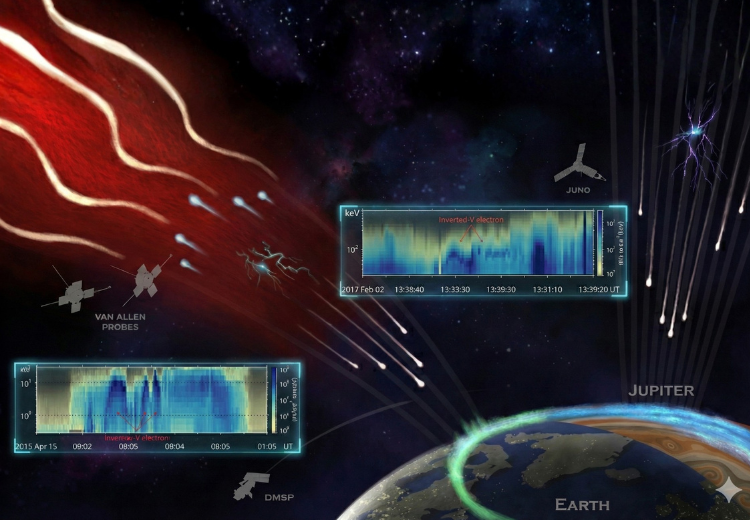
The northern lights may be known to millions, but a much smaller number understands their cosmic origins. “The aurora is related to the solar wind, where solar nuclear fusion ejects particles that travel to Earth and other planets,” explains Yao Zhonghua, associate professor in the Department of Earth and Planetary Sciences at the University of Hong Kong (HKU). “But exactly how those particles accumulate and release their energy to power the aurora has long remained a mystery. Our work shows that the aurora operates on a similar principle to an electric car. The solar wind delivers energy to a planet, and the planet’s magnetic field acts as a giant energy storage unit – something we’ve termed a space battery.”
When any system stores excess energy, it becomes unstable and must release it. Charged particles cannot easily cross magnetic field lines due to the Lorentz force, but they can slide along them directly to the Earth’s polar regions. As these particles travel along magnetic field lines, they hit an acceleration zone that suddenly gives them a massive boost of energy. For over 30 years, scientists haven’t known what powers this. “Our discovery provides clear evidence of what gives energy to the space battery: magnetic field waves,” says Yao.
One of the challenges that prevented questions around the space battery from being answered was the perfect alignment required, involving measurements of the source energy of the magnetic waves in deep space, of the number of particles entering the acceleration region, and the resulting aurora at an exact location on Earth.
“Even with dozens of satellites operating for decades, finding an instance where multiple spacecraft align perfectly along a single field line during a major auroral event is incredibly rare,” Yao says. “However, thanks to modern big data analysis and computational power, we were able to survey vast amounts of information to isolate the best event, perform a quantitative analysis and prove that the energy calculations between the space waves, the battery and the atmosphere match perfectly."
“This compelling research not only identifies the long-sought energy source driving auroral arcs, detailing how waves accelerate their powering electrons, but also presents an exciting extension of this terrestrial mechanism to Jupiter,” says Vassilis Angelopoulos, principal investigator for Nasa’s THEMIS mission.
HKU’s discovery could be applied to other planets and even beyond our solar system, changing how scientists look for auroral activity and magnetic environments on distant planets. Aside from its interplanetary potential, the discovery also provides the possibility of boosting our understanding of our modern, technology-dependent life.
“The aurora itself is just the beautiful, visual phase of a massive energy release,” adds Yao. “The other, more invisible phases of space weather involve ground magnetic perturbations – which can severely disrupt GPS navigation, power grids and oil pipelines – and high-energy particle radiation, which threatens satellites and space facilities. While my research is not a direct forecasting tool, understanding the exact physical mechanisms of how particles are accelerated is crucial for creating reliable prediction models concerning space weather.”
Given the sheer scale of space missions, it is extremely unlikely that a single institution will have access to all the necessary expertise. For HKU’s aurora research, collaboration played a pivotal role. Yao partnered with a fellow Peking University graduate, now working at the University of California, Los Angeles. Cross-examining their respective datasets from both Earth and Jupiter helped facilitate unforeseen breakthroughs concerning auroras.
“Space and planetary science are naturally multidisciplinary,” says Yao. “You cannot have space science without robust engineering support. The importance of a collaborative approach simply cannot be overstated. Today, Hong Kong acts as a super connector, a conduit for international scientists and mainland Chinese space agencies to exchange ideas. To understand how the universe works, you cannot isolate yourself by country or focus on just one planet; you have to work together across borders and even across worlds.”