
CityUHK develops innovative new materials to generate global impact
The Centre for Advanced Structural Materials has joined forces with the University of Cambridge to bridge the gap between research and commercial product

Sponsored by City University of Hong Kong

Sponsored by

Sponsored by
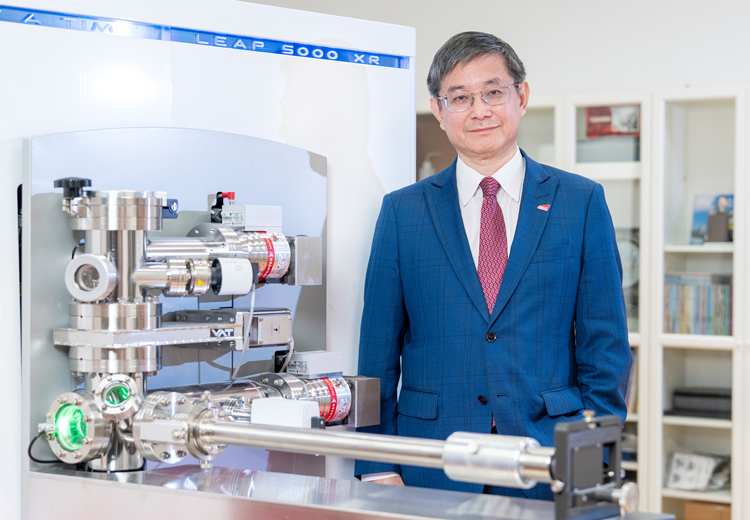
The Centre for Advanced Structural Materials at City University of Hong Kong (CityUHK) aims to prepare people and develop innovative technologies for Industry 5.0, according to the centre’s director, Jian Lu, a professor of materials science and mechanical engineering. “Industry 4.0 is mainly about automation and creating digital twins, but Industry 5.0 means we take environmental issues into account in industrialisation,” he says.
In March 2026, the Hong Kong government announced that two CityUHK proposals had been accepted as part of the third InnoHK research cluster, SEAM@InnoHK. InnoHK is a flagship initiative to bolster Hong Kong as a hub for global research collaboration. SEAM@InnoHK focuses on sustainable development, energy, advanced manufacturing and materials.
Lu is spearheading a project with the University of Cambridge in the UK to harness AI to design new materials and products. Researchers can use machine learning and AI to discover and rapidly test new materials. The collaboration selected four applications that tap into markets valued between $10 billion (£7.4 billion) and $100 billion (£74.4 billion). The size of the markets means that any impact will be amplified, Lu says.
The first application involves developing a new generation of air-conditioning and refrigeration systems. Air-conditioning and fans account for 20 per cent of buildings’ total energy costs around the world, according to the International Energy Agency. This demand is set to rise as global temperatures increase. The centre’s goal is to develop more efficient and carbon-free refrigeration technologies using solid phase transformation materials, Lu says.
Similarly, the second application looks at cooling in data centres, which is also inefficient. This is a growing problem as demand for AI tools drives the expansion of these centres. “If we continue like this, AI will consume 30 to 40 per cent of our total electricity production,” says Lu. “We are now working on a new alloy with a new geometry that can enhance cooling efficiency,” he says.
The third application aims to reduce the weight of electric vehicles. For each kilogram of body weight, a car needs up to 800 grams of battery, Lu says. “If we can reduce the weight of the car, we can reduce the size of the battery needed,” he says. They aim to use recycled aluminium and 3D-printing technologies to significantly reduce car weight.
The final project plans to use new materials, such as glass and transparent ceramics, in smartphones to reduce their weight and cost and improve their efficiency, he says.
Such innovation requires both global collaboration and interdisciplinary research. “CityUHK is the most international university in the world,” Lu says. “It is necessary to have international collaboration to foster innovative approaches.”
At the same time, tackling such complex challenges requires input from multiple disciplines. “To design the new material, we need to have a computer scientist, chemist and physicist,” Lu explains. “To produce the product, we need colleagues from industrial and mechanical engineering, and material science and engineering. It’s a truly multidisciplinary team for a multidisciplinary project.”
The InnoHK initiative aims to bridge the gap between fundamental research and real-world solutions, he says. The research is also likely to result in spin-out companies to commercialise these products.
“China is a major manufacturer of all four of these applications,” says Lu. “If even one of the four applications is successful, we will have a major impact worldwide.”