News Talks podcast: Sussex v OfS – what could it mean for UK HE?

We discuss why the University of Sussex is challenging the OfS in court and what it could mean for freedom of speech, institutional autonomy and the role of the regulator

Published on
February 6, 2026
Last updated
February 6, 2026
Montage of podcast icon with Sasha Roseneil, vice-chancellor of University of Sussex, the Royal Courts of Justice and Kathleen Stock
Source: University of Sussex/iStock/Shutterstock montage

Listen to this podcast on Spotify or Apple podcasts.

We discuss why the University of Sussex has mounted a legal challenge against a £585,000 fine imposed by the Office for Students (OfS) for failing to uphold freedom of speech.

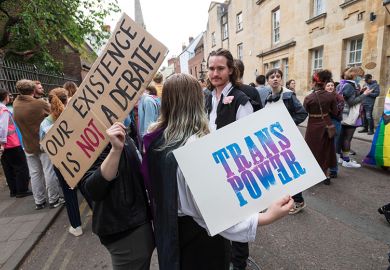
The case, being heard in the High Court in London this week, brings to the fore questions over academic freedom, institutional autonomy, trans rights and the role of the English regulator.

On this episode of News Talks Times Higher Education editor Chris Havergal talks to Miranda Prynne about the background to the case, the key points upon which Sussex is disputing the OfS findings and the broader implications for universities and the way they are regulated.

Register to continue

Why register?

  • Registration is free and only takes a moment
  • Once registered, you can read 3 articles a month
  • Sign up for our newsletter
Please
or
to read this article.

Related articles

Reader's comments (2)

The Sussex policies are very much open to interpretation. In this case it appears that the applied interpretation was a problem itself too. Separately there appears to be a significant case of selective enforcement. Finally, just because Sussex was the one caught doesn't per se mean that it is invalid because others weren't.
new
There is no "fine line" to be walked on freedom of speech. Arguing that female spaces should be for females, and that merely claiming you are a female does not make you a female, are not contentious. They are contentious however "on campus" only because campuses, at 90%+ left/progressive, are not diverse and representative environments. That lack of diversity means fringe positions, unfettered by competing between narratives, become mainstream. THIS is why the sector needs a regulator. The lack of diversity in university culture creates exactly the situation where reasonable positions, such as Kathleen Stock held, are hounded out. The entire ecosystem of HE, the THE included, is swimming in this downstream lack of diversity and fail to appreciate how out of touch we are with valid alternative opinion. The gender-critical opinion is a simple one: I, a male, cannot and should not be free to enter female spaces. That is not because I personally pose a risk to women. It is because a small, but disproportionate, number of males pose a risk to females. And as such, myself and all natal post-pubescent males, are rightly discriminated against - that we are discriminated against on account of a small subset of our group is irrelevant. The discrimination is justified. It applies to all of us, irrespective of how we identify, and apart from a few edge cases (of which trans itself isn't one) it applies to all - trans included.

Sponsored

Featured jobs

See all jobs
ADVERTISEMENT