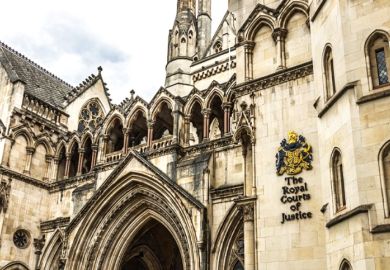
The Office for Students (OfS) has made a wise decision not to appeal against the High Court’s recent ruling that it had shown “bias”, adopted a “closed mind” and “misdirected itself” in fining the University of Sussex over alleged free speech violations.
We were not surprised by the judge’s verdict. The reason, however, has nothing to do with the specifics of the Sussex Trans and Non-Binary Equality Policy Statement. Rather, it derives from our own experience of engaging with the OfS on a separate matter relating to academic freedom and freedom of speech in higher education: a matter that has also led to ongoing legal action against the OfS about which the Sussex ruling is particularly instructive.
At about the same time that the OfS announced its formal investigation of Sussex in 2021, we were researching religious privilege in higher education for the National Secular Society (henceforth, “the Society”) and identified several “bible colleges” with governing documents that overtly restrict freedom of speech and academic freedom by requiring governors, staff and students to adhere to a “statement of faith” or other doctrinal beliefs.
These bible colleges were registered as higher education providers by the OfS several years beforehand, based on self-assessment and seemingly without any serious checks of their foundation governing documents. As a result, a freedom of information request revealed that these registered providers – most of which are churches, groups of churches, or wholly controlled subsidiaries of churches – received £86 million of public funds in student loans and capital grants between 2018 and 2025 to indoctrinate (in the true sense of the word) rather than educate students.
In October 2021, the Society submitted the first of seven third-party notifications to the OfS highlighting the restrictions on academic freedom and freedom of speech enshrined in the governing documents of these colleges, together with additional governance concerns. Over more than four years, the only response we received from the OfS was entirely at odds with the transparency expected of a government regulator: the OfS would neither “confirm nor deny” that it would investigate the issue.
Furthermore, in face-to-face meetings with us, the OfS’ director of freedom of speech, Arif Ahmed, appeared unable or unwilling to answer direct questions. These included: do institutions whose governing documents require staff and students to adhere to a statement of faith uphold academic freedom and freedom of speech? Why has the OfS not investigated these bible colleges when it spent three years investigating Sussex? And does Ahmed agree that the alleged breach of registration conditions at Sussex, which concerned an internal policy document that could be amended readily, was less egregious than that of the bible colleges, whose restriction on free speech is enshrined in their foundation governing documents which cannot be altered?
The lack of transparency and apparent failure to recognise the issue, along with the dearth of action by the OfS over a four-year period, left the Society with no option but to initiate legal proceedings, and a pre-action letter prior to judicial review was sent to the OfS on 28 February.
In advance of a full OfS response to the pre-action letter, the Sussex judgment provides much needed clarity.
The ruling confirms that the OfS “misdirected itself” in treating an internal policy document in the same way it would a foundation governing document. The judge also noted that internal policy documents do not necessarily put staff jobs or students’ studies at risk, whereas foundational governing documents do. Indeed, some bible colleges make it an occupational requirement to subscribe to a particular doctrine, and we have made the OfS aware of a student who was shamed in chapel and dismissed from her course for becoming pregnant – thereby breaching the college’s disciplinary code based on the evangelical belief that only heterosexual sex within marriage is permissible.
The finding that the OfS acted with a “closed mind” is also pertinent. The refusal to properly consider the bible college issue over a prolonged period, offering different excuses for inaction at different times, is hardly consistent with an open mind.
The question is: why is the regulator acting this way? Does the OfS wish to privilege evangelical churches by waiving the registration criteria that apply to all other providers? Is it seeking to cover up its error in registering these bible colleges in the first place? Or does it simply lack the competence to undertake its regulatory duties in relation to academic freedom and freedom of speech?
Whatever the explanation, the wider issue extends far beyond these small colleges. The integrity of the sector, which the OfS has a duty to uphold, depends on consistent application of its rules to all providers. The continued registration and public funding of bible colleges could also open the door for other churches and faiths with restrictive doctrines to register and receive public funds to indoctrinate students.
With a new chair in post, and new chief executives taking up a joint appointment shortly, the regulator now has the opportunity to avoid further damaging legal judgements by showing transparency and consistency and agreeing to properly address the restrictions on academic freedom and freedom of speech in bible colleges.
Chris Higgins is former vice-chancellor of Durham University and Keith Sharpe is former professor of education at the University of Liverpool. Both are members of the National Secular Society’s secular education forum.
Register to continue
Why register?
- Registration is free and only takes a moment
- Once registered, you can read 3 articles a month
- Sign up for our newsletter
Subscribe
Or subscribe for unlimited access to:
- Unlimited access to news, views, insights & reviews
- Digital editions
- Digital access to THE’s university and college rankings analysis
Already registered or a current subscriber?