ADVERTISEMENT
As Iran shows, dual-use research risks making campuses military targets
We are witnessing the collapse of the idea that, as civilian institutions, universities should not be targeted in wartime, says Roohola Ramezani
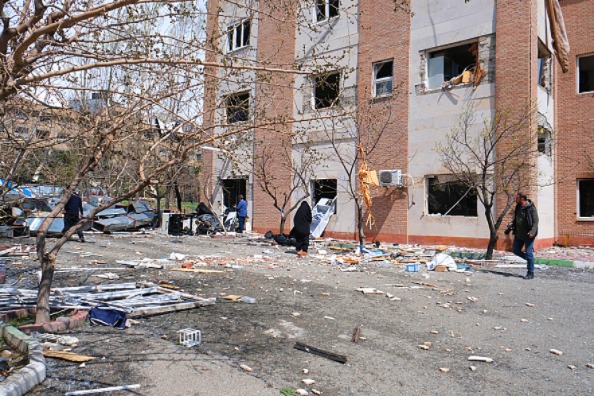
Source: Kaveh Kazemi/Contributor/Getty Images
When a bomb struck Sharif University of Technology on 6 April, it hit more than concrete and steel. It struck at an idea that has underpinned higher education for centuries: that universities, even in wartime, remain spaces apart.
Often described as “Iran’s MIT”, Sharif symbolises the country’s technical ambition. But it is also, according to sanctions regimes and expert analysis, a site where the boundaries between civilian research and military application have grown dangerously blurred.
Nor was Sharif’s an isolated case. Iran’s science minister, Hossein Simaei Saraf, says more than 30 institutions have been hit directly since Israel and the US launched their assault on 28 February. And reporting by Science magazine has documented extensive damage to academic and research infrastructure: from the Pasteur Institute of Iran, the country’s leading public health research centre, to engineering hubs at the Iran University of Science and Technology. Laboratories, data centres and even dormitories have been struck.
But in some cases, at least, the targeting has appeared highly specific. At Shahid Beheshti University in northern Tehran, the Laser and Plasma Research Institute was reduced to rubble. At Isfahan University of Technology, a facility that one source described to the Amirkabir University of Technology’s student newsletter as having long been off limits to ordinary students, was hit twice. And at Sharif, the Shahid Rezaei Research Institute, a site that has faced specific US sanctions over alleged links to drone development, was among the buildings destroyed.
These attacks reflect a view that certain research facilities constitute legitimate military targets even if they are housed on university campuses. For instance, in a statement acknowledging strikes on Imam Hossein University, an institution with well-documented ties to the Islamic Revolutionary Guard Corps (IRGC), the Israeli military said the campus served as “a civilian cover” for weapons development.
ADVERTISEMENT
The phrase “civilian cover” is the crux of the issue. For decades, international humanitarian law has been seen to bar direct attacks on educational institutions. Yet the same legal framework acknowledges that a civilian object can lose its protection if it is used for “military purposes” or “military action” – although “in case of doubt whether an object which is normally dedicated to civilian purposes, such as a place of worship, a house or other dwelling or a school, is being used to make an effective contribution to military action, it shall be presumed not to be so used.”
The grey zone lies in determining who decides when that threshold has been crossed, and what evidence is required to justify the crossing. Independent verification of specific military uses remains limited, often obscured by the fog of war and the opacity of the Iranian state. This ambiguity is precisely what makes the precedent so troubling. When the classification of a campus hinges on intelligence assessments that are neither public nor contestable, the traditional concept of academic sanctuary becomes contingent on geopolitical trust.
The attacks on Iran’s campuses also raise a broader question about a central ideal of modern academia: that knowledge is open, universal and democratised. In practice, frontier research has long been shaped by political and military priorities, and access to it remains deeply uneven.
The escalation has already triggered a dangerous feedback loop. In late March, following strikes on Iranian universities, Iran’s Revolutionary Guard issued a statement declaring that “all Israeli and American universities located in the West Asia region will become legitimate targets until two universities are struck in retaliation”. The statement urged students, faculty and staff to maintain a distance of at least one kilometre from their campuses.
The threat was not rhetorical. As THE reported last month, American-affiliated institutions across the Gulf scrambled to respond. The American University of Beirut moved teaching online for two days. The American University of Madaba in Jordan suspended in-person classes. The US embassy in Iraq warned about the American universities in Baghdad, Sulaymaniyah and Dohuk being targeted.
This is the grim logic of modern conflict: when one side treats universities as extensions of the security state, the other reciprocates. Campuses are now positioned as strategic assets to be defended or destroyed.
The ceasefire has, for now, halted the airstrikes. It offers Iranian universities a moment to assess the staggering toll. Graduate students are locked out of laboratories. Internet blackouts have severed connections to global scholarship. Some scientists, including those with alleged ties to defence programmes, have been killed in targeted strikes – and not for the first time.
ADVERTISEMENT
At the Pasteur Institute, founded in 1920 and a member of the global Pasteur Network, the losses include national reference laboratories for cholera and tuberculosis, WHO collaborating centres and irreplaceable biological collections. Its director, Ehsan Mostafavi, told Science that rebuilding would require starting over on “infrastructure that had taken decades of effort to establish and equip”.
As Iran’s universities begin to rebuild, they must confront a difficult choice: do they seek to distance themselves from research areas that could attract future military attacks, or do they double down on work considered to be essential to national sovereignty?
For the international academic community, the ceasefire is an opportunity to engage rather than merely observe. The targeting of Iranian universities, however justified or unjustified in individual cases, sets a precedent that could echo globally. If dual-use research can legitimise strikes on the Sharif or Beheshti campuses, what protects a university in a future conflict where the lines between civilian and military science blur? The same legal ambiguities invoked in Iran could, in different circumstances, be applied elsewhere.
The ceasefire might hold but the question it leaves behind will linger. In a world of dual-use science and strategic competition, can a university ever be just a university again?
Roohola Ramezani has a PhD in philosophy from Shahid Beheshti University, Tehran. He was formerly research fellow at the IFK International Research Centre for Cultural Studies in Vienna.
Read more about
Related articles
Featured jobs
ADVERTISEMENT