Business schools need to “put the learner in charge of their degrees” to ensure they present students with a “crisper” value proposition, according to a longstanding college president.
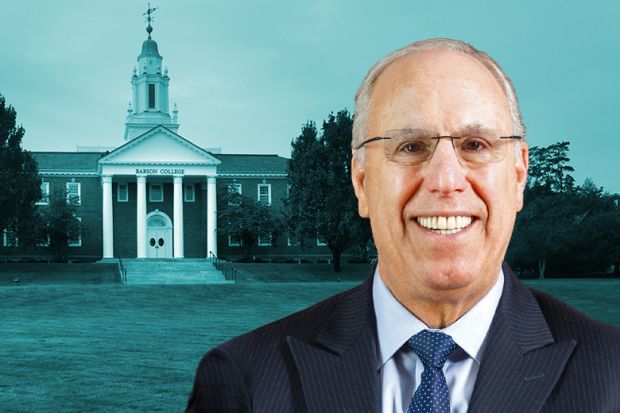
Stephen Spinelli, president at Babson College in the US, who is set to retire in June after 22 years at the institution, said that a difficult time for higher education could also be “exciting”.
“Colleges are going through very difficult times,” Spinelli said. “They’re having to rethink their business models and say, ‘am I providing the kind of value necessary for learners to go be successful in life?’
“They’re being challenged economically, sociologically and psychologically. The industry will change, and it is evolving rapidly and it will emerge even stronger. I am absolutely convinced. It will be different, I think. But it’ll be stronger, and I think that’s super exciting.”
US business schools have been hit by an increasingly hostile government approach to international students and “political drama” that has “gotten in the way of education”, he said, as well as a challenging economy and graduate jobs market.
Amid this environment, questions have been raised about the value of higher education, and MBA courses in particular, which are more expensive than typical master’s programmes.
Spinelli acknowledged this but said it was therefore the role of business school leaders to demonstrate the value of their courses and ensure they remain relevant to students in a rapidly evolving economic and technological environment.
“It’s expensive to do a four-year degree. I personally think it’s absolutely worth it. But across the broad spectrum of colleges one could make that argument, and that says to people like me, presidents of colleges, that we've got to deliver a [crisper] value proposition. When you come here, what do you want out of this?
“I’ve got to be able to say I can do that or you ought to go somewhere else. And then I have to keep my word…clarity in the value proposition should be underpinning most businesses. Higher education has got to get with it.”
He said that key to this was giving students more choice over their degrees. “Higher education has got to do a better job of putting the learner in charge,” which could include giving them more choice over their modules – especially for postgraduates.
He argued that lifelong learning was the “biggest opportunity” for business schools and said that this shift was helping “shake universities out of their stodginess” as more people increasingly look to informal methods of learning, including podcasts.
“We can’t be constrained by old business models,” Spinelli said. “We’ve straitjacketed ourselves, and then we wonder why we can’t move nimbly. Without nimble change and evolution, I think some will fail, and that’s life.”
Spinelli, who has been president since 2018, described Babson as having “led the revolution” of entrepreneurship education, with the institution having recently been ranked the leading US university for entrepreneurship by the US News & World Report for a 30th consecutive year. Integral to this is developing graduates who are “problem solvers” and can “react quickly” to challenges, he said.
As part of this, Babson’s first-year students are required to start a business, which he said puts “into context” what students are learning in the classroom.
“Part of my criticism of higher education in general is that it doesn’t integrate into their lives well enough. When you can show relevance, students absorb knowledge, and one of the best ways to show relevance is through experience.”
But it hasn’t always been easy, he explains. “When I first got involved with entrepreneurship, everybody said you couldn’t teach it. You’re born with it, people said, which seems silly to me. You might be born a great swimmer but you’ve still got to practise. We all naturally do some things but to be great at it we have to work hard at it.”
For Spinelli, who has also led several businesses, the disruption to companies from AI and economic shocks only makes entrepreneurship more relevant for graduates to learn.
“The pace of change is so dramatic, and the interface of technology is continually disrupting business models…the world is saying, and students are saying to us, ‘I need to be trained to be able to react quickly’. And how are we doing that? Entrepreneurship is the perfect vehicle.”
Register to continue
Why register?
- Registration is free and only takes a moment
- Once registered, you can read 3 articles a month
- Sign up for our newsletter
Subscribe
Or subscribe for unlimited access to:
- Unlimited access to news, views, insights & reviews
- Digital editions
- Digital access to THE’s university and college rankings analysis
Already registered or a current subscriber?