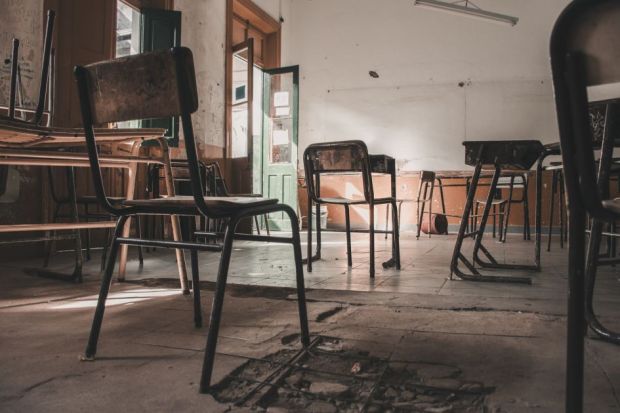
Research infrastructure across English universities is “ageing” and “deteriorating”, according to a funder, with an estimated £5.2 billion needed to bring estates back to a “fully operational standard”.
Research England’s report on the condition of research estates, published on 4 November, has found that a “substantial proportion” of the country’s research estate is in “poor condition”.
Several universities across England have ageing estates that are no longer fit for purpose. They own and operate out of historic buildings that are difficult to adapt, as well as listed buildings that entail higher maintenance costs.
London universities reported additional pressures including spatial constraints and vibrations from the Tube network underground affecting how research activities can operate.
The report surveyed a total of 72 universities between March and November 2024, representing 72 per cent of sector research income.
Providers were asked to assess the condition of their research estate (defined as being used at least 25 per cent for research purposes) using the following definitions: condition A (new condition), condition B (operationally safe), condition C (operational but major repair needed) and condition D (inoperable).
Sixty-nine institutions responded to the survey question on estate condition. The median provider reported that 25 per cent of its research estate is in condition C or D, meaning that repairs are required in the short term or the infrastructure is currently inoperable.
Of the 69 providers, 17 said that 50 per cent or more of their research estate was in condition C or D. Research England said this reflects an “uneven exposure” across higher education providers to estate-related pressures on research activity.
Providers with the greater share of estate in categories C and D included some of the most research-intensive universities in the country.
When asked to estimate the cost of bringing their research estates to a “fully operational” condition, 64 providers gave figures that in total would require an investment of £3.61 billion. Scaling this to the whole sector, Research England estimated the overall need at £5.2 billion to £5.3 billion.
Despite increased pressures on research estates, including growing maintenance backlogs, budgets across the sector have become more constrained as a result of rising costs and declining capital investment.
Total non-residential capital and maintenance spending fell by 28 per cent in real terms between 2017-18 and 2022-23, with capital expenditure dropping by 34 per cent.
Construction costs have risen by an average of 4.6 per cent a year over the past decade, and they are predicted to continue to increase by 2.4 per cent in 2026.
The report says: “The evidence shows a clear and widening gap between the level of investment required to maintain and improve the research estate and the proportion of income that universities are able to commit.”
Providers have said that the condition of research infrastructure directly corresponds to research quality, talent recruitment, energy and equipment costs, and human safety.
Only 32 universities (63 per cent) said that 80 per cent to 100 per cent of their research-related infrastructure is fully accessible for wheelchair users or people with access needs.
Twelve universities reported that 60 per cent to 80 per cent of their estate is accessible, and seven universities reported that less than 60 per cent of their estate is accessible.
A crumbling research estate is also one of the reasons why higher education providers are lagging behind on their environmental goals.
Sixty-one per cent of institutions reported that less than 40 per cent of their research-related infrastructure meets their environmental sustainability and net zero targets.
Register to continue
Why register?
- Registration is free and only takes a moment
- Once registered, you can read 3 articles a month
- Sign up for our newsletter
Subscribe
Or subscribe for unlimited access to:
- Unlimited access to news, views, insights & reviews
- Digital editions
- Digital access to THE’s university and college rankings analysis
Already registered or a current subscriber?