Universities have been told not use Research England infrastructure funding to build new laboratories as non-digital research capital budgets are set to fall by a quarter within two years.
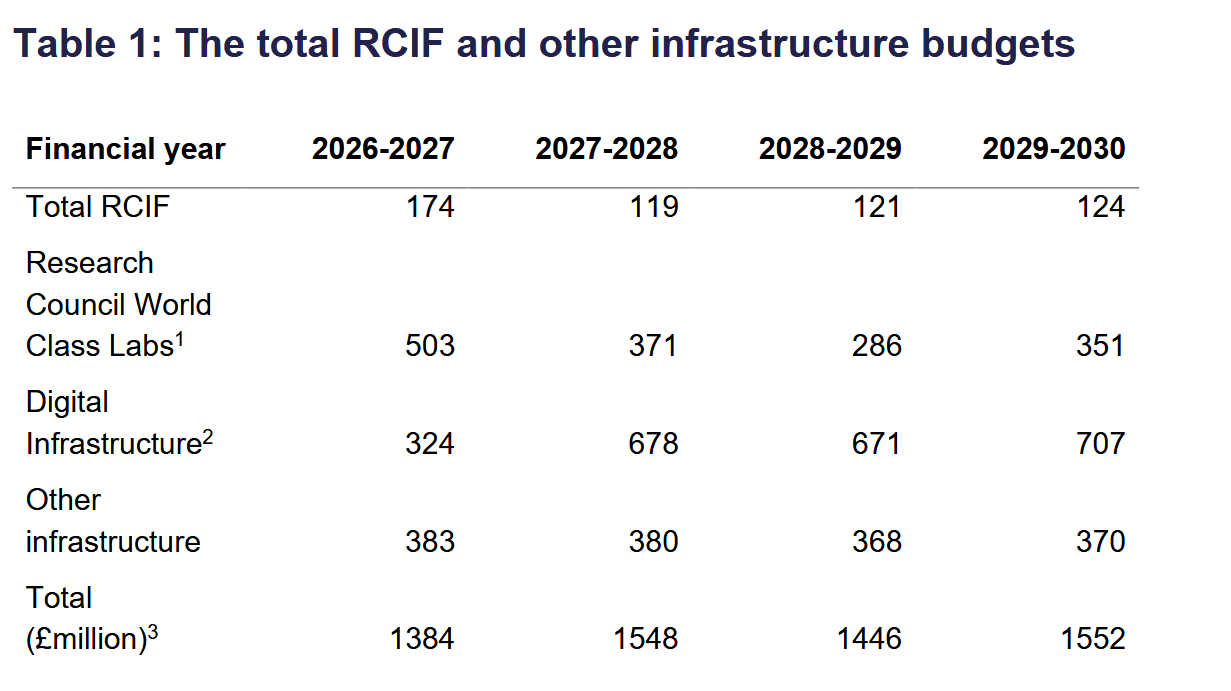
In a letter to vice-chancellors sent on 10 March, Research England confirmed that the overall research capital budget would increase from £1.384 billion in 2026-27 to £1.552 billion in 2029-30, a rise of £168 million or 12 per cent over the spending review period.
Those increases are not, however, evenly spread across funding streams: annual funding for digital infrastructure will more than double from £324 million in 2026-27 to £707 million in 2029-30. Meanwhile, investment in the research councils’ World Class Labs programme started in 2020 will fall from £503 million this academic year to £286 million in 2028-29, before rising to £351 million in 2029-30.
Research England’s mainstream Research Capital Infrastructure Funding (RCIF) will also fall from £174 million this year to £124 million by 2029-30, says the letter, which also signals plans to reform the formula used to distribute this money from 2027-28.
Overall, non-digital research infrastructure spending will fall from £1.060 billion this year to £775 million in 2028-29 – a 26 per cent decrease – before rising to £845 million in 2029-30, still 20 per cent lower than in 2026-27.
That shift in spending reflected large-scale investment in major digital research infrastructure over the coming few years, explained Research England’s executive director Jessica Corner. These include commitments of more than £2 billion in supercomputing capabilities over the next four years, including the £750 million Next National Supercomputing Service, based at the University of Edinburgh.
In addition to outlining infrastructure budgets over the coming four years, Corner also stressed how research capital funds “must now be directed towards sustaining existing research facilities to support the maintenance and upkeep of existing infrastructure, including buildings, estate and equipment”.
Research England funding “should not be used for new buildings or major new infrastructure,” she continued.
Speaking to Times Higher Education, Corner said that this instruction was informed by a review of institutional research infrastructure, due to be published shortly, which found existing facilities are “not in great condition.”
“Universities do build new things but have to balance this with maintaining existing facilities and we are directing the system to prioritise this rather than using RCIF funds for new ventures,” she said on the “strategic shift” at UK Research and Innovation (UKRI) to maintain facilities rather than “developing them anew”.
Drawing attention to the post-16 education White Paper, published in October, Corner also asked institutions to “work together to identify opportunities for sharing equipment and facilities, and where decisions are being taken to decommission activities of facilities which may lead to gaps in credibility”.
The cuts to non-digital-related research spending by Research England follows an outcry over significant cuts at the Science and Technology Facilities Council, which is seeking to find cost reductions of £162 million by 2029-30, partly as a result of pressure caused by higher energy prices and rising international subscription costs as a result of unfavourable exchange rates.
The sharp uplift in funding for digital research infrastructure could also raise questions about the massive uplifts in support for artificial intelligence-related research while other budgets remain relatively flat. The UK is committing some £1.6 billion towards AI-related research over the next four years, with a £40 million funding call by the Engineering and Physical Sciences Council announced earlier this month.
Addressing this perceived funding disparity, Dan Shah, chief of investment planning and strategy at UKRI, told THE that the additional digital research spending would be used to tackle challenges in all parts of academia.
“You might be using AI resources to address problems in all kinds of disciplines,” he said, adding that “some of these computing investments will be used for more than just AI research”.
In her letter Corner also highlighted “small year-on-year increases in funding for Higher Education Providers in their core QR allocation”, made possible by a £425 million increase up to 2029-30. “The flexibility remains for [universities] to direct funds to prioritised activity which for some providers might include to support equipment and infrastructure to support research activity,” she said.
Register to continue
Why register?
- Registration is free and only takes a moment
- Once registered, you can read 3 articles a month
- Sign up for our newsletter
Subscribe
Or subscribe for unlimited access to:
- Unlimited access to news, views, insights & reviews
- Digital editions
- Digital access to THE’s university and college rankings analysis
Already registered or a current subscriber?