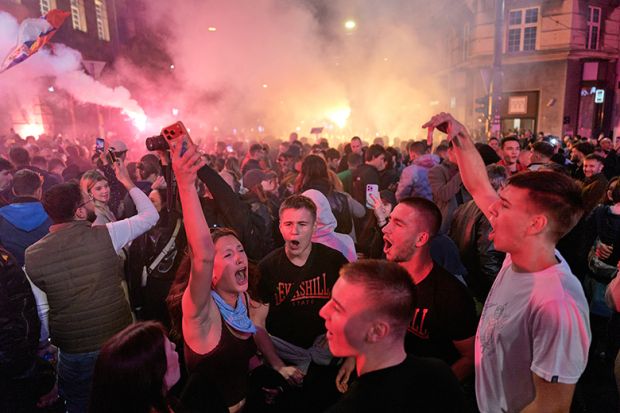
Student anti-government demonstrators in Serbia have won a historic victory in snap parliamentary elections but now face the challenge of turning a protest movement into a functioning government.
The movement, known as Student List – Students Win, is projected to win about 140 seats in the 250-seat parliament, putting an end to right-wing populist leader Aleksandar Vučić’s 14-year rule.
Sunday’s elections came after nearly two years of protests that began after the collapse of a canopy at a railway station in the city of Novi Sad that killed 16 people. Students accused authorities of failing to tackle corruption and demanded accountability over the disaster.
The student-led protests in 2024, which began with campus blockades, spread to 400 cities and towns across the country. The group eventually put together a list of candidates including university professors, doctors, athletes and other professionals to run in the parliamentary elections, pledging to fight corruption and to reduce political interference in public institutions.
Despite its victory, the student movement has not yet named a prime minister. The top candidate is Ilija Srdanović, a cardiologist and professor at the University of Novi Sad, but experts say he is not likely to take on the role.
Florian Bieber, professor of South-east European politics at the University of Graz, described the victory as a “major breakthrough”, saying the scale of the result had surprised observers.
He said the outcome showed strong public support for universities, which had faced political pressure, attacks from Vučić and hostile media coverage over the past two years. The win would help restore academic freedom which had been curbed across universities in the country, he stressed.
“One of the key demands of the movement was increased funding for higher education and also general education, so certainly this will become a priority,” he said.
But he warned that loyalists of the outgoing government remained in management and advisory positions across public institutions. “There’s a question of how these people will behave,” he said.
Eric Gordy, professor of political and cultural sociology at UCL, said the movement was able to succeed because students were seen as independent of the political establishment. “This is a grassroots, leaderless, bottom-up movement,” he said, adding that there was strong solidarity between students and professors during the protests.
But Gordy warned that turning a protest movement into a government could bring new challenges. He said many of the candidates lacked political experience and that the movement had also avoided taking clear ideological positions to attract a broad range of supporters, but governing would force its members to make difficult political choices. “Now they’ll have to [take a stronger political stance], and that means there could be internal fighting,” he added.
Ljubica Spaskovska, a senior lecturer of history at the University of Exeter, described the victory as a seismic moment of “intergenerational solidarity” that brought together younger activists and established academics.
She also drew parallels with the youth-led Otpor movement that helped overthrow Slobodan Milošević in 2000, warning that political victories did not always deliver the changes supporters had hoped for.
“[The student movement] refers to direct democracy in their manifesto. So I think a horizontal structure like that would be challenging to turn into a more hierarchical political structure. But it’s not impossible,” she added.
While the candidates’ lack of political experience could make governing challenging, Spaskovska said it could also be an advantage because voters are eager for new figures who had not been compromised by years of involvement in politics.
Register to continue
Why register?
- Registration is free and only takes a moment
- Once registered, you can read 3 articles a month
- Sign up for our newsletter
Subscribe
Or subscribe for unlimited access to:
- Unlimited access to news, views, insights & reviews
- Digital editions
- Digital access to THE’s university and college rankings analysis
Already registered or a current subscriber?