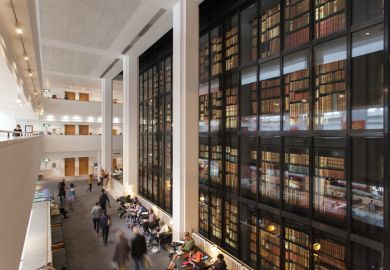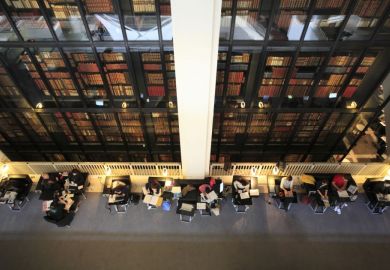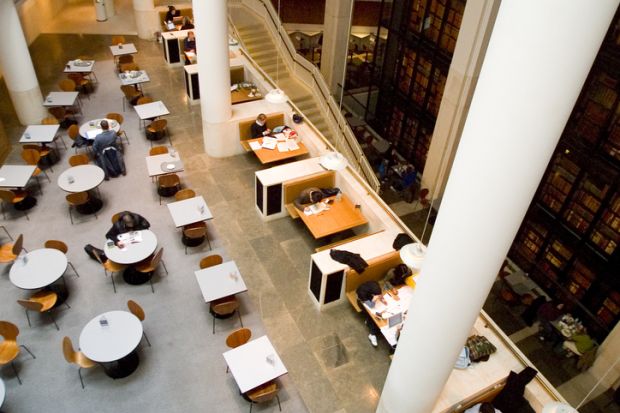
The British Library’s plan to repurpose some of its reading rooms as paid-for workspaces has sparked concern among researchers.
In an update sent to library users on 21 October, the library says it wants to modernise some of its spaces, seeking to ensure that it generates “the necessary revenue to keep our core services free”.
The library writes: “Next year we’ll also begin work on repurposing our Science and Social Sciences Reading Rooms to become a flexible workspace and generate a new revenue stream.”
It added that the “technology-enabled workspace will be available for hire by workers and businesses for coworking, collaboration and meetings” and will exist alongside the institution’s free spaces for study and collection access. Times Higher Education has asked the library for more details.
Simon Harley, associate fellow of the Royal Historical Society, expressed concern over the plans on X.
Speaking to Times Higher Education, he said: “My principal concern is that the British Library is embarking on this long-term plan when it clearly hasn’t…returned service to pre-cyberattack levels.”
The library has suffered from the fallout of a major cyberattack in 2023 that impacted many of its digitised research resources, some of which are yet to recover.
Harley noted, for example, that “a huge amount of material” digitised in collaboration with the European Union’s European initiative for the centenary of the First World War is still not available, three years down the line.
Posting on X about the update, James Crossland, professor of international history at Liverpool John Moores University said: “Ever since the cyberattack, the British Library has been blundering down [the] enshittification road.”
Georgy Kantor, fellow in ancient history at the University of Oxford, said the plans to charge were “utterly horrible”.
However, Margot Finn, vice-president for research and higher education policy at the British Academy, told THE that “the core and continued problem the library faces is the cost and consequences of the 2023 hack: this made the library unusable for ages and has severely cut into not only their reserves but their user base.”
“So as long as they are simply relocating expert staff into new extant reading rooms, the desire to generate income from one reading room may well be a necessary step to preservation,” she said.
Regarding the reading rooms impacted, the library assured regular users “that our commitment to science and social sciences remains as strong as ever”.
“The services we offer here will relocate to other Reading Rooms, maintaining the same level of specialist support for your research and access to the collections that you receive currently.”
Peter Mandler, emeritus professor of modern cultural history at the University of Cambridge, told THE that he did not share the concerns raised on social media as a sometime user of the rooms set to be affected by the changes.
“I have never been entirely clear why [social sciences] needed a separate reading room,” he said, noting that in his experience it is usually “thinly populated”.
“It might be useful to know what they will do with the open-shelf reference works in the repurposed rooms” he added.
The British Library also highlighted that this summer it has started on its “multi-purpose extension”, which is due to open in 2032.
Register to continue
Why register?
- Registration is free and only takes a moment
- Once registered, you can read 3 articles a month
- Sign up for our newsletter
Subscribe
Or subscribe for unlimited access to:
- Unlimited access to news, views, insights & reviews
- Digital editions
- Digital access to THE’s university and college rankings analysis
Already registered or a current subscriber?