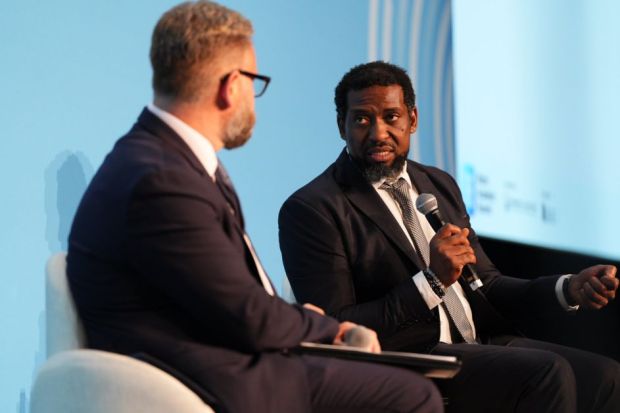
South Africa’s higher education minister has conceded that the trouble-hit National Student Financial Aid Scheme (NSFAS) is unsustainable and acknowledged that the country will have to consider alternative funding models.
Speaking at Times Higher Education’s World Academic Summit, being held in Cape Town, Buti Manamela said student loans might have to play a greater part in the system but emphasised that the focus would remain on ensuring that undergraduates from poorer backgrounds could continue to enrol.
NSFAS’ funding shortfall has grown to R15 billion (£691 million) and is projected to hit R33 billion by 2029.
The scheme has struggled to keep up with demands on its funds ever since former president Jacob Zuma promised in 2017 that students from households with a combined annual income below R350,000 would be eligible for free tuition and financial support.
Students have complained they have received late or no payments from the funding body, an issue that contributed to the student riots seen throughout the country last year.
Meanwhile, there have been reports that public universities are owed billions of rands in NSFAS funding.
The situation has been exacerbated by reports of poor governance, with Manamela appointing an administrator earlier this year in an attempt to stabilise the organisation.
Speaking at the summit, hosted by the University of Cape Town in partnership with the University of Bristol, the minister said that increasing student finance had been a “major intervention” which had helped millions of students but there was now a need to “protect it and ensure it becomes sustainable”.
“The current model is unsustainable and each time we have had to exceed what is allocated by almost double,” Manamela said. “Let’s explore some external funding, fundraising, let’s look at our students and [how they can] contribute to their accounts, and the loan component of the system.
“But [we have to] maintain the principle that access has to target particularly those who are from poor backgrounds. So the principles will have to be maintained, but how do we get the scheme to sustain itself?”
Manamela was also asked whether access to NSFAS funding would be extended to students from private universities, which are playing an increasingly prominent part in the South African higher education system.
The minister said that private higher education providers had been asked to propose how eligibility to the scheme could be widened, and that the government would follow up on this.
“I think it’s a discussion that will continue,” Manamela said.
Register to continue
Why register?
- Registration is free and only takes a moment
- Once registered, you can read 3 articles a month
- Sign up for our newsletter
Subscribe
Or subscribe for unlimited access to:
- Unlimited access to news, views, insights & reviews
- Digital editions
- Digital access to THE’s university and college rankings analysis
Already registered or a current subscriber?