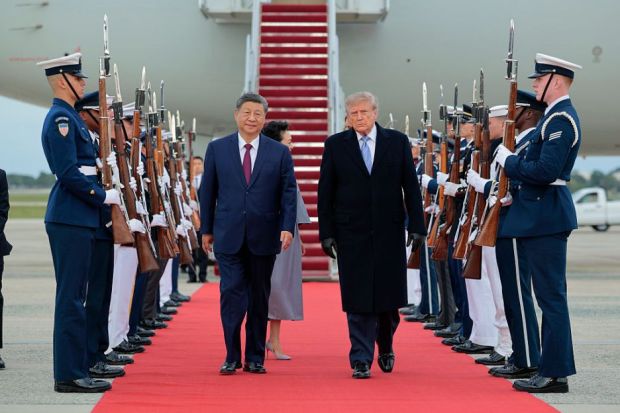
Donald Trump has been urged to raise the detention of American scholar Min Zin during his meeting with Xi Jinping in Washington, potentially giving academic freedom a key spot in the state visit’s agenda.
Researchers have been calling for the release of Zin, who was detained at Kunming Changshui International Airport on 3 June while travelling at the invitation of a Chinese university to participate in an academic workshop. The US citizen was travelling on a 10-year multiple entry visa.
Chinese authorities accused Zin of “espionage and endangering national security”. Allies of Zin said there was no evidence to support those claims.
Trump was also expected to raise the detainment of Youlin Chen with the Chinese president, who arrived in the US on 23 September. Chen is a Chinese-born American seismologist who has been detained in China for nearly two years.
Clare Robinson, advocacy director of Scholars at Risk, told Times Higher Education that governments across the globe used detentions to “suppress scholarly inquiry”.
“We have seen Chinese authorities use such detentions to suppress dissent over the years…demonstrating that the use of wrongful detention is part of a long-term campaign to silence those who question the status quo, who have new ideas,” Robinson said.
“Ideas are not crimes. Min Zin should not be in prison for his ideas, and Scholars at Risk calls for his immediate release.”
Speaking on Capitol Hill last week, Sylvia Zin said she had not been able to speak directly with her husband and learned about his condition through US consular officials who visit him.
Zin told the House Foreign Affairs Committee that her husband was initially being interrogated for four to six hours every day and she has “no idea” where he is being held under investigation.
“Min’s lifelong work is entirely dedicated to independent academic freedom,” she said.
A former student activist in Myanmar’s (then Burma’s) democracy movement in 1988, Zin is now executive director of the Myanmar Institute for Strategic and Policy Studies (ISP-Myanmar).
ISP-Myanmar is an independent thinktank that explores China’s activities and strategic development in Myanmar, with Zin believed to divide his time between the US and Myanmar, as well as having a base in Thailand.
Zin is also a PhD candidate in Travers department of political science at the University of California, Berkeley.
A close friend of Zin, Win Min, a policy adviser and researcher based in Thailand, told Times Higher Education that he had discussed the June trip with Zin but neither considered it a “security risk”.
Zin had travelled to Shanghai the previous year to attend an academic conference without incident.
“Any time he travels to China, we talk about it. About the trip, where he would be going, the agenda that he would discuss,” said Min.
Min said that Zin was working on issues that are sensitive to China, including rare earth mining in Myanmar and China’s role in Myanmar’s political conflict.
Asked whether it was becoming more risky for scholars to travel to China for professional and academic reasons, Min said that China was taking an increasingly “precautionary or extreme reaction” in relation to engagement on Myanmar.
“I think China has become quite vigilant in terms of the information about its activities and investment activity.”
Register to continue
Why register?
- Registration is free and only takes a moment
- Once registered, you can read 3 articles a month
- Sign up for our newsletter
Subscribe
Or subscribe for unlimited access to:
- Unlimited access to news, views, insights & reviews
- Digital editions
- Digital access to THE’s university and college rankings analysis
Already registered or a current subscriber?