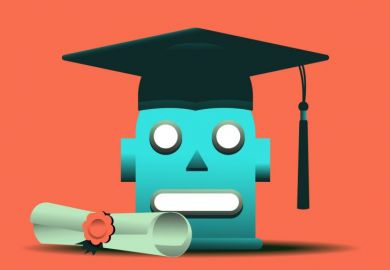
Academic researchers are considerably under-reporting their use of artificial intelligence, according to a survey conducted by Oxford University Press (OUP).
In a survey of researchers from around the world, significantly more than half (64 per cent) of the 2,606 respondents reported benefiting from incorporating the technology into their research. But only 36 per cent said they recorded how they used the technology as they conducted their research. And 46 per cent of journal authors and 39 per cent of book authors said they had not “fully” acknowledged AI’s place in their manuscript preparation, particularly in drafting the narrative.
Meanwhile, 25 per cent of peer reviewers said they had not divulged their use of the tool, particularly in language editing.
Additionally, 48 per cent of researchers had not fully disclosed AI use in grant applications; common uses were narrative drafting, translation, editing and plain language summaries.
The report reveals that some 44 per cent of researchers are concerned that disclosing their use of artificial intelligence will negatively impact how others view their work.
The survey follows findings released last month revealing that the use of large language models in US research funding proposals has increased dramatically since 2023, which some argue results in less original and more generic ideas that often replicate prior projects.
The survey suggests that there is a “greater proportion” of AI sceptics in the arts and humanities, with scientists more likely to regularly use artificial intelligence in their work. Those starting out in research are also more likely to have used the technology.
The most common reported usage was to discover and summarise existing articles in a particular subject area. One respondent said this “reduces the time to locate arcane material. What might have taken hours [or] weeks in a library can be found instantaneously.”
In a foreword to the survey, Sophie Goldsworthy, global academic publisher at OUP, said the findings could help inform how publishing and research communities “work together to build a durable, AI-enabled future”.
Nearly three-quarters (74 per cent) of survey respondents felt there was a general lack of clarity about what AI use should be disclosed, but Goldsworthy said that “guidance about AI use, disclosure and authorship has been developed across the industry in an attempt to ensure the utmost integrity in research outputs, grant applications and peer reviewing”.
Nevertheless, in light of the survey results, OUP has updated its guidelines to stress that authors must disclose AI use in all work that leads to books and journal articles.
In addition, OUP’s authors are to be told that they are responsible for reviewing and verifying any AI-generated content in their work.
David Clark, OUP’s managing director, said: “There remain major differences in how researchers are adopting, applying and disclosing [AI]. We continue to prioritise working with the research community to develop clear publishing standards that support readers and authors in an AI-enabled world.”
On Friday, Springer Nature released its own revised guidance on AI use, shifting the emphasis from prohibition to transparency.
Register to continue
Why register?
- Registration is free and only takes a moment
- Once registered, you can read 3 articles a month
- Sign up for our newsletter
Subscribe
Or subscribe for unlimited access to:
- Unlimited access to news, views, insights & reviews
- Digital editions
- Digital access to THE’s university and college rankings analysis
Already registered or a current subscriber?