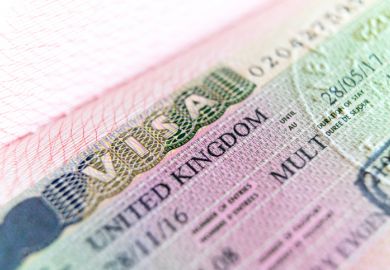
A High Court judge has dismissed a legal challenge brought by prospective international students prevented from studying in the UK by the government’s “visa brake”.
Seven students had hoped to overturn the measure imposed by the Home Office in March, which suspended study visas for citizens of Afghanistan, Sudan, Cameroon and Myanmar.
They included Razan Farah, who held an offer for the MSc in applied digital health at the University of Oxford, and has ambitions to “advance digital health in Sudan”, and Rawan Ali, who had wished to study an MSc in women’s health at UCL, where she had deferred her place until 2027-28 as a result of the brake.
High Court judge Karen Steyn has ultimately sided with home secretary Shabana Mahmood, finding that she was not wrong to interpret Home Office data in the way she did.
“I reject the contention that the Secretary of State could not rationally derive any indication of misuse of the student visa route,” the judgment found.
Lawyers for Mahmood had argued that there is a “very high level of risk” that people issued visas from the suspended countries would later go on to claim asylum, potentially contributing to abuse of the system.
Lawyers for the seven potential students, meanwhile, who come from Sudan and Afghanistan, disputed the idea that applying for a student visa is a “predictive” action of future behaviour.
They suggested that the Home Office decision failed to consider the lack of options for further study facing the candidates in their countries of origin, but Steyn was unconvinced by this argument.
“In my view [Mahmood] was not rationally obliged to regard rules concerned with immigration and border control as an appropriate vehicle for addressing the consequences of discrimination abroad,” the judge writes.
“The claimants do not have any right or legitimate expectation that they will be permitted to enter the UK to study here,” Steyn adds.
Despite rejecting the claim overall, the judge did find aspects of the challenge to have been legitimately arguable.
“Nonetheless, the student visa brake has potentially serious consequences for them and, no doubt, for many others who are affected by it.”
She continues: “It has dashed the hopes and expectations of some exemplary, public-spirited students who had succeeded in securing places at prestigious universities, many of whom had secured or been short-listed for scholarships. Being prevented from taking up a place in higher education may have profound and lasting consequences for an individual’s life chances.”
Steyn said that “the importance of the interests affected and the nature of the potential consequences call for heightened scrutiny”.
It is understood some of the claimants are considering appealing the decision.
Register to continue
Why register?
- Registration is free and only takes a moment
- Once registered, you can read 3 articles a month
- Sign up for our newsletter
Subscribe
Or subscribe for unlimited access to:
- Unlimited access to news, views, insights & reviews
- Digital editions
- Digital access to THE’s university and college rankings analysis
Already registered or a current subscriber?