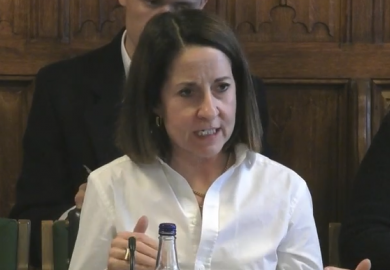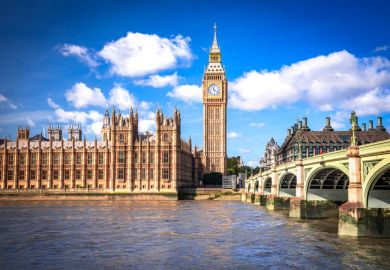
Over the weekend, it became clear that the Department for Science, Innovation and Technology (DSIT) was for the chop along with its two key ministers, Liz Kendall and Patrick Vallance. The news has since been confirmed. DSIT is to be folded into the Department for Business and Trade (DBT), which will be renamed the Department for Business, Innovation, Science and Trade.
Many important figures in our sector spoke out about this change as soon as it was first mooted. Adam Tickell, the vice-chancellor of the University of Birmingham, took to LinkedIn, for example, to warn “universities and the research system will be a small cog in a large DBT wheel”. He went on to express “hope that the rumours of DSIT’s demise are unfounded”.
Vivienne Stern, the CEO of Universities UK, similarly hoped DSIT “doesn’t disappear”. She warned that “in DBT there would be immense pressure to move more of the budget towards today’s priorities”.
I sympathise with these views. Endless Whitehall reorganisations tend to be a way of dodging hard policy rather than delivering it. It sends a signal that real change is under way even when, as in this case, it is not clear what on earth it all means for policy.
Moreover, it takes years for Whitehall mergers to settle down, and DSIT is being shuttered just as it was taking off. Established by Rishi Sunak in early 2023, it lasted just over three years, only a little longer than the earlier Department for Innovation, Universities and Skills, which survived for about two years, from 2007 to 2009, before being similarly subsumed into what was then the Department for Business, Innovation and Skills.
The Institute for Government (IfG) warned long ago (2010) that machinery of government changes is “often announced at very short notice”, “usually poorly managed” and “always costly”. And the institute has separately shown that, while some departments, such as the Home Office and the Ministry of Defence, tend to sail on unchanged from government to government, it is the three areas where universities have most interest that are mucked around with most often: skills, higher education and research.
However, the initial responses to the changes that we have heard from the higher education sector may turn out to be too negative. The new arrangements need not be a disaster. The precedent of science and research sitting within the business department between 2009 and 2023 was a pretty happy one. Being inside a big department gives extra heft around the Cabinet table.
As Greg Clark, the former secretary of state for business, has just pointed out on X, “Government has too many silos. Reuniting the science, innovation and business departments…can make the whole more powerful, joined-up and effective.”
Nonetheless, even he is rightly not over the moon about the new arrangements. This is because they leave responsibility for much of what universities do in the Department for Education (DfE), which gives higher education a lower priority than early years, schools or special educational needs.
The split between teaching and learning on the one hand and science and research on the other has caused confusion. It is painfully obvious which bits of the Post-16 Education and Skills White Paper, published last October, were written by the DfE and which were written by DSIT. And now DSIT is being wound up before we have found out exactly what its “specialisation” agenda meant for broad-based universities and the volume of university-based research.
For good reason, the IfG’s 2010 report recommended that “departmental reorganisations should be unlinked from the immediate context of ministerial reshuffle announcements”. It also recommended that “any large-scale changes should not be implemented until after an affirmative parliamentary resolution”. Such an approach would have allowed for a proper conversation over whether the new arrangements make sense.
In the end though, it is important to remember that whatever the precise Whitehall arrangements, they will always be imperfect. This is because you have to separate different policy areas into different departments, so some boundaries are inevitable.
And what matters even more than the arrangements is the people in charge. Are they competent? Do they understand their brief? Do they get on with the ministers at other government departments whose interests overlap? What Cabinet committees do they sit on? And do they have the ear of No 10 and the Treasury?
On that, time will tell.
Nick Hillman OBE is chief executive of the Higher Education Policy Institute and a former special adviser to the minister for universities and science.
Register to continue
Why register?
- Registration is free and only takes a moment
- Once registered, you can read 3 articles a month
- Sign up for our newsletter
Subscribe
Or subscribe for unlimited access to:
- Unlimited access to news, views, insights & reviews
- Digital editions
- Digital access to THE’s university and college rankings analysis
Already registered or a current subscriber?