This time 10 years ago, many academics and universities were campaigning hard for a “remain” vote in the upcoming Brexit referendum.
Dire warnings were issued about the effect the UK’s withdrawal from the European Union would have on research networks, student flows and, most of all, the willingness of the EU’s best and brightest academics to come to – or remain in – the UK.
The first two of those predictions do seem to have come to pass over the ensuing decade. UK participation in Horizon Europe was paused after Brexit and restored only in 2023, resulting in the share of EU-funded income won by UK universities declining from 16 per cent in 2019 to less than 11 per cent in that year, according to one study. And the number of EU students in the UK fell sharply after they became liable for full international fees in 2021; the number of new starters was 57 per cent lower in 2023-24 compared with 2020-21, according to the University of Oxford’s Migration Observatory.
But it is a somewhat different story when it comes to EU academics.
Many were previously lured to the UK by the country’s strong scientific traditions, world-class universities and the absence of any need for visas or residence permits. Many observers feared that suddenly being treated like any other overseas national, with all the immigration bureaucracy and expense that comes with that, would cause many EU nationals to consider that lure well and truly tarnished.
But while the international profile of UK academia now looks quite different from what it did in 2016, it is far from diminished – and even its EU quarter has held up remarkably well.
The UK academic workforce as a whole has grown by nearly a quarter (23 per cent) since 2014-15, hitting about 245,000 by 2024-25, the most recent year for which Higher Education Statistics Agency data is available (although that figure represented a unique 1 per cent decline from the previous year’s high point). During this period, the sector has stabilised around a large domestic core while becoming more globally diverse, with the UK share of the total workforce actually falling, while the non-EU share has expanded considerably and the EU share has declined only modestly.
UK academic workforce
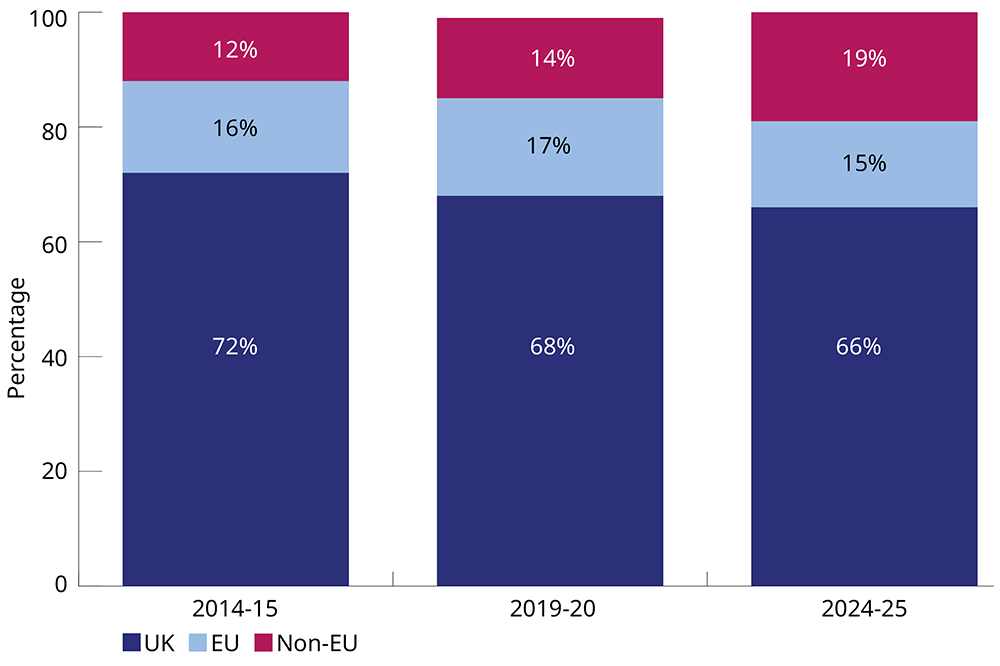
In 2014-15, 72 per cent of the academic workforce were UK nationals. By 2019-20 – the final academic year before Brexit formally took effect – that had fallen to 68 per cent, and it carried on falling, reaching 66 per cent by 2024-25. The proportion accounted for by EU nationals also fell post-Brexit by two percentage points to 15 per cent – but that is only one percentage point lower than the figure in 2014-15.
The real change has been in non-EU representation. In 2014-15, that stood at 12 per cent, but it has risen to 19 per cent by 2024-25, reinforcing a diversification trajectory that predated the referendum. In 2014-15, the non-EU international cohort was more concentrated than it is now, with the US accounting for 17 per cent of all non-EU nationals, China 15 per cent, India 9 per cent, Canada 6 per cent and Australia 6 per cent. Iran, Russia and Japan made up just 3 per cent each.
But while the Chinese and Indian cohort has continued to grow post-Brexit, international growth since 2019-20 has also been driven by significant rises in recruitment from Nigeria, Pakistan, Brazil, Iran, Turkey, Egypt and South Korea.
In percentage terms, the number of academics from Hong Kong has grown over the past decade, rising from only 105 in 2014-15 to 150 in 2019-20 and then accelerating to 420 in 2024-25, as new migration pathways to the UK became available to Hong Kong residents in the wake of the passing of the National Security Law. Hesa classifies academics from Hong Kong separately from those from the Chinese mainland.
While causation cannot be inferred, the timing and scale of the shift towards non-EU international recruitment becomes clearer in absolute numbers. Since 2019-20, EU academic staff numbers decreased by 1,460 while non-EU staff increased by 15,040.
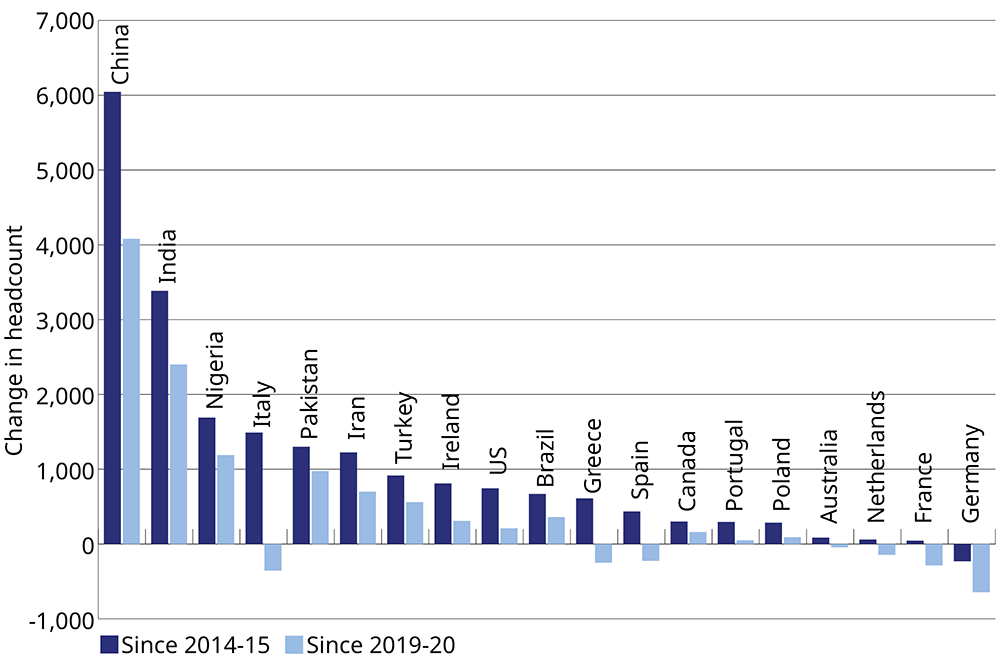
Among the 20 countries that contribute the most international staff to the UK, the biggest rises between 2019-20 and 2024-25 were concentrated outside Europe. China added the most academics (4,080), followed by India (2,400), Nigeria (1,190), Pakistan (975), Iran (700) and Turkey (560).
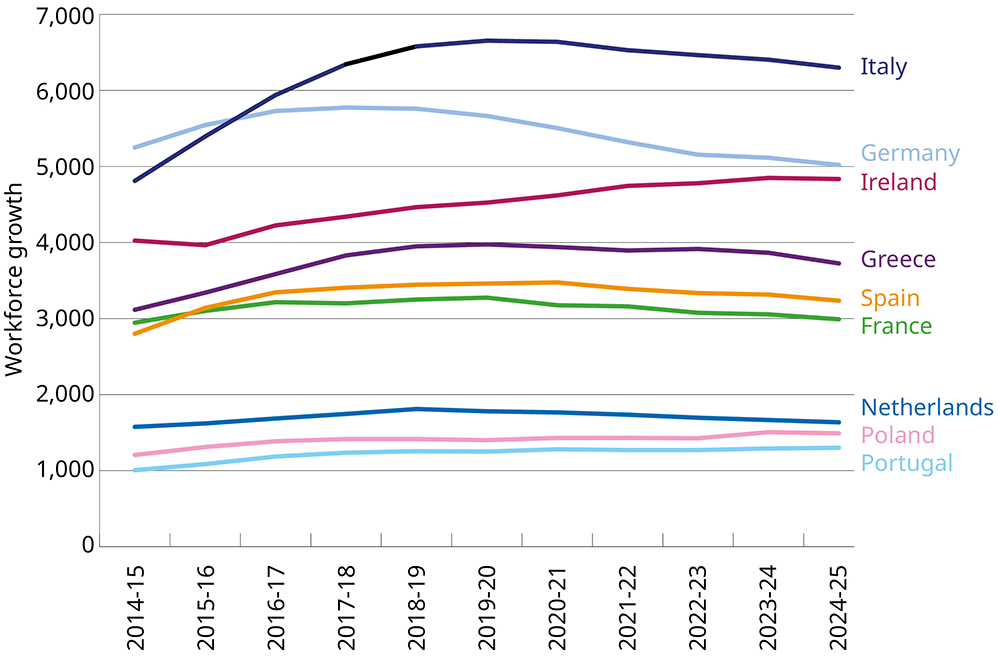
By contrast, several major EU contributors have seen modest contractions, including Germany (-645), Italy (-355), France (-285), Greece (-250), Spain (-225) and the Netherlands (-145). Yet others remained stable or recorded slight growth, such as Ireland (+310), Poland (+90), Slovakia (+55) and Portugal (+50).
Change in academic headcount
Change in sector share
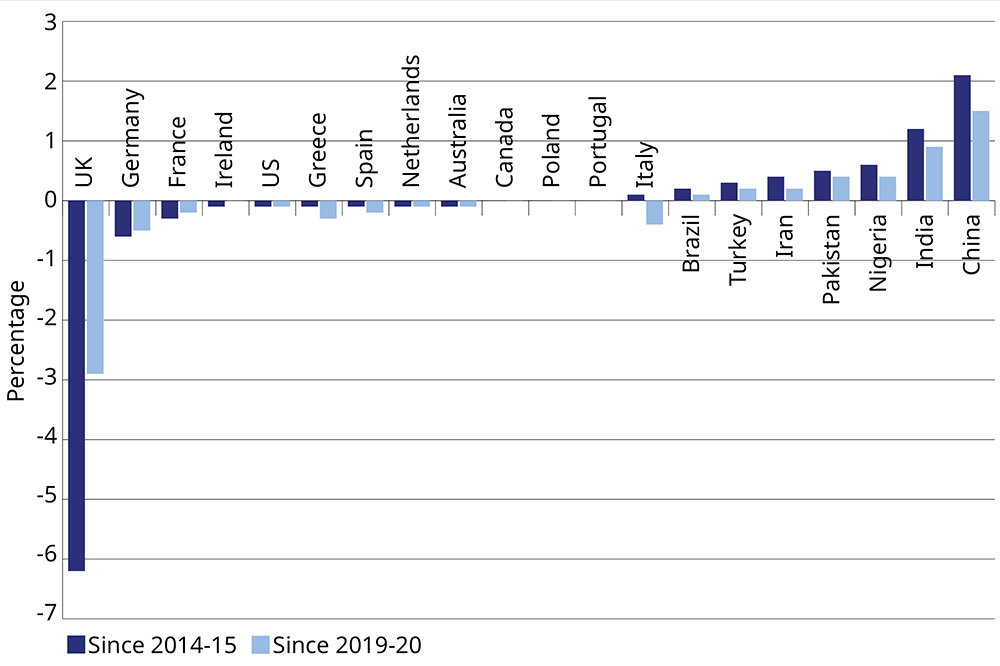
While the UK share of the whole fell by around three percentage points, the number of UK academics actually rose by 7,400, reflecting the overall expansion of the sector.
In 2014-15, the top international contributors to the UK academic workforce were predominantly European, headed by Germany (5,250), Italy (4,810) and Ireland (4,025). There were also significant cohorts from Greece, France, Spain, the Netherlands, Poland and Portugal. Non-EU nationals, such as the Americans, Chinese, Indians, Canadians and Australians were also present, but mostly in smaller numbers.
Even by 2019-20, this broad structure remained intact, although signs of diversification were emerging as Iran and Nigeria entered the top ranks, contributing more than 1,000 academic staff. And by 2024-25, the composition of the leading nationality groups had become much more globally diverse.
EU academic workforce growth, selected countries (2014-25)
Non-EU academic workforce growth, selected countries (2014-25)
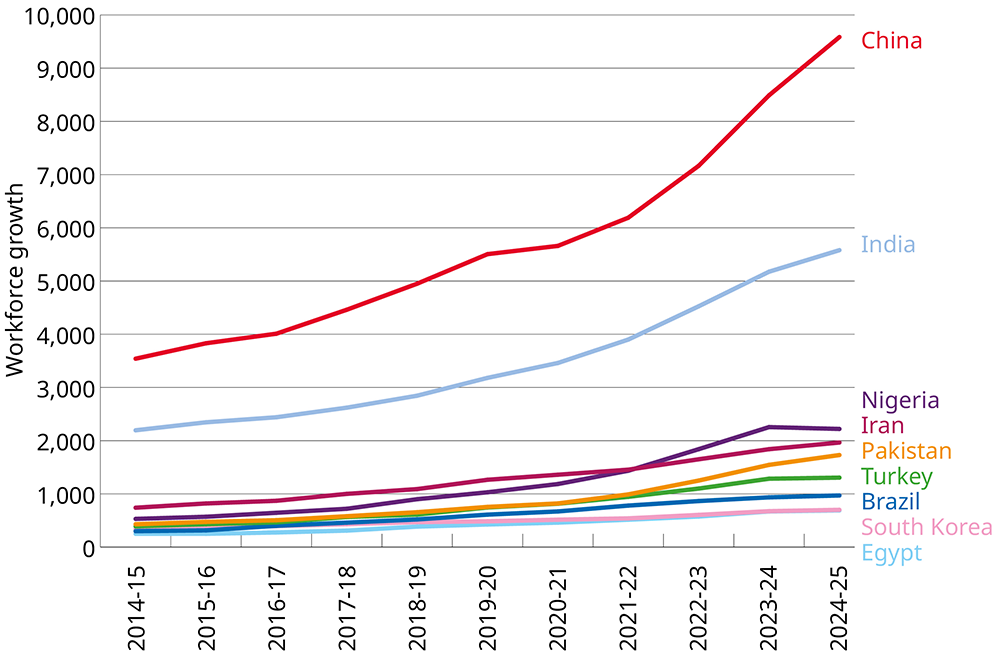
China has emerged as the second-largest nationality after the UK, with 9,585 nationals. India ranks fourth, with 5,580, and the US seventh, with 4,650. While Germany, Italy and Ireland remain significant contributors, their relative dominance has diminished, and the top 20 nationalities now also include Nigeria, Iran, Canada, Pakistan, Australia, Turkey and Brazil.
International staff are much more common in the Russell Group than elsewhere in the sector. In 2024-25, the mission group’s 24 universities employed the majority of all UK international academics: 57 per cent of both EU and non-EU nationals. Yet the trends within the Russell Group also mirror the national pattern: EU staff have decreased slightly since 2019-20, by 2.4 per cent, while non-EU staff have risen by almost 50 per cent, from 18,005 to 26,755.
Despite that, the total share of Russell Group staff accounted for by non-EU nationals has increased only modestly, from 54 per cent in 2014-15 to about 57 per cent in 2024-25, largely because the overall Russell Group academic workforce expanded at the same time by 35 per cent. That was significantly faster than the sector-wide figure of 23 per cent; UK nationals alone have grown by 23 per cent since 2014-15 within the Russell Group.
The broad trend is clear: the international growth within research‑intensive universities has moved decisively beyond Europe, reflected in the fact that the absolute growth in international staff is overwhelmingly driven by non‑EU academics.
These shifts also have disciplinary consequences because the proportions of EU and non-EU staff vary by subject.
EU academics have a fairly balanced disciplinary distribution. Their largest concentrations in 2024-25 were in medicine, dentistry and health (22 per cent), followed by biological, mathematical and physical sciences (19 per cent), social studies (14 per cent), engineering and technology (13 per cent) and humanities, language-based studies and archaeology (9 per cent).
Non‑EU academics, by contrast, were heavily concentrated in STEM and applied fields, particularly engineering and technology, where their representation is nearly double that of EU staff.
In 2024-25, 25 per cent of non‑EU academics were in engineering and technology; 17 per cent were in medicine, dentistry and health; and another 17 per cent were in biological, mathematical and physical sciences. There were additional concentrations in administration and business studies (13 per cent) and social studies (12 per cent).
Importantly, this pattern is mirrored in recent growth: of the 15,010 additional non‑EU academics recruited since 2019-20, over a quarter entered engineering and technology (26 per cent), with further growth concentrated in medicine, dentistry and health (18 per cent), administration and business studies (16 per cent), the biological, mathematical and physical sciences (14 per cent) and social studies (12 per cent).
These subject areas, then, are becoming increasingly reliant on non‑EU mobility. Of the nearly 11,500 non-EU academic staff working in engineering and technology disciplines in 2024-25, for instance, 30 per cent were Chinese – more than double the next biggest cohort, Indians (14 per cent). This may be considered particularly risky given the political sensitivity that has arisen over academic collaboration with China owing to issues such as intellectual property and security concerns.

Moreover, there can be no guarantee that international staff, whether Chinese or otherwise, will continue to want to come to the UK in the same numbers as they do now. Geopolitical tensions and public concerns about immigration levels reshape not only institutional strategies but also the lived conditions of migrant academics working in the UK.
All international academics, not just EU nationals, now have to navigate a far more constrained and administratively demanding immigration environment than they used to, with visa compliance requirements and immigration-related costs such as the health surcharge rising sharply in recent years. And skilled worker visas tie employees to their sponsoring institution, so if salaries are aligned only with the minimum visa threshold, migrant academics may find that their income does not reflect the financial pressures created by the immigration system – or the cost of living in the UK.
Yes, the figures discussed above suggest that the perceived benefits of UK academic employment continue to be seen to outweigh these barriers, including by academics from low-income countries. However, this should not lead the sector to assume that international mobility will remain effortless or uninterrupted.
As the academic workforce becomes more globally distributed, UK higher education gains broader international reach, but also greater exposure to geopolitical volatility owing to visa policy shifts, diplomatic tensions or immigration caps. In this context, universities cannot overlook the challenges their migrant academics face or the vulnerabilities they themselves inherit because of their staff demographics.
The future trajectory will be shaped not only by institutional strategy, but also by the stability of migration regimes, research funding frameworks and wider geopolitical conditions. Universities need to be increasingly “crisis‑ready” – with workforce planning, support structures and risk assessments that reflect the realities of a globally sourced academic labour force.
Fadime Sahin is a course lead and senior lecturer on the MSc in accounting and finance at the University of Portsmouth.
Register to continue
Why register?
- Registration is free and only takes a moment
- Once registered, you can read 3 articles a month
- Sign up for our newsletter
Subscribe
Or subscribe for unlimited access to:
- Unlimited access to news, views, insights & reviews
- Digital editions
- Digital access to THE’s university and college rankings analysis
Already registered or a current subscriber?