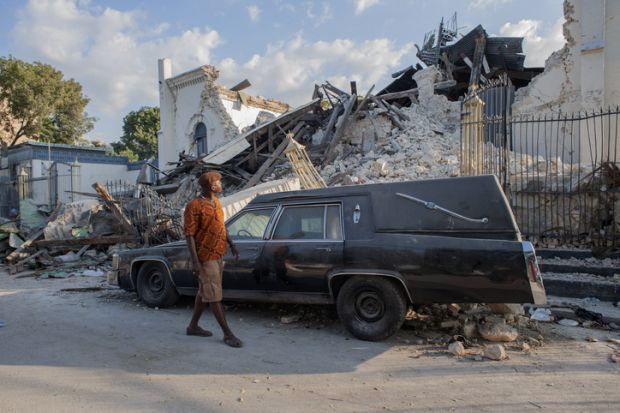
The catastrophic earthquake that struck Haiti in 2010 is estimated to have impaired or completely demolished 87 per cent of its higher education institutions.
At the same time, professors and students were among those who fled the Caribbean country in the aftermath of the tragedy.
It was the nail in the coffin for an already fragile tertiary system that had been beset by years of underfunding – but it hadn’t always been this way.
“I remember a time when Haitian degrees were highly regarded; when Haiti was both a land of learning and a land of transmission,” said Laurent Saint-Cyr, the chair of the Caribbean nation’s transitional governing council, in a speech in January.
“A time when the road to knowledge ran in both directions: people left Haiti to learn, but they also came here to study. This credibility has weakened in recent years, but it can be restored.”
Saint-Cyr’s speech was marking the launch of a new national Council for Higher Education and Scientific Research (ANESRS), created to regulate and oversee Haiti’s 176 higher education institutions.
“Haiti is at a critical stage in the transformation of its higher education and research system,” Jacques Abraham, the council’s high commissioner, told Times Higher Education.
“The growing need for quality assurance, stronger institutional governance and internal recognition of Haitian degrees made the establishment of a dedicated regulatory and strategic body both necessary and urgent.
“We aim to build a coherent, transparent and performance-driven higher education system that contributes directly to national development.”
The council has been created at a particularly tricky time for Haiti. The past decade has seen armed gangs take control of large parts of the country and food insecurity spread to half of the population.
Although there are ongoing efforts to restore democracy, elections have not been held since 2016. This turbulence has further damaged the country’s education system.
“The buildings of several faculties at the State University of Haiti have been looted and set on fire; the premises of several private universities have suffered the same fate, and the equipment in numerous research laboratories has been vandalised,” said Evens Emmanuel, a Haitian academic and council member.
However, he said, the sector has adapted and resisted, including by launching more online education services. Supporting these initiatives will be key to the new agency’s role.
And, while restoring higher education to its former glory may not seem like a priority in the face of Haiti’s other challenges, Abraham and Emmanuel are confident that improving the quality of the system will uplift the country as a whole.
These wide-ranging issues “undeniably create a complex operating environment”, said Abraham. “It would be unrealistic to suggest that higher education reform takes place in isolation from these broader realities.
“However, rather than viewing these challenges solely as obstacles, we see them as reinforcing the urgency of our mission.
“In times of instability, strong institutions become even more essential. A structured, transparent and credible higher education system contributes to stability by building human capital, reinforcing professional standards and restoring confidence in public institutions.”
The new agency’s immediate priorities include bolstering the country’s research output. “Why is each of [Haiti’s] 176 universities not yet able to produce at least one international publication in an indexed journal per year?” asked Emmanuel.
He said he believed ANESRS should focus on developing career plans for academics and a support programme for Haitian scientific journals, which would include strengthening the national Open Science policy.
And, while the country wants to restore international scientific links, Emmanuel is adamant that any partnerships must be equitable, referencing one of his own papers that accuses Western actors of treating institutions in the Global South “mainly as data collection sites”.
Abraham said the agency aims to establish Haiti “as a credible and reliable academic partner, capable of contributing to global knowledge while strengthening its own national priorities”.
“We do not view restoration as a return to the past, but as a modernisation effort grounded in Haiti’s intellectual tradition and aligned with global academic standards,” he continued.
“With the support of international partners, we believe Haiti can once again become not only a place where students leave to study, but also a place that attracts knowledge, collaboration and innovation.”
Register to continue
Why register?
- Registration is free and only takes a moment
- Once registered, you can read 3 articles a month
- Sign up for our newsletter
Subscribe
Or subscribe for unlimited access to:
- Unlimited access to news, views, insights & reviews
- Digital editions
- Digital access to THE’s university and college rankings analysis
Already registered or a current subscriber?