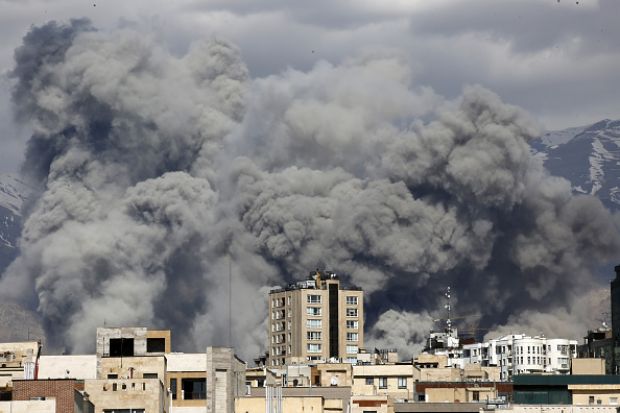
As the new war involving the US and Israel against Iran rages on, one question to which neither Donald Trump nor Benjamin Netanyahu appears to have an answer is what Iranian governance will look like when it is over.
Beyond insisting that the current regime must fall – and killing supreme leader Ayatollah Ali Khamenei and much of the rest of Iran’s senior leadership – the US and Israel appear willing to leave it to Iranians to determine their future, with Trump urging Iran’s people to “seize control” of their destiny and “take over” their government.
But what would the people do with power once they have it? The renewed wave of campus protests that the war interrupted offers a revealing glimpse into what any post-war political transition might look like – and it is not what many Western academics might expect.
During the very recent campus protests of Tehran’s Sharif University of Technology, something remarkable happened. Students chanted: “Its name is Aryamehr. Sharif is over.” To an outsider observer, the words might seem cryptic. But for those versed in Iran’s complex political iconography, they represent a seismic shift in students’ consciousness.
Aryamehr was the honorific title of Mohammad Reza Pahlavi, the last Shah of Iran, who was overthrown in the 1979 Islamic Revolution. The university itself was founded by the Shah as Aryamehr University. Its current name honours Majid Sharif Vafaghi, a former student and member of the leftist organisation Mojahedin-e Khalq (MEK), who was killed under disputed circumstances before the revolution, reportedly by the same organisation. By reclaiming the old name, students are, in effect, rendering a damning verdict on the past four decades.
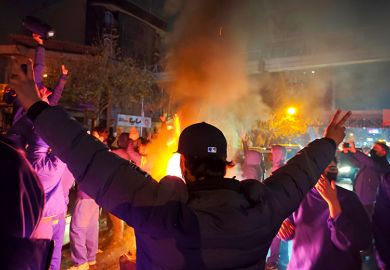
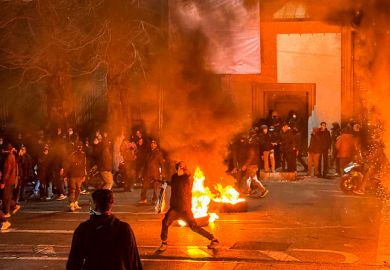
What made the protests historically noteworthy is not only that they closely followed the brutal repression of the previous waves of protests, which saw many thousands of people killed in January. It was also the explicit naming of an alternative to the Islamic Republic. Previous cycles of protest – from the 1999 dormitory attacks to the 2009 Green Movement and the 2022 Woman, Life, Freedom uprising – were largely defined by opposition to the current government rather than calls for a specific alternative.
Another example: students at Tehran’s Alzahra University chanted: “Alzahra is over. Farah is its name now.” The reference is to Farah Pahlavi, the Shah’s widow, who founded the university. At Ferdowsi University in Mashhad, around 2,000 students gathered singing Ey Iran, a patriotic anthem from the pre-revolutionary era. And at Tehran University, students unfurled Iran’s pre-revolutionary lion and sun flag while chanting: “The Shah is coming home. Zahhak will be overthrown,” invoking the mythic tyrant Zahhak as a reference to Khamenei. At various universities, Lion and Sun Associations have been formed that explicitly endorse Reza Pahlavi, the Shah’s son, as leader of a “transitional period” toward secular democracy.
The response from authorities, once again, was swift. Thinly veiled threats were issued by supreme court chief justice Gholam-Hossein Mohseni-Ejei – who is reportedly a member of a three-person council that has temporarily assumed leadership of Iran. In response, some universities moved to online-only instruction for the remainder of the Persian year, a tactic previously used to disperse protesters. And at least 180 students have received summons to disciplinary committees, with three already suspended for “disrespecting the national flag”.
But why would students – who, around the world, are associated with progressive politics – brave arrest and death to campaign for the restoration of a monarchy?
The secular democracy, national sovereignty and individual freedoms that Iranian students are demanding are all fundamentally liberal values. But in the Iranian context, these demands have fused with monarchist symbolism and anti-leftist sentiment, creating a political hybrid that defies easy classification.
For a generation born after 1979, the Pahlavi era has acquired a mythological quality, a lost golden age of secularism, prosperity and international engagement. This image is selective, glossing over the lack of political freedom under the Shah. But when students chant “Long Live the Shah”, they are engaging in symbolic politics, using the most potent available symbol to express total opposition to the current order. The Shah represents the antithesis of the Supreme Leader: secular, nationalist, outward-looking.
This explains why even students who might prefer a democratic republic find themselves chanting monarchist slogans. This is the politics of “anyone but them”, a radicalisation born of desperation; after decades of failed reform movements and crushed uprisings, many students have concluded that only total rupture will suffice.
The anti-leftism in slogans such as “Death to the three criminals: the cleric, the leftist, the Mojahedin” or “The sickle, the hammer, the turban; 1979 is over” comes from the fact that the Islamic Republic presents itself as the embodiment of anti-imperialist resistance. And that is how it is seen by some leftists abroad, too. The students point to the fact that leftists in Western academic departments are always quick to criticise Israel and the US but often remain largely silent about Iran’s crackdowns. In that sense, they see the left not as an ally but as an obstacle.
Students also believe that communist movements allied themselves with Ayatollah Khomeini’s Islamists to overthrow the Shah, and there is an element of truth to that: the MEK, for instance, was originally a left-leaning Islamist guerrilla group that fought the Shah, before later turning against the Islamic Republic. For today’s protesters, the group represents yet another ideological current that promised liberation but delivered repression.
So the protesters are not “progressive” in the Western campus sense. They are not marching for Palestine or demanding decolonised curricula. They are explicitly rejecting these frameworks as foreign imports, chanting “Not Gaza. Not Lebanon. My life for Iran”.
Not all students see the monarchy as representative of an idealised past. For some, monarchy is simply a strategic choice: a secular institution that could contain the deeply entrenched religious establishment. But the distinction hardly matters to the students: when you are facing down baton-wielding security forces, the niceties of constitutional theory recede into irrelevance.
Now the protests have been stopped by the war. The universities are closed until further notice, and the internet is almost dead again. But something has shifted within Iran. The students have named their alternative. They have drawn their ideological lines.
As the likely leaders of any domestically-driven overthrow of the Islamic Republic, their vision of the future would be likely to prevail. Whether they get to implement that vision, however, remains very much open to question.
Roohola Ramezani has a PhD in philosophy from Shahid Beheshti University, Tehran. He was formerly a research fellow at the IFK International Research Centre for Cultural Studies in Vienna.
Register to continue
Why register?
- Registration is free and only takes a moment
- Once registered, you can read 3 articles a month
- Sign up for our newsletter
Subscribe
Or subscribe for unlimited access to:
- Unlimited access to news, views, insights & reviews
- Digital editions
- Digital access to THE’s university and college rankings analysis
Already registered or a current subscriber?