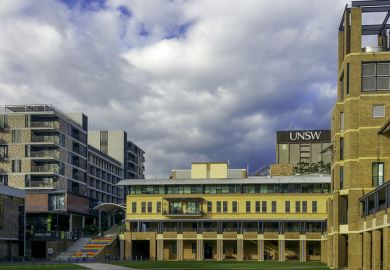
The wealth gap among universities in Australia’s largest state has widened, with the two biggest and richest institutions now pocketing more than half the entire sector’s income.
Lat year the University of Sydney and UNSW Sydney absorbed 51 per cent of the combined earnings of the 10 public universities in New South Wales (NSW), up from 45 per cent before the pandemic, according to newly published financial accounts. Their combined share of enrolments stands at about 36 per cent.
UNSW finished the year with a A$422 million (£224 million) surplus, mainly because of ballooning international education earnings that rocketed past A$1.7 billion – almost double their value just two years earlier.
Sydney’s surplus fell from A$550 million in 2024 to A$195 million last year, as its expenses surged and its investment income almost halved. It nevertheless achieved 7 per cent growth in its revenue from overseas students, which also exceeded A$1.7 billion. Its chancellor and vice-chancellor had earlier warned staff that it was experiencing a “softening of student demand from China”.
Meanwhile five of the other eight NSW institutions ended the year in deficit, roughly repeating the pattern of a year earlier. Western Sydney University and the University of Technology Sydney, both of which have flagged major staff cuts, recorded the biggest shortfalls, of A$133 million and A$54 million respectively.
While seven of the eight institutions increased their take from overseas students, their combined international education income – about A$1.6 billion – was less than either Sydney or UNSW earned from this revenue stream.
The two institutions each earned in excess of A$3.8 billion overall, with foreign students contributing more than 44 per cent. The other eight averaged revenue well under A$1 billion, with overseas students contributing 22 per cent.
UNSW said its 2025 results reflected a “temporary set of circumstances”. International enrolments were “elevated by pent-up post-Covid demand and strong rankings growth” – conditions that were “already correcting” in 2026, partly because of government policy to constrain international admissions.
“The surplus will be reinvested entirely in the university’s operations,” a spokesman said. “That includes bridging the structural funding gap for domestic students, where commonwealth support continues to fall short of delivery costs, and addressing a significant capital investment backlog.”
Research-intensive universities say they need a lot of international education revenue because government funding only covers about two-thirds of the expenses of conducting research, and little if any of the costs of building and updating facilities. Administrators also argue that surpluses offer an exaggerated picture of universities’ finances because they include one-off and tied earnings.
“The university cannot rely on income from philanthropy or investments to fund its core operations,” Sydney vice-chancellor Mark Scott and chancellor David Thodey told staff. “A substantial portion of philanthropic funding is restricted under the university’s endowment, and investment returns vary from year to year.”
An alternative “statement of financial performance” published in Sydney’s annual report, outside the audited accounts section, says the institution recorded an “underlying” deficit of A$176 million once philanthropic and investment income were removed. This figure “provides a clearer picture of the university’s financial performance”, Scott and Thodey said.
Richard Dennis, a former economics academic, said such arguments were “nonsense” because the expenses associated with those earnings – such as the costs incurred in conducting research supported by philanthropy – were not likewise deducted from the balance sheets.
“You can’t just take the revenue out and leave the costs in,” said Dennis, co-CEO of the Australia Institute thinktank. “Private sector investors would not accept the CEO of a company saying: ‘Just put the audit accounts aside; the numbers you need to focus on are the ones management has presented’. Unis…are sitting on large surpluses, pretending they have deficits.”
Dennis said universities were “writing their own rules” with accounts that made it impossible to judge the efficiency of their activities, because revenue and costs were not directly comparable. The 2024 accounts of several universities have been substantially revised in the 2025 annual reports, with costs such as scholarships “presented” as expenses after previously being accounted for in the income columns.
The 10 universities’ accounts show that their salary bills rose by an average of 8 per cent last year, while sundry expenses increased 5 per cent. Teaching grants went up by an average of 6 per cent, and income through the domestic students’ loan scheme rose 9 per cent.
Register to continue
Why register?
- Registration is free and only takes a moment
- Once registered, you can read 3 articles a month
- Sign up for our newsletter
Subscribe
Or subscribe for unlimited access to:
- Unlimited access to news, views, insights & reviews
- Digital editions
- Digital access to THE’s university and college rankings analysis
Already registered or a current subscriber?