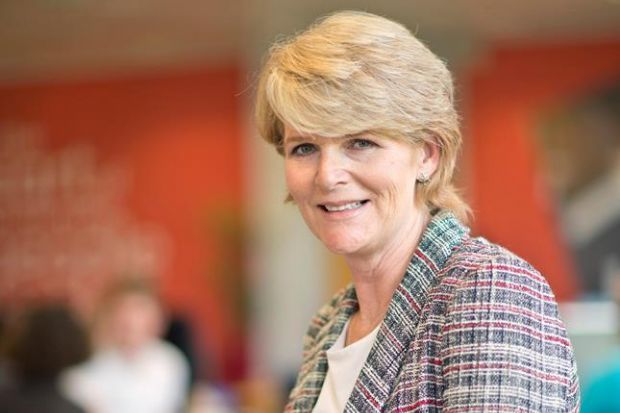
UK universities might need to move away from traditional degree provision to address the “nightmare scenario” facing them, according to former Ucas chief executive Mary Curnock Cook.
Pointing to declining participation, with this year’s school-leavers’ entry rates dropping in England, Wales, and Northern Ireland, as well as the forthcoming demographic fall in the UK’s 18-year-old population, Curnock Cook said: “It’s…pretty clear that international students are not going to be riding in on their white horses to save us, either.”
The number of applications for UK study visas fell 16 per cent in the key month of August this year, figures released last week reveal.
Cook, who served as the admissions service’s chief executive between 2010 and 2017, also cited the rise of AI and digital provision as a threat to universities’ traditional business model, warning that universities “risk being bypassed” by alternative providers if they don’t adapt.
Speaking at a London event organised by the Policy Institute at King’s College London (KCL), she likened the peril to that facing the news industry. “Many newspapers assumed their historical dominance and their prestige titles would protect them [from the digital age],” she said. “But, of course, the ones that survived were those who adapted their delivery models while carefully preserving trust and quality.
“The most successful publishers ultimately realised that they were not in the newspaper business, but in information and...audience relationships...similarly, universities need to confront the idea that their purpose may not be to award degrees but maybe to develop human capability.”
Cook currently chairs the board at the Dyson Institute of Engineering and Technology, a training centre set up by inventor Sir James Dyson at his technology firm’s Wiltshire base, which secured full taught degree-awarding powers in 2024. She also serves on examinations board Pearson’s qualifications committee.
She continued: “Even though the three-year degree has been the dominant delivery mechanism in much of the past century, a broader portfolio of relationships between universities and learners may be the only credible route to a lifelong learning society.” Just as newspaper publishers “stopped assuming that journalism had to be delivered on paper”, she said, “universities may need to stop assuming that learning has to be delivered primarily through the three-year degree”.
In her view, “advances in AI challenge the core purposes of the university in a way that previous technology changes simply didn’t.” However, she emphasised that she was not suggesting a “big-bang change in the operating model” but rather “intentional” and “gentle” adaptation.
The King’s event was convened to discuss a paper by former Sheffield Hallam University vice-chancellor Chris Husbands.
Published by the Higher Education Policy Institute on 23 July, the paper found that financial pressures on English higher education are advancing far more quickly than initially predicted, with the current system “unsustainable in any plausible funding model”.
Husbands was on a panel that also included Rachel Mills, senior vice president for academic life at KCL, and Bobby Duffy, director of the Policy Institute.
His report predicted an increasingly differentiated sector, and he discussed his vision of a few “global player” universities operating alongside large, regional universities and university groupings focusing on areas such as science and health; local universities; and small, specialist institutions.
“We’ve seen the Kent-Greenwich merger,” said Husbands, referencing the recent creation of a “superuniversity” by the universities of Kent and Greenwich. “There may be others coming down the track.”
But “the challenge facing the sector is predominantly a financial challenge”, he emphasised. “I think [we must] add together the social challenge, technology change, policy change. This is a moment of inflection.”
Register to continue
Why register?
- Registration is free and only takes a moment
- Once registered, you can read 3 articles a month
- Sign up for our newsletter
Subscribe
Or subscribe for unlimited access to:
- Unlimited access to news, views, insights & reviews
- Digital editions
- Digital access to THE’s university and college rankings analysis
Already registered or a current subscriber?