The UK government’s unexpected “partial U-turn” on post-study visas could risk creating a “two-tier” sector in which universities are rewarded for “postcode over performance”, it has been warned.
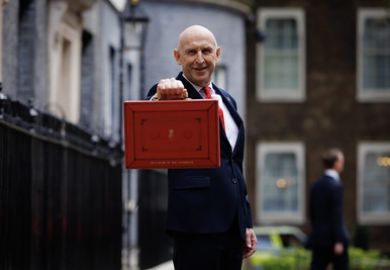
A Budget document indicated that there will be some exemptions to the plan to cut the length of time international students can stay and work post-graduation from two years to 18 months.
It says the graduate visa will last two years “for graduates from high compliance universities where there are strong labour market outcomes”, without defining how this will be decided.
Speaking to Times Higher Education, Diana Beech, director of the Finsbury Institute at City St George’s, University of London, said the policy had a “real risk of creating a two-tier sector”.
The approach “clearly favours universities in cities with strong graduate labour markets and institutions serving professions with clear employment pathways”, she said.
“Universities in less prosperous regions, or small, specialist institutions educating students for sectors characterised by freelance and portfolio careers, could be disadvantaged through no fault of their own.”
Beech warned that “the danger is that ministers end up measuring postcodes rather than performance”. She added that “if the government is not careful, it could end up rewarding and penalising institutions for where they are located rather than the value they add to their students”.
Moreover, Beech, former policy adviser to three ministers for universities, science, research and innovation, said the “challenge for government will be defining ‘high compliance’ and ‘strong labour market outcomes’ in a way that is transparent and has an evidence base”.
She said that compliance could be judged through Home Office sponsorship and visa data, but “graduate outcomes are far harder to interpret because they are shaped as much by local labour markets and demographics as by institutional quality”.
Nick Hillman, director of the Higher Education Policy Institute, told THE he did not think the plan was a good idea and should be considered as a “a partial U-turn given the cut to 18 months hasn’t yet taken effect”.
“It’s all at one with a Budget that, as just about everyone has said, was full of micro-management and short of the big stuff,” he added. Many in the sector criticised the Budget for the omission of any concrete measures to alleviate the financial crisis it is facing.
Hillman said: “I worry that they’ll just try to use Russell Group membership as a proxy” to measure whether universities are “highly compliant”. But he warned that would not be sensible given the group is a “self-selecting lobbying club”.
His best estimate is the government will look to include “between a quarter and a third of mainstream universities” on the list.
Johnny Rich, director of the ResearchPlus group of universities, said defining what is meant by strong labour outcomes and how they will be measured will be key.
“If we don’t work closely with the government to answer those questions, it could be the difference between a system that supports skills needs, graduates and universities, and one that encourages elitism and incentivises institutions to game their data.
“If this rules out more than a few bad actors, it will look very much like the government is anointing favoured universities to be internationally competitive. ResearchPlus universities would probably come out of it well, but we wouldn’t support it as it wouldn’t be in the wider public interest.”
For Chetal Patel, head of immigration at London-based law firm Bates Wells, “the challenge is that the government has announced the headline without explaining the criteria”.
She warned that this “policy effectively creates a ‘high-compliance club’ for universities” and, like Beech, she said if eligibility is limited to a “relatively small number of institutions” there is a risk of creating a two-tier sector.
“The move may help protect the UK’s competitiveness in the international student market, but introducing different post-study work rights based on the institution attended could also create uncertainty for prospective students and their advisers,” she warned.
The graduate visa change is part of a package of measures designed to “tighten the immigration system for low and medium-skill individuals while improving the offer to international talent”, the Budget document says.
Patel added that there are also “practical questions” for the Home Office as universities and students will “want clarity on how compliance status is assessed, how often it is reviewed, and what happens if an institution’s status changes while a student is studying”.
Register to continue
Why register?
- Registration is free and only takes a moment
- Once registered, you can read 3 articles a month
- Sign up for our newsletter
Subscribe
Or subscribe for unlimited access to:
- Unlimited access to news, views, insights & reviews
- Digital editions
- Digital access to THE’s university and college rankings analysis
Already registered or a current subscriber?