‘How many more have to die?’ Parents renew fight for duty of care

Bereaved families push politicians to make universities’ responsibilities toward their students clearer as suicide deaths continue

Published on
January 13, 2026
Last updated
January 13, 2026
Source: Robert Abrahart
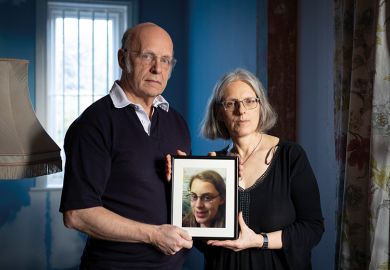
Robert Abrahart pictured with his wife Maggie

Bereaved parents whose children died by suicide while at university are taking their fight back to Westminster, claiming that more students are dying because of politicians’ refusal to impose a “duty of care” on institutions.

Robert and Maggie Abrahart, whose daughter Natasha died in 2018, have long argued that the government needs to make clear what is expected of staff at universities when dealing with students in crisis.

Previously the High Court ruled that the University of Bristol had contributed to Natasha’s death by failing to adjust its assessments to account for her anxiety disorder.

On 13 January politicians will, for the second time, debate the merits of statutory duty of care for universities.

ADVERTISEMENT

Robert Abrahart said the last time the matter was discussed in Parliament under the Conservative government, in 2023, conversations became “diverted” away from duty of care to wider conversations around mental health support. “But that’s not what we were asking for.”

“We want a statutory duty [for universities] to behave reasonably, and introduce a minimum standard of expected behaviour from staff and institutions more generally,” he said. Currently, there is no general legal duty for universities to monitor attendance, follow up repeated absences or act on known patterns of risk unless they have expressly assumed responsibility for the student, he noted.

ADVERTISEMENT

He said a duty of care is “not about suicide prevention, although in my view it would help”, and noted that there have been roughly 400 student suicides since the last parliamentary debate on the topic – “which is more than three a week”.

The previous higher education minister, Robert Halfon, argued at the time that a legal duty of care was not necessary because it already exists under common law, but Abrahart said this was not explicit enough.

“For someone to say, ‘we'll get there eventually’ doesn’t really help if your child’s just died. There seems to be some inertia, and what we’re looking for is some mechanism to drive this forward with a bit of speed. It’s not that nobody knows what you shouldn’t do. They just don’t do it,” he said.

He argued that there was “no urgency” from politicians to address the issue, adding “they’re not the ones burying their children”. 

Introducing a duty of care would give staff “clear guidance” and is about ensuring universities and staff “aren’t careless in the way they treat their students”.

ADVERTISEMENT

Campus spotlight guide: Make good mental health a university priority


He noted that current law requires universities to “not cause harm” to students but “universities typically don’t go around harming students”. Instead, a duty of care needs to be more active and explicit in safeguarding students, bringing universities’ responsibilities in line with the duty of care owed by employers to their employees, argued the retired university lecturer, who has been joined in the campaign by other parents of students who died by suicide.

“Change should have happened years ago. It wasn’t a big ask…if we could have saved half of the students, because I believe most of these are preventable deaths, that’s 200 kids.

“Most parents are shattered [after the loss of their child]. They’re destroyed. The fact that you’ve got 20 or 30 prepared to speak out is quite amazing. If this can is to be kicked down the road yet again by this government, how many deaths will it take? One hundred and sixty [student suicides] a year is the latest estimate – that’s quite a lot in my book.”

ADVERTISEMENT

He said that although he had been hopeful that the change to a Labour government in July 2024 might have brought progress, he added: “The status quo is so entrenched it’s going to be a difficult thing to move”.

James Naish MP, who scheduled the debate, said although universities play a “central role” in young people’s lives, “the law remains unclear about what responsibilities and duties they have to their students where serious harm is foreseeable”.

“More and more students are seeking help from their universities with their mental health yet there is still no clear legal framework setting out a baseline of what universities are expected to do when harm is foreseeable and vulnerability is evident,” the Labour politician told Times Higher Education. 

“The case of my constituents, the Abraharts, made clear that this is an issue of wide significance that the courts cannot resolve on a case-by-case basis. In the absence of legislation, bereaved families are left to seek answers only after tragedy has occurred. This is unacceptable.”

ADVERTISEMENT

juliette.rowsell@timeshighereducation.com

• If you’re having suicidal thoughts or feel you need to talk to someone, a free helpline is available around the clock in the UK on 116123, or you can email jo@samaritans.org. In the US, the National Suicide Prevention Lifeline is 1-800-273-8255. In Australia, the crisis support service Lifeline is 13 11 14. Other international suicide helplines can be found at www.befrienders.org.

Register to continue

Why register?

  • Registration is free and only takes a moment
  • Once registered, you can read 3 articles a month
  • Sign up for our newsletter
Please
or
to read this article.

Related articles

Reader's comments (10)

In my experience, the academic demands in UK Higher Education for undergraduate programmes are not unreasonable - unlike South Korea, China, Singapore, and Japan. Perhaps there needs to be a discussion about whether a student should have their health managed adequately *prior* to embarking on an undergraduate programme as well. Universities are not a substitute for CAMHs - their ability to support undergraduates is very limited, and more resources devoted to them will financially stretch their prerogatives in education provision. This is akin to asking police officers to take on the role of social workers because there are not enough social workers to do their job. See Kathryn Ecclestone's The Dangerous Rise of Therapeutic Education.
Many be we need a fitness to study test for students? Not sure academics can oversee the mental health of students and act as suicide preventors as they are neither qualified to do so nor have the time.
It's all very well making demands, but we need some clarity about what is expected from universities, too. Is it the provision of mental health first aiders, just as we have first aiders trained to deal with accidents and illness onsite? If so, how is training to be funded? Is it an increase in the counselling and support services that are already offered? (And if so, where is the funding for it?) Students are adults and as such are expected to take some measure of responsibility for themselves. We cannot do anything for a student unless they reach out and ask for help.
Employers have a duty of care to their employees in so far as their employment can directly affect employees. Surely tutors can have some form of (defined) duty of care over tutees in so far as their studies (and assessment) can directly affect tutees. I use the term tutors as a catch all phrase for all staff providing education who are employed (or contracted) by the HE provider. The employing authority of a UK university is the board of governors (ie University Council). Any 'duty of care' in HE needs to be a matter for Council to formally consider. It is not only up-to management to consider and disregard. It does sound like now is the right time for government to get involved.
This is a very distressing subject of course, though we have to acknowledge that rates of suicide among students are significantly lower than those of the age group in the general population. If we want to provide more support then I think Universities must provide more dedicated specialist mental health counsellors. It is simply no good going on about the "duty of care" in general terms. Employers also have a"duty of care" to their academic staff but they seem to be quite happy to subject them to serious levels of anxiety and over work. There are no stats kept on academics suicides, though we know anecdotally several have occurred due to work and other pressures. We simply can not just expect academic staff to take on board more and more responsibiities that are not part of their job profile and, indeed, at the same time as many are under threat of redundancy (and pay and pension issues). We also note that VC pay and annual bonus awards continue to rise.
I agree.
fully agree
Well we have competing imperatives here again. We are expected to teach more students in a mass higher education system with larger class sizes and fewer members of staff, and to act as advisors to more and more students, many of whom (if not actually the majority these days) have mental health issues. Such students need bespoke care. At the same time we are supposed to be more effecient and do more with less, we are supposed to be some sort of counsellor/therapist/life coach/social worker all at the same time. We are supposed to guard against grade inflation and make our assessment regimes tougher, while again at the same time paying due regard to the students' neurodiversity and sensitivities. Many of our students are not on campus and often have poor attendance, it's not like they are living at home and attending school every day.
Just to put forward my point further about how light-touch the academic demands are in the UK was a BBC report in 2007 (http://news.bbc.co.uk/1/hi/education/7011121.stm): UK: "The think tank's survey found that students were offered 14.2 hours of teaching per week on average. The range was from just over 20 hours to 8.4 hours." Germany: 35 hours per week Portugal: 40 hours per week UK academics all know this to be true. I also know of Spanish academics - they told me that undergraduates in their full-time programme attend FULL TIME - from 9am to 5pm literally. The exception is perhaps Wednesday afternoons for non-academic activities. They were shocked when I told them that students at my UK university attend about 10 hours per week when, at their university, undergraduates accomplish that PER WEEKDAY. They were shocked that my programme was 'full-time'. I also know of Indonesian academics who say the same thing to me. They were also shocked that, despite such low teaching hours, attendance was about 50% (at best). In their university, attendance is *mandatory* and students risk expulsion for poor attendance. At UK HE, do we? If a student cannot even handle what we have in UK HE, then they are not ready for HE. Much less fussing over (only!) three assessment deadlines in a semester.
Less than 10 years ago I was able to walk a student to an on-campus centre where the student could get mental health support in person right away. All of this has disappeared. There is a "hotline" that no student has had any good words about. It seems at a minimum the older systems should be restored, and yes this should probably involve regulators because otherwise it won't happen. just imposing a duty of care will make this fall on staff who cannot actually help. There need to be concrete requirements.

Sponsored

Featured jobs

See all jobs
ADVERTISEMENT